BMR Calculator — Mifflin, Harris‑Benedict, Katch (kcal/kJ)
BMR Calculator (Mifflin, Harris & Katch–McArdle)
BMR (Basal Metabolic Rate) is an estimate of how many calories your body uses each day at complete rest. Use this free calculator to estimate BMR in kcal/day (and kJ/day) with step-by-step working using Mifflin–St Jeor, Harris–Benedict (revised), or Katch–McArdle. For full daily-calorie planning, use our TDEE calculator.
This tool is part of our broader health calculator collection. You may also find our adult BMI calculator and child & teen BMI calculator useful, or explore all tools in our Health Calculators hub.
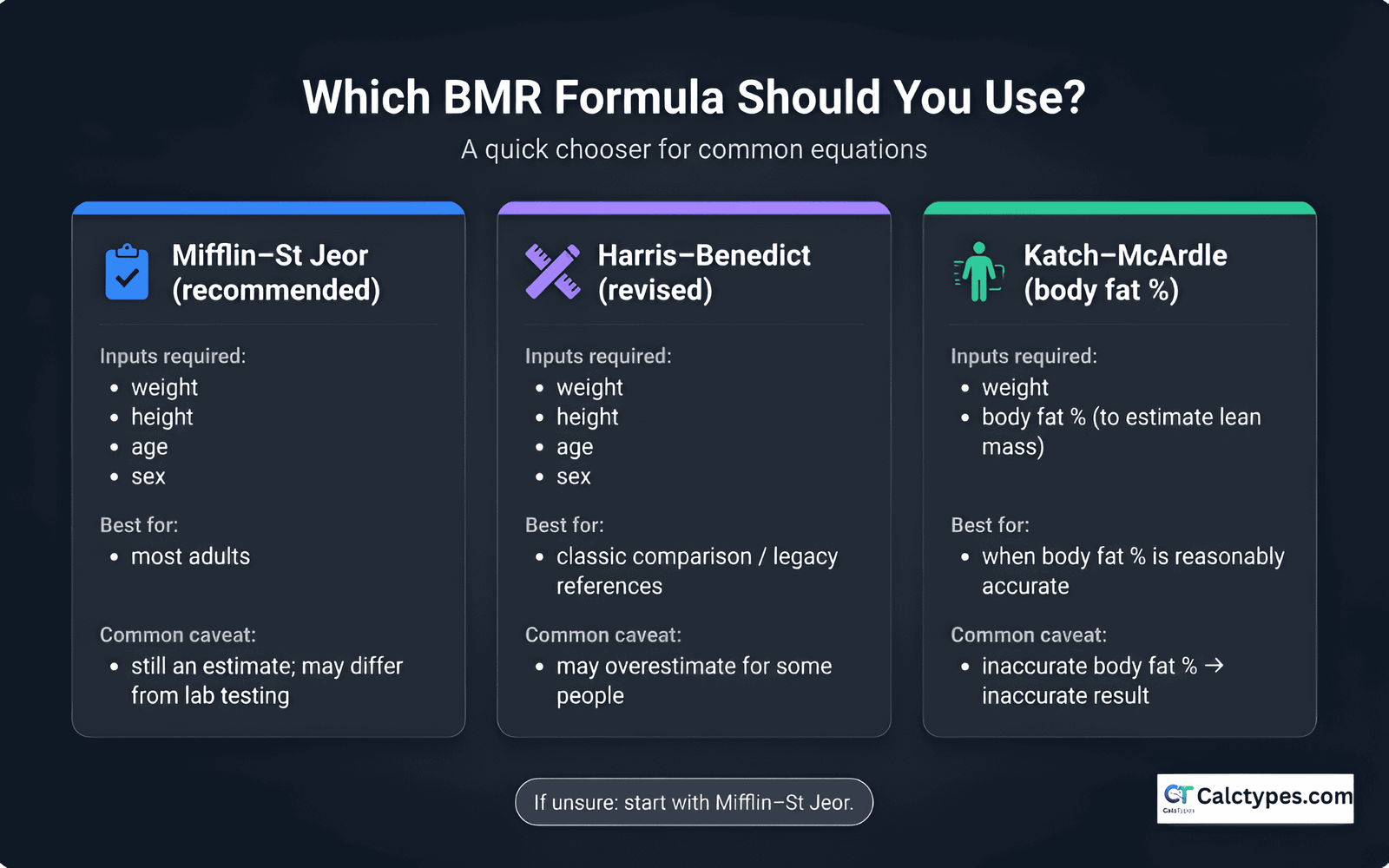
Which BMR formula should you use? (Mifflin vs Harris vs Katch–McArdle)
- Mifflin–St Jeor (recommended): best default for most adults.
- Harris–Benedict (revised): classic option; may slightly overestimate.
- Katch–McArdle: best if you know your body fat % (uses lean body mass: BMR = 370 + 21.6×LBM).
If you’re unsure, start with Mifflin–St Jeor.
Calculate Your BMR
Your Details
Your Results
Assumptions & Warnings
📊 BMR vs Maintenance Comparison
🧾 Calculation Steps
Steps update automatically based on your selected formula and inputs.
📋 Detailed Breakdown
| Parameter | Value |
|---|---|
| Enter your details to see the breakdown. | |
How to Use This BMR Calculator
- Select your formula: If you’re unsure, choose Mifflin–St Jeor (recommended for most adults).
- Choose your unit system: Metric (kg, cm) or US (lb, ft/in).
- Enter your details: Weight and (depending on formula) age, sex, height, or body fat %.
- Optional: select an activity level to estimate maintenance calories.
- Use results responsibly: treat as a baseline estimate, then adjust gradually based on multi-week trends.
For day-to-day planning, most people use maintenance (TDEE-style) rather than BMR alone. Open our TDEE calculator for a more detailed breakdown.
Understanding BMR and Daily Calorie Needs
BMR estimates how many calories your body needs each day to maintain vital functions at complete rest — breathing, circulation, temperature regulation.
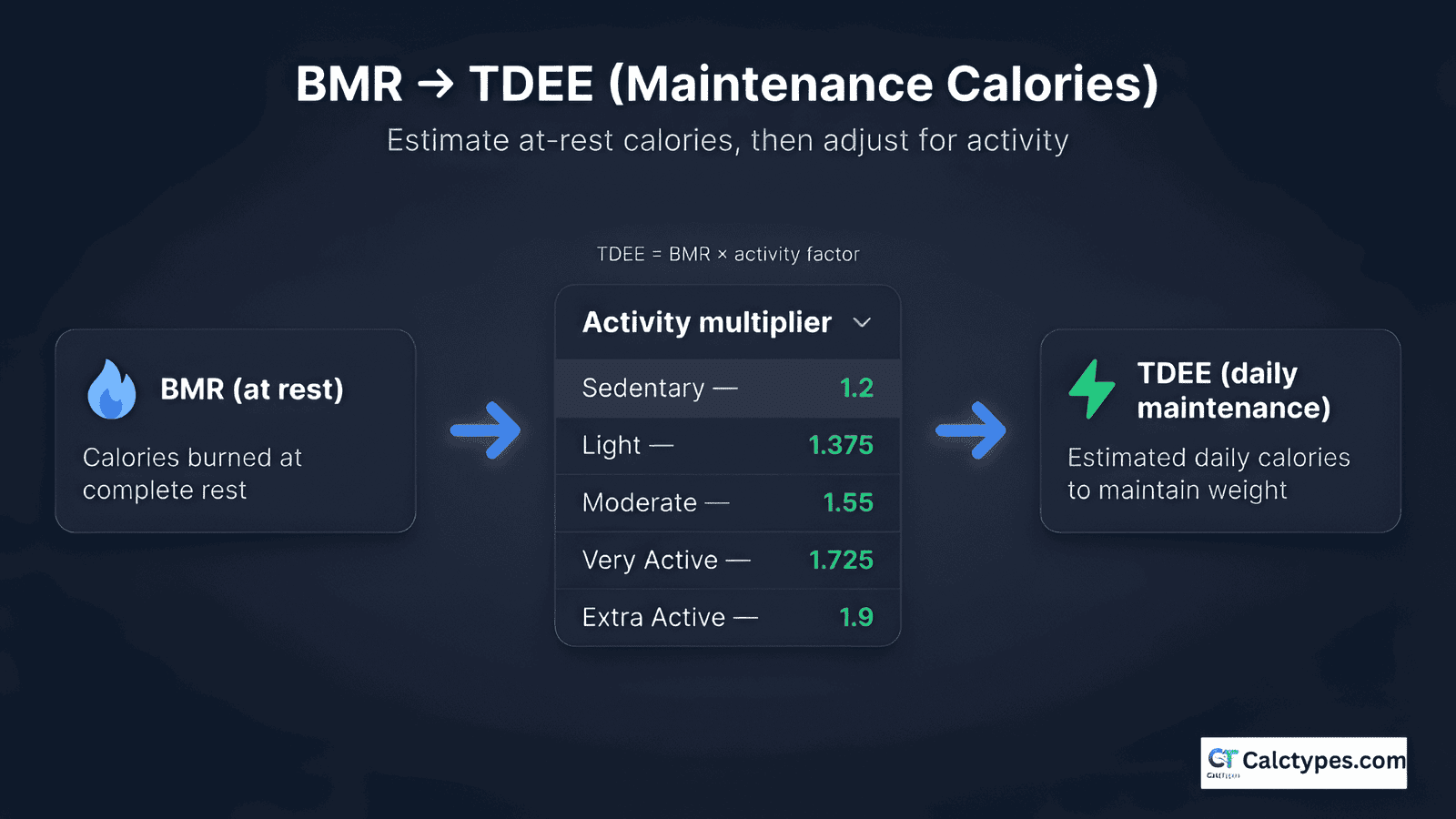
Maintenance calories estimate daily needs by adjusting BMR for activity. This is a simplified model but a useful planning starting point.
BMR and RMR are often used interchangeably in everyday tools, but they are not identical measurements. We explain the difference here: BMR vs RMR.
Which BMR Formula Should You Use?
This calculator includes three widely used equations. The best choice depends on the data you have available.
Mifflin–St Jeor (recommended default)
Often used as a strong general-purpose estimate for adults because it only needs sex, age, height, and weight. Published in 1990 and widely validated.
Harris–Benedict (revised)
A classic alternative equation (Roza & Shizgal, 1984). Some users compare it against Mifflin–St Jeor because results can differ meaningfully.
Katch–McArdle (LBM-based)
Uses lean body mass (LBM) derived from your body fat %. It can be useful when body fat % is reasonably accurate, and it does not require sex or age inputs. The commonly used calculator form is: BMR = 370 + (21.6 × LBM in kg).
If body fat % is guessed, the LBM estimate can be meaningfully off—so the BMR output inherits that error.
Want a deeper side-by-side comparison and decision guide? See BMR formula comparison.
How Accurate Is a BMR Calculator?
Predictive BMR formulas are population-based estimates. Your real resting energy expenditure can be higher or lower. What matters most is using the estimate consistently and adjusting based on outcomes and wellbeing over time.
- Individual variation: genetics, sleep, stress, medications, and health conditions can shift real energy needs.
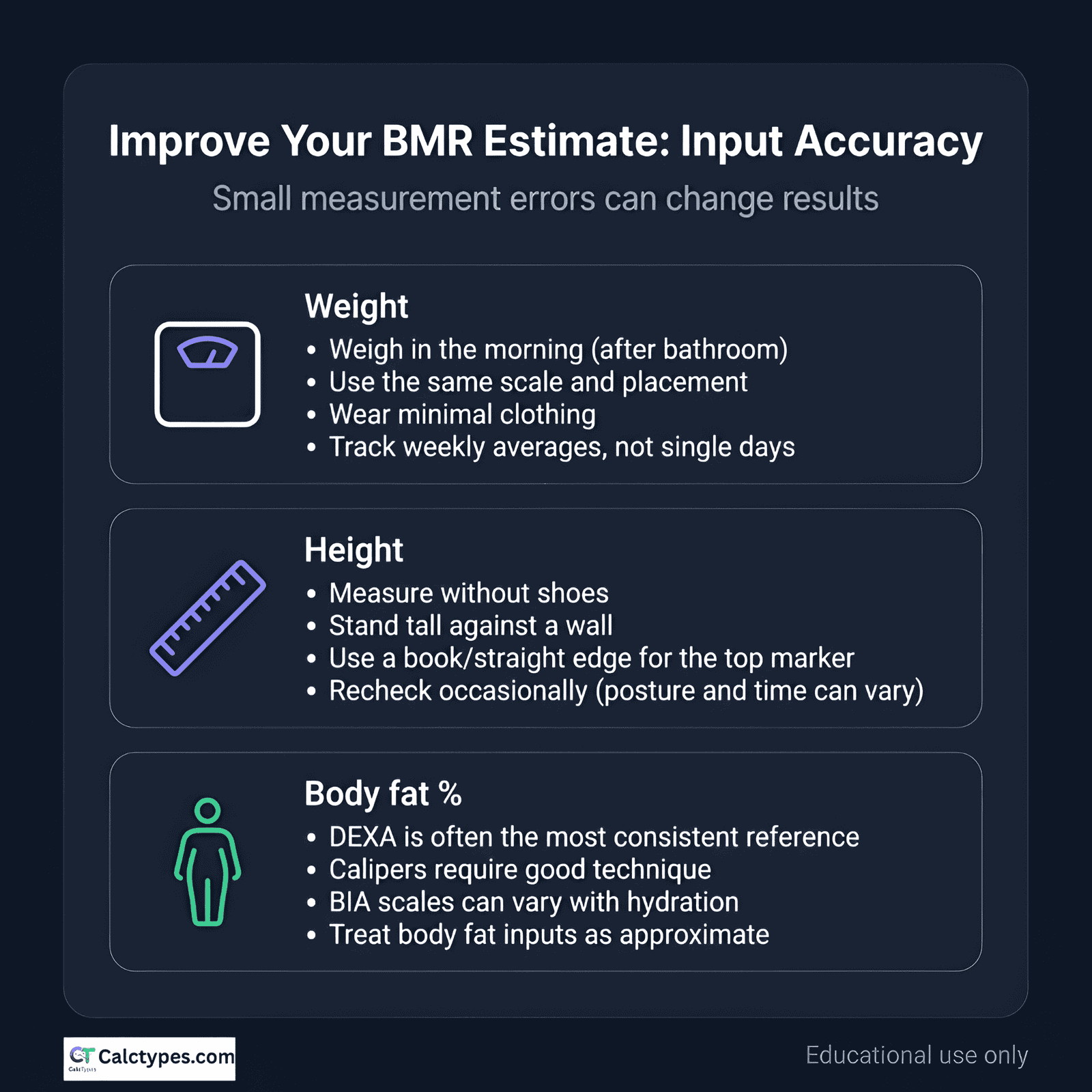
- Input accuracy: small errors in height/weight matter; body fat % matters a lot for Katch–McArdle.
- Maintenance model: activity multipliers are simplified averages, not guarantees.
For a direct measurement, labs may use indirect calorimetry — considerably more accurate but not widely accessible.
Questions People Ask
Plain-English answers with enough detail to use the results responsibly.
How do I calculate my BMR?
To calculate your Basal Metabolic Rate (BMR), you plug your measurements into a predictive equation. In practice, you have two good ways to do it:
- Use this calculator (recommended): enter your age, sex (if needed), weight, and height (or body fat % for Katch–McArdle). The tool handles unit conversion (Metric/US), rounding, and the kcal↔kJ conversion automatically.
- Do it manually: choose a formula (Mifflin–St Jeor / Harris–Benedict / Katch–McArdle), then calculate BMR manually using the correct units.
If you’re unsure where to start, choose Mifflin–St Jeor. It’s widely used because it works reasonably well for many adults using only basic inputs (height, weight, age, sex).
If you know your body fat percentage with decent accuracy, Katch–McArdle can be useful because it estimates BMR from lean body mass (the metabolically active part of your weight).
Important: BMR formulas produce a planning estimate, not a medical measurement. The gold-standard way to measure resting energy expenditure is a lab test (often via indirect calorimetry).
What is the formula for BMR?
There isn’t one universal BMR formula, because different equations were developed from different populations and assumptions. The most common formulas used in calculators are:
- Men: BMR = 10×W + 6.25×H − 5×A + 5
- Women: BMR = 10×W + 6.25×H − 5×A − 161
- Men: BMR = 88.362 + 13.397×W + 4.799×H − 5.677×A
- Women: BMR = 447.593 + 9.247×W + 3.098×H − 4.330×A
BMR = 370 + (21.6 × LBM in kg), where LBM = weight × (1 − bodyfat%/100).
Notice the key point: formulas aren’t “right vs wrong” in a single-person sense—they’re statistical predictions. That’s why two different equations can give different answers for the same inputs.
What is the best BMR formula?
“Best” depends on your data quality and what you’re trying to do (basic planning vs comparison vs lean-mass-based estimate). A practical decision framework:
- Mifflin–St Jeor: best default for many adults because it uses simple inputs and is commonly supported in the literature.
- Katch–McArdle: best when your body fat % is reasonably accurate (DEXA, good calipers, consistent method). If body fat % is guessed, Katch can look “precise” but be wrong because LBM becomes wrong.
- Harris–Benedict (Revised): useful as a classic comparison reference; some users run both HB and Mifflin to see a range.
If you want a “real-world best answer,” use one formula consistently for 2–4 weeks, compare predicted maintenance vs your trend, and adjust your calorie target based on outcomes (weight trend, training performance, sleep, hunger, wellbeing).
What is the difference between BMR and TDEE?
BMR is your estimated energy need at complete rest—think “baseline engine cost.” TDEE (Total Daily Energy Expenditure) is what you burn on a normal day, including movement and digestion.
Many planning tools estimate maintenance calories (TDEE) as: TDEE ≈ BMR × activity multiplier. That’s the model used in this calculator when you select an activity level.
A helpful mental model is that TDEE generally includes:
- BMR/RMR: baseline energy at rest
- NEAT: non-exercise movement (walking, standing, fidgeting)
- Exercise activity: training/sports
- TEF: thermic effect of food (energy to digest/process food)
If your goal is weight change or maintenance planning, use a TDEE-style number as the starting point (not BMR alone). For deeper planning, use the TDEE calculator.
What is the difference between BMR and RMR?
BMR (Basal Metabolic Rate) is traditionally measured under very strict lab conditions—fully rested, fasted, thermoneutral environment, minimal movement.
RMR (Resting Metabolic Rate) is measured under less strict conditions and is often slightly higher than true basal. In everyday use, many online “BMR calculators” are essentially estimating resting energy needs—not a perfect basal lab value.
That’s why you’ll see the terms used interchangeably on the web. If you want the nuance and examples, see: BMR vs RMR.
What is the Katch–McArdle BMR formula (370 + 21.6 × LBM)?
Katch–McArdle is lean-mass-based. The core idea is: lean tissue drives a lot of resting energy use, so we estimate BMR from lean body mass (LBM) instead of total weight.
Formula (kcal/day): BMR = 370 + (21.6 × LBM in kg)
Steps:
- Convert weight to kg (if needed).
- Compute LBM = weight × (1 − bodyfat%/100).
- Compute BMR = 370 + (21.6 × LBM).
The main limitation is measurement: if body fat % is estimated poorly, the LBM estimate can be meaningfully off, and the BMR output will inherit that error.
Want to verify the exact constants (“370” and “21.6”) or cite an authoritative reference? Jump to: Sources & Further Reading.
For full worked examples, see our dedicated Katch–McArdle BMR calculator.
Is the Katch–McArdle equation really “370 + 21.6 × lean body mass”?
Yes—this is a commonly used presentation of the Katch–McArdle lean-mass BMR equation in many exercise physiology references and calculators: BMR = 370 + (21.6 × LBM in kg).
If you’re comparing sources online, you may see small differences due to formatting, rounding, or whether a site labels it as BMR vs RMR. The most important practical point is that LBM must be in kilograms for the 21.6 constant to make sense.
For citations used on this page, see Sources & Further Reading.
Why does the calculator ask for sex?
Some equations (notably Mifflin–St Jeor and Harris–Benedict) use sex as a variable because, on average, body composition differs between males and females in ways that affect predicted resting energy needs (for example, average lean mass distribution).
In other words, “sex” here is not a value judgment—it’s a model input used by these specific equations. Katch–McArdle does not require sex because it is based on lean body mass directly.
If you’re unsure which to select for your situation, a practical approach is: run both options and treat the result as a range, then adjust based on real-world tracking over time.
How accurate is a BMR calculator?
BMR calculators are useful, but they are not the same as measuring your metabolism in a lab. They are population-based predictions, meaning the average error can be meaningful for an individual.
Common reasons real needs differ from formula output:
- Biology & variability: genetics, hormones, sleep debt, stress load
- Health factors: illness, medications, thyroid status, recovery state
- Measurement error: incorrect height/weight, guessed body fat %
- Adaptive changes: long dieting phases can reduce expenditure; overfeeding can increase it
Best practice: use the calculator output as a starting estimate, then adjust based on multi-week trends. That is more reliable than chasing a “perfect” single-day number.
Can teenagers use this BMR calculator?
Use caution. Most popular BMR equations are primarily validated in adult populations and do not fully model the energy needs of growth and development.
If you are under 18, it’s safer to treat any output as a rough educational estimate and discuss nutrition/training changes with a qualified professional, especially if performance sport, medical conditions, or any eating/weight concerns are involved.
Does this calculator work in kilograms and show kJ/day?
Yes. You can switch between Metric (kg, cm) and US (lb, ft/in). The primary output is in kcal/day, and the calculator also shows kJ/day.
Conversion used: 1 kcal = 4.184 kJ. (So kJ/day = kcal/day × 4.184.)
Common mistakes when using a BMR calculator
These are the most common mistakes that cause people to misapply BMR results:
- Using BMR as a calorie target instead of using maintenance/TDEE as the starting point.
- Inconsistent units (lb vs kg, ft/in vs cm, or mixing inputs across unit systems).
- Picking Katch–McArdle with guessed body fat % (LBM becomes inaccurate, so BMR becomes inaccurate).
- Over-trusting the number and ignoring real-world feedback (weight trend, performance, hunger, sleep, recovery).
- Changing calories too aggressively instead of using small adjustments and watching 2–4 week trends.
- Comparing yourself to “normal BMR” lists without accounting for body size, lean mass, and age.
A good approach is: calculate → estimate maintenance → track trend → adjust gradually.
What is a normal (or good) BMR?
There is no single “normal” BMR because BMR mainly scales with body size and especially lean mass, and it also changes with age. Two healthy people can have very different BMR values for totally normal reasons. If you want context for ranges and what affects them, see what is a good BMR.
Instead of asking “Is my BMR normal?”, a better question is: Does my estimated maintenance (TDEE) match my real-world trend?
If your maintenance estimate consistently overshoots/undershoots what happens in real life, adjust the maintenance target rather than assuming something is “wrong” with your metabolism.
How do I use BMR for weight loss or weight gain?
In most cases you should not use BMR directly as your intake target. Use BMR as a base to estimate maintenance calories (TDEE), then adjust based on your goal:
- Weight loss: start from maintenance and use a modest deficit, then adjust based on a multi-week trend.
- Weight gain: start from maintenance and use a modest surplus, then adjust based on rate of gain and performance.
The reason “modest” is emphasized: aggressive changes can backfire (hunger, adherence issues, performance drop, sleep disruption).
For a fuller planning breakdown, use the TDEE calculator and treat all numbers as estimates—not prescriptions.
How can I increase my BMR?
BMR is strongly influenced by lean body mass, so the most meaningful long-term lever is typically building or maintaining muscle. Practical, commonly cited contributors include:
- Resistance training (supports lean mass over time).
- Adequate protein and overall nutrition (supports training and recovery).
- Sleep & stress management (indirectly affects activity, appetite, recovery).
- More daily movement (NEAT) (this affects TDEE more than “true BMR,” but it matters for maintenance).
If you have medical concerns (fatigue, unexpected weight changes, etc.), consult a clinician rather than self-diagnosing based on calculator output.
Methodology — How We Calculate BMR
This calculator estimates BMR using published predictive equations and optionally estimates activity-adjusted daily calories by multiplying BMR by an activity factor.
Important notes
- BMR vs RMR: terms are often used interchangeably; predictive equations may not match either measurement perfectly.
- Katch–McArdle inputs: uses body fat % to estimate lean body mass (LBM), then applies BMR = 370 + 21.6×LBM (kg).
- kJ conversion: we convert using 1 kcal = 4.184 kJ (thermochemical).
- Rounding: results are rounded to the nearest whole kcal/day for readability.
- Activity multipliers: sourced from McArdle, Katch & Katch Exercise Physiology; these are simplified averages.
Limitations (Important)
- Estimate only: equations can differ substantially from lab measurement.
- Not designed for every scenario: teens, pregnancy/lactation, elite athletes, and many medical conditions may fall outside the “average” fit.
- Body fat % uncertainty: Katch–McArdle is sensitive to body fat % error.
- Not medical advice: not for diagnosis, treatment, or individualized prescriptions.
- Not for compliance decisions: do not use alone for clearance or compliance requirements.
Full policy: CalcTypes Disclaimer.
Sources & Further Reading
These references support the formulas and concepts used in this calculator.
- Mifflin MD et al. (1990) — A new predictive equation for resting energy expenditure in healthy individuals — American Journal of Clinical Nutrition
- Roza AM, Shizgal HM (1984) — The Harris Benedict equation reevaluated: resting energy requirements and the body cell mass — American Journal of Clinical Nutrition
- McArdle WD, Katch FI, Katch VL — Exercise Physiology: Nutrition, Energy, and Human Performance — commonly cited reference for activity multipliers and widely used presentations of lean-mass-based energy estimation (including Katch–McArdle-style calculations).