What Is a Good BMR? How to Use Your Basal Metabolic Rate Safely
What Is a Good BMR?
“Good BMR” is a common search—but BMR is not a score. This guide explains what your basal metabolic rate number means, why it varies so much from person to person, and how to use it safely as a planning tool instead of a verdict on your metabolism.
Department of Pathology, Aligarh Muslim University (A.M.U.), Aligarh
Reviewed this educational guide for appropriate definitions, limitations, and safe interpretation of basal metabolic rate (BMR), resting energy expenditure, and related calculator outputs. No diagnostic or treatment claims are made.
Quick takeaway
- There is no single “good” BMR. BMR mostly reflects body size, body composition, age, and sex—not willpower or moral worth.
- Use BMR as a starting estimate. Convert it to maintenance calories (TDEE), follow a consistent plan, then adjust based on multi‑week trends.
- If you have medical conditions, are under 18, pregnant, or have an eating‑disorder history, rely on a qualified professional, not a calculator alone.
On this page
What BMR means (in plain English)
Basal metabolic rate (BMR) is an estimate of how many calories your body would use in 24 hours if you lay at complete rest in a thermoneutral environment after an overnight fast. It represents the energy cost of basic life‑support functions such as breathing, circulation, organ function, and temperature regulation—not walking to the kitchen, working, training, or daily chores.
In practice, most people never have their BMR measured in a lab. Instead, online tools estimate something very close to BMR or resting metabolic rate (RMR) using equations built from research data. Examples include the Mifflin–St Jeor, Harris–Benedict, and Katch–McArdle formulas. These equations take inputs such as age, sex, height, weight, and sometimes estimated body fat percentage to predict resting energy needs.
Is there a “good” BMR?
BMR is not a “score” that can be good or bad. A higher or lower number is usually a reflection of underlying biology: body size, lean mass, age, and sex. A tall, muscular person will tend to have a higher BMR than a smaller person with less lean mass, even if both are completely healthy.
From a planning perspective, the more useful question is: “Does my estimated BMR help me plan realistically?” If your BMR‑based calculations lead to sustainable energy intake, performance, and wellbeing, then the estimate is doing its job, even if the exact number is not perfect.
- If your estimate is too low, you may feel consistently tired, hungry, or under‑recovered when following your plan.
- If your estimate is too high, you may not see expected changes in body weight or composition because intake quietly exceeds your true needs.
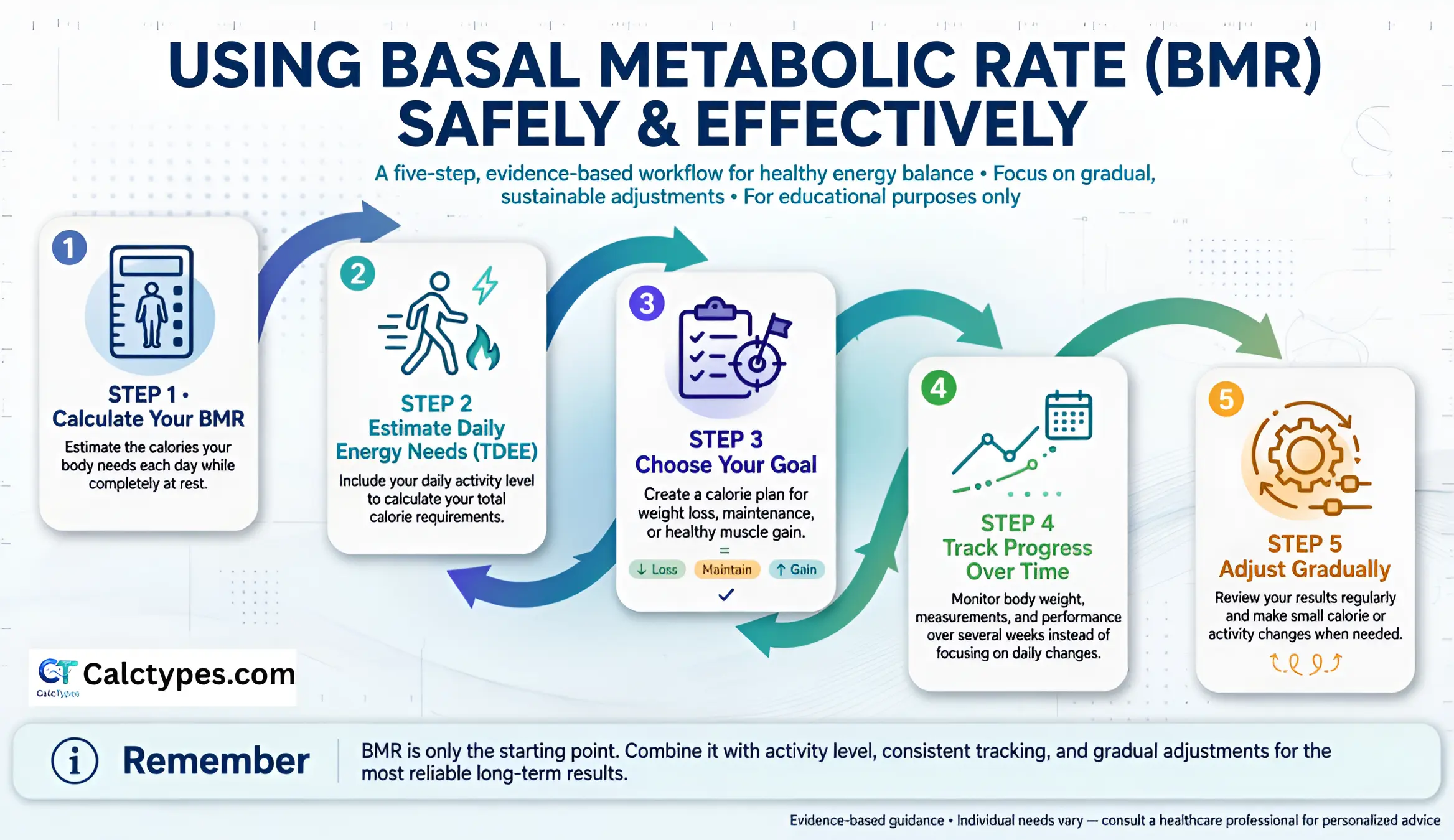
A practical “good BMR” workflow is: estimate → use it to set maintenance (TDEE) → follow a consistent plan → track trends → adjust gradually.
Why BMR varies from person to person
Even with the same height and weight, two people can have quite different resting energy needs. Predictive equations capture population averages, but individual biology adds variation on top of that.
- Lean body mass: Muscle and organ tissue are more metabolically active than fat tissue. More lean mass usually means higher resting energy needs.
- Age: Many equations decrease estimated BMR with age, reflecting average changes in body composition and physiology across populations.
- Sex: Some formulas use sex as an input to account for typical differences in body composition between men and women at the same BMI.
- Sleep, stress, medications, and health conditions: Hormones, inflammation, and certain drugs can nudge energy expenditure up or down.
- Measurement error: Height and weight entry errors, rounding, and inaccurate body‑fat estimates (for Katch–McArdle) can all shift results.
If you have a reasonably accurate body‑fat estimate, you can compare your result with an LBM‑based equation using the Katch–McArdle BMR calculator. Differences do not mean one is “right” and the other “wrong”—they offer alternate starting points to test against real‑world trends.
How to use your BMR number (a practical workflow)
- Calculate BMR with a reliable equation and correct units using the BMR calculator. If you want to check the math yourself, see how to calculate BMR manually. Ensure height, weight, age, and sex fields are accurate.
- Estimate maintenance calories (TDEE) by applying an activity factor based on your job, daily movement, and structured exercise. The TDEE calculator can help.
- Choose a reasonable adjustment if you have a goal such as weight gain or loss. Many people find that small, gradual surpluses or deficits are more sustainable than aggressive changes.
- Track trends, not individual days. Use weekly averages for body weight, simple measurements, performance, and wellbeing (sleep, hunger, energy, mood) rather than reacting to day‑to‑day noise.
- Adjust slowly. If trends do not match your goal after a few weeks, nudge intake or activity in small steps rather than overcorrecting.
When to be cautious (and what to do instead)
Extra caution is warranted when calculators are used by people under 18, those who are pregnant or lactating, individuals managing chronic diseases, people taking medications that affect weight or appetite, or anyone with a current or past eating disorder. In these situations, a simple BMR or TDEE estimate is not an adequate basis for medical or nutrition decisions.
If your goal involves weight change, many people find it safer to start by estimating maintenance (TDEE), monitoring health and wellbeing, and considering gradual, supervised adjustments. Professional support can help interpret numbers in context and keep the focus on overall health rather than chasing a specific BMR value.
Questions people ask
What is a good BMR for a man?
There is no single “good” BMR for all men. A man’s basal metabolic rate mostly reflects his body size, body composition, age, and health status. For example, a taller, more muscular man will usually have a higher BMR than a shorter man with less lean mass, even if both eat well and are in good health. Predictive equations such as Mifflin–St Jeor may give BMR values in the 1,500–2,200 kcal/day range for many adult men, but healthy values can fall outside this band depending on size and build.
From a practical standpoint, the more important question is whether your estimated BMR and TDEE help you plan in a way that feels sustainable. Suppose an equation estimates your BMR at 1,750 kcal/day and your maintenance calories at around 2,400 kcal/day. If you consistently eat near that maintenance level, track your weight and wellbeing over several weeks, and your body weight stays relatively stable with good energy and performance, then the estimate is working for you—regardless of whether it is “high” or “low” compared with someone else’s number. If your plan feels unsustainable or your trends do not match your expectations, it is usually more helpful to refine the plan than to judge the BMR itself as good or bad.
What is a good BMR for a woman?
As with men, there is no single “good” BMR for all women. A woman’s BMR depends on her height, weight, age, lean body mass, and other biological factors. Many adult women will see estimates somewhere between about 1,200 and 1,800 kcal/day from common equations, but healthy values can reasonably fall below or above this range. A smaller woman with a sedentary lifestyle might naturally have a lower BMR, while a taller woman with more muscle mass can have a substantially higher BMR without it implying anything about health or “metabolic speed.”
What matters more than hitting a particular BMR target is how you use that estimate. For example, if a calculator estimates your BMR at 1,350 kcal/day and your maintenance calories at 1,900 kcal/day, the next step is not to chase a “better” BMR but to ask whether that maintenance level supports your everyday functioning. If you follow a plan based on that estimate, feel reasonably energized, and your weight stays relatively stable across several weeks, the number is serving its purpose. If you feel unwell or your weight trends do not line up with your goals, adjusting your plan and, when needed, consulting a qualified professional is a safer approach than trying to change your BMR directly.
Why is my BMR low?
A “low” BMR on a calculator is often a reflection of body size and composition, not a problem to fix. People who are shorter, lighter, or have less lean mass will naturally have lower resting energy needs than taller or more muscular individuals. Many predictive equations also reduce estimates as age increases, because average lean mass tends to decline and hormonal patterns shift across adulthood. If you are comparing your BMR to someone taller or with more muscle, it may look low even though it accurately reflects your own physiology.
That said, it is worth double‑checking your inputs: ensure height, weight, age, and sex are entered correctly and that units (kg vs lb, cm vs in) are not mixed up. Different equations can also give different results; equations that use lean body mass (like Katch–McArdle) will diverge from weight‑only formulas if your body‑fat estimate is off. If a “low” calculator value leads you toward an intake that feels unsustainable—for example, persistent fatigue, preoccupation with food, or difficulty maintaining a healthy weight—it is a signal to treat the number as a rough starting point, not a fixed rule, and to seek professional guidance if you have health concerns.
Why is my BMR high?
A relatively high BMR estimate usually reflects a larger body size, higher lean mass, or both. Muscle tissue and major organs are metabolically active, so people who are taller, heavier, or have more muscle will generally require more energy at rest than smaller individuals. Being young, especially in late teens and early adulthood, can also be associated with somewhat higher average resting energy expenditure compared with later decades of life. In these contexts, a higher BMR is expected rather than something to fix.
It is important not to equate a high BMR with automatically “burning fat faster.” BMR is only one part of total daily energy expenditure; actual changes in body weight still depend on your overall energy balance over time. If your BMR and TDEE estimates are high, that simply means your body is predicted to use more energy each day, not that any eating pattern will lead to weight loss. As always, check that your inputs are accurate and consider how well a plan based on those estimates matches your lived experience: Are your energy levels, performance, and multi‑week weight trends aligned with your goals? If not, refining your plan or consulting a professional is more productive than worrying about the BMR number itself.
Should I eat my BMR?
For most people, deliberately eating at or below calculated BMR for long periods is not recommended. BMR reflects the energy cost of basic life‑sustaining processes at complete rest, under tightly controlled laboratory conditions. In daily life, you almost always burn more than BMR because you move, think, work, and interact with your environment. That additional energy use is captured in your total daily energy expenditure (TDEE), which combines BMR with physical activity and other factors.
Many nutrition and clinical guidelines instead start from an estimate of maintenance calories (TDEE) and, if a change in body weight is appropriate, make modest adjustments around that level. Eating close to BMR for extended periods may increase the risk of low energy availability, poor recovery, or difficulty meeting nutrient needs, especially without professional oversight. If a calculator suggests that eating near your BMR would be necessary to meet a goal, it is a good moment to pause and seek personalized advice rather than simply following the number. This is particularly important if you are under 18, pregnant, managing illness, or have an eating‑disorder history.
How accurate is a BMR calculator?
BMR calculators are based on predictive equations developed from research in groups of people. When applied to new individuals, they usually provide a reasonable starting estimate but not a perfect measurement. For many adults, commonly used equations may be off by roughly 5–15%, which can translate to differences of 100–300 kcal/day or more in either direction. Individual factors such as genetics, hormones, sleep, stress, medications, and health conditions can all cause your true resting energy needs to differ from the group averages on which equations are built.
More direct methods, such as indirect calorimetry in a clinical or sports‑science setting, can measure resting energy expenditure more precisely, but they are not practical or necessary for most people. In everyday use, the value of a calculator comes from combining its estimate with structured observation: set a plan based on your estimated BMR and TDEE, follow it consistently, track multi‑week trends, and then adjust gradually. When used in this way—as a flexible starting point rather than a final answer—BMR calculators can be very helpful without needing to be perfectly accurate.
Important disclaimer
Sources
Methodology
This page is an educational guide about interpreting basal metabolic rate (BMR) and BMR‑based calculators. It does not run calculations itself.
- The conceptual explanations of BMR and TDEE reflect commonly used predictive equations such as Mifflin–St Jeor, Harris–Benedict, and Katch–McArdle.
- Example ranges (e.g., “many adults fall between …”) are illustrative, based on typical outputs for a variety of heights, weights, and ages, not strict clinical cut‑offs.
- Recommendations emphasize using calculator outputs as starting points, combined with multi‑week trends and professional oversight where appropriate.
Limitations and disclaimers
- Predictive equations cannot capture every individual factor (e.g., genetics, hormones, medical conditions, medications, or extreme training loads).
- Small errors in height, weight, or body‑fat inputs can meaningfully change BMR estimates, especially with lean‑mass‑based equations.
- BMR and TDEE numbers are not diagnostic tools and cannot replace a full medical or nutrition assessment.
- This content is not intended for emergency use or for individuals who are under 18, pregnant, or living with complex medical conditions without professional supervision.