Calorie Calculator for Kids & Teens (Child TDEE, Ages 2–18)
Calorie Calculator for Kids & Teens — Child TDEE Calculator (Ages 2–18)
Use this calorie calculator for kids and teens to estimate daily maintenance calories with the 2023 National Academies Estimated Energy Requirement (EER) equations. The calculation uses age, sex, height, weight and—starting at age 3—an activity category, making it more appropriate for growing children than an adult BMR/TDEE multiplier.
Enter details
Daily Calorie Estimate & Recommendations
Show calculation steps (formula breakdown)
Disclaimer: This calculator estimates daily calorie needs for generally healthy children and teens ages 2–18. It does not replace medical advice. Children with underweight, obesity, eating disorders, chronic illness, pregnancy, or sports-performance goals should be assessed by a pediatrician or registered dietitian. If you are considering intentional weight change for a child or teen, seek professional guidance first.
More free tools for your child’s growth and health
- Height & Weight Percentile Calculator — see how your child’s height and weight compare with CDC growth charts, plus a mid-parental height estimate.
- CDC Child & Teen BMI Calculator — BMI percentile, weight category and a healthy weight range for your child’s height.
- Child Water Intake Calculator — how much your child should drink each day by age, activity and weather.
- Daily Added Sugar Limit — sugar limits for children in grams and teaspoons.
Expert Review & Pediatric Safety Context
The page’s pediatric-safe framing and activity interpretation have been reviewed by the contributors below. The calculation method on this revision has been updated to the 2023 National Academies EER equations shown in the methodology and sources sections.
How Many Calories Does a Child or Teen Need Per Day?
Most parents searching for a “calorie calculator for kids” want one number: how much should my child be eating in a normal day? The useful answer is a range, not a single age-only target. Children and teens of the same age can differ by hundreds of calories per day because sex, body size, activity, and growth all matter.
What the calculator above gives you is a maintenance estimate — the daily energy needed to support the child’s current body size while also allowing for normal growth and development. For minors, “maintenance” is not the same idea as adult weight maintenance: energy also supports height gain, bone and muscle development, school-day concentration, and recovery from sport.
Calories Per Day for Kids and Teens by Age and Sex
These are broad reference bands, not prescriptions. They summarize federal estimated calorie needs across sedentary through active categories. Use the calculator above for a more individualized estimate.
| Age band | Girls (kcal/day) | Boys (kcal/day) |
|---|---|---|
| 2–3 years | 1,000–1,400 | 1,000–1,400 |
| 4–8 years | 1,200–1,800 | 1,200–2,000 |
| 9–13 years | 1,400–2,200 | 1,600–2,600 |
| 14–18 years | 1,800–2,400 | 2,000–3,200 |
Where these bands come from: Dietary Guidelines for Americans 2020–2025, Appendix 2, Table A2-2 (ODPHP-hosted PDF) , which reports estimated calorie needs by age, sex, and physical activity level. The lower end here reflects the sedentary entries and the upper end reflects the table’s active entries.
About USDA Table E3.1.A4: the government table you supplied lists selected “calorie level(s) assessed” when evaluating the nutrient adequacy of USDA Food Patterns. It is useful methodological context, but it is not itself a recommended-calorie-needs table, so those selected modeling levels are not used as intake ranges here. View Table E3.1.A4.
The current Dietary Guidelines for Americans 2025–2030 emphasizes that calorie needs depend on personal factors; USDA’s DRI Calculator for Healthcare Professionals uses age, sex, height, weight, and activity level for individualized estimates.
These bands are intentionally wide. A smaller, less-active teen and a larger teen training most days can have very different energy needs, even when they are the same age. Enter the child’s actual measurements and a realistic activity level above rather than treating an age row as an exact target.
How to use the result: treat it as a planning anchor and compare it with real-world signals over time — steady energy, normal growth, hunger and fullness cues, school concentration, and recovery from activity. If a child or teen is skipping meals, showing anxiety around food, losing weight unintentionally, or has a medical condition affecting growth or nutrition, seek guidance from a pediatrician or registered dietitian rather than relying on a calorie target.
How This Calorie Calculator for Kids & Teens Works
This page estimates a child’s or teen’s daily energy requirement using pediatric Estimated Energy Requirement (EER) equations rather than an adult BMR multiplied by an activity factor.
- Convert measurements to kilograms and centimeters.
- Use exact age in years, including entered months.
- Use the 2023 sex-specific EER equation for ages 2–2.99 or ages 3–18.99.
- For ages 3–18, apply the equation that corresponds to Inactive/Sedentary, Low Active, Active or Very Active.
- Add the age- and sex-specific energy cost of growth recommended in the 2023 DRI report.
- Show the estimate and a practical ±10% planning range; that displayed range is a CalcTypes usability aid, not an official National Academies confidence interval.
Child TDEE Calculator Methodology: 2023 Pediatric EER Equations
The calculator uses the 2023 National Academies of Sciences, Engineering, and Medicine (NASEM) Dietary Reference Intakes for Energy. The newer method replaced the older 2005 PA-multiplier equations with separate prediction equations for each activity category for boys and girls ages 3–18.
Activity Categories Used in the 2023 Child EER Calculator
| Calculator label | How it is used |
|---|---|
| Sedentary / Inactive | Uses the NASEM Inactive equation. |
| Low Active | Uses the NASEM Low Active equation. |
| Active | Uses the NASEM Active equation. |
| Very Active | Uses the NASEM Very Active equation. |
Unlike the older 2005 equations, the 2023 method does not use one PA multiplier inside a single child equation; each activity category has its own coefficients.
2023 Pediatric EER Equations Used
Ages 2.0–2.99 years (height in cm, weight in kg, age in years):
Boys:  EER = −716.45 − 1.00×age + 17.82×height_cm + 15.06×weight_kg + 20
Girls: EER =  −69.15 + 80.00×age +  2.65×height_cm + 54.15×weight_kg + 15

Ages 3.0–18.99 years — Boys:
Inactive:    EER = −447.51 + 3.68×age + 13.01×height_cm + 13.15×weight_kg + growth
Low Active:  EER =   19.12 + 3.68×age +  8.62×height_cm + 20.28×weight_kg + growth
Active:      EER = −388.19 + 3.68×age + 12.66×height_cm + 20.46×weight_kg + growth
Very Active: EER = −671.75 + 3.68×age + 15.38×height_cm + 23.25×weight_kg + growth

Ages 3.0–18.99 years — Girls:
Inactive:    EER =   55.59 − 22.25×age +  8.43×height_cm + 17.07×weight_kg + growth
Low Active:  EER = −297.54 − 22.25×age + 12.77×height_cm + 14.73×weight_kg + growth
Active:      EER = −189.55 − 22.25×age + 11.74×height_cm + 18.34×weight_kg + growth
Very Active: EER = −709.59 − 22.25×age + 18.22×height_cm + 14.25×weight_kg + growth
Primary source: National Academies, Dietary Reference Intakes for Energy (2023), Table 5-15.
Energy Cost of Growth Added to the EER
| Age | Boys | Girls |
|---|---|---|
| 2.0–3.99 years | +20 kcal/day | +15 kcal/day |
| 4.0–8.99 years | +15 kcal/day | +15 kcal/day |
| 9.0–13.99 years | +25 kcal/day | +30 kcal/day |
| 14.0–18.99 years | +20 kcal/day | +20 kcal/day |
Worked Example: Teen TDEE / EER for a 15-Year-Old Boy
Example: 15 years, Male, 55 kg, 168 cm, Low Active
Growth allowance (age 14–18): +20 kcal/day

EER = 19.12 + (3.68×15) + (8.62×168) + (20.28×55) + 20
    = 2,657.9 kcal/day
Calculator display (nearest 5): 2,660 kcal/day
Limitations of This Child & Teen Calorie Calculator
This calculator uses evidence-based pediatric EER equations, but it is still an estimate. Real calorie needs vary because children are growing and because real life is not “average.”
1) Individual variation (two kids can differ even with the same inputs)
Genetics, muscle mass, sleep, stress, puberty timing, and day-to-day movement (“non-exercise activity” like fidgeting, walking around, climbing stairs) can create meaningful differences between children with identical age/sex/height/weight/activity selections.
2) Medical conditions and medications are not accounted for
Chronic illness, digestive disorders, endocrine conditions (thyroid, diabetes), and certain medications can change appetite, absorption, or metabolism. If any of these apply, a clinician’s assessment is more appropriate than a general formula.
3) Not designed for special clinical situations
- Eating disorders or disordered eating
- Pregnant/breastfeeding adolescents
- Severe illness recovery, malnutrition, or medically supervised weight management
- Elite youth athletes with very high training loads
4) Input accuracy matters a lot
Height and weight errors (or choosing an activity level that doesn’t match the child’s typical week) can shift the estimate substantially. Use current measurements and a realistic activity selection.
5) Snapshot, not a treatment plan
This tool doesn’t interpret a growth chart trend, puberty stage, lab markers, or dietary quality. If growth or eating patterns are concerning, seek professional guidance.
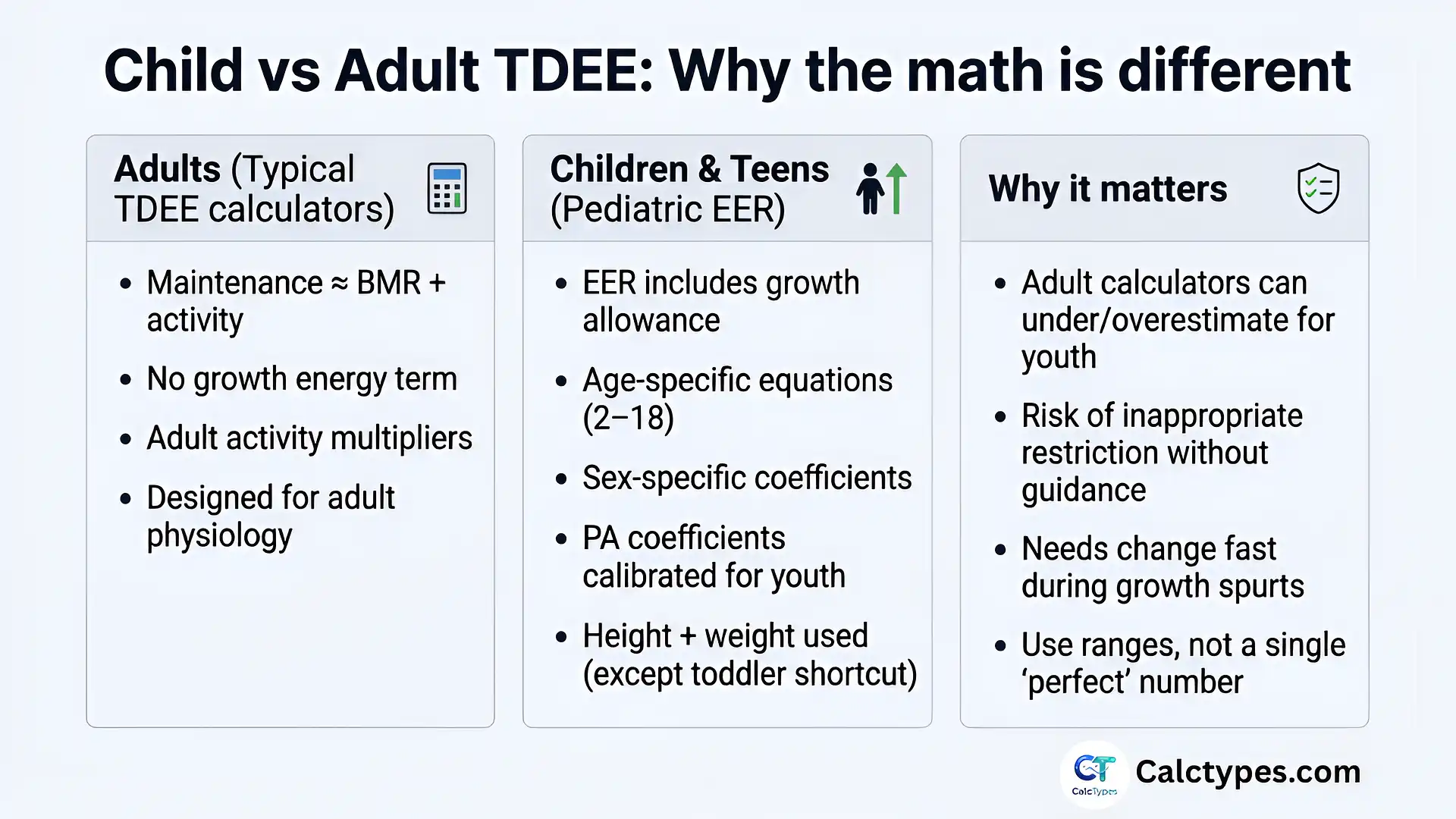
Visual guide: Why child/teen formulas differ from adult TDEE
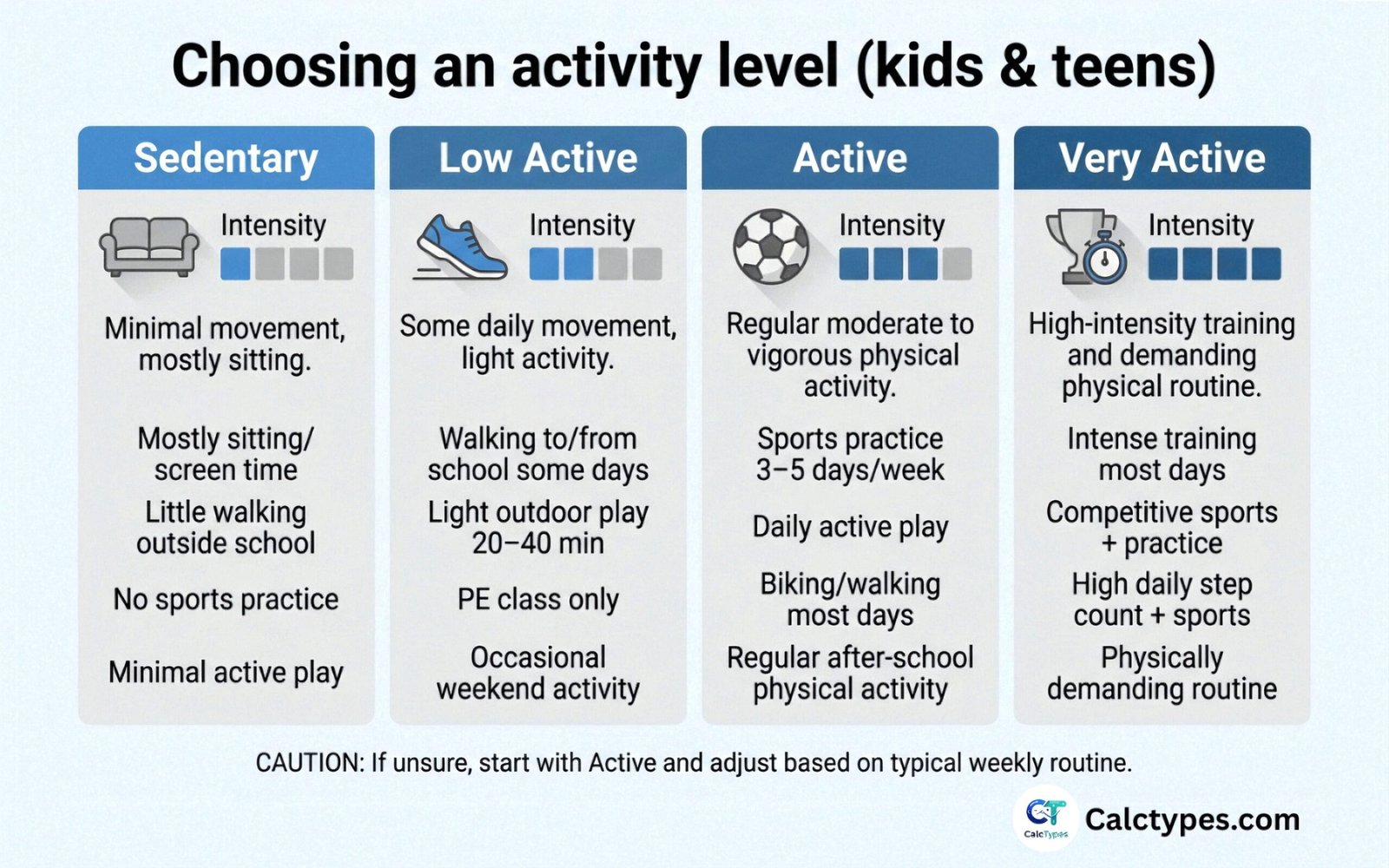
Visual guide: Activity level examples (sedentary → very active)
Questions People Ask About Calorie Calculators for Kids & Teens
Each question is an H3 heading and opens when clicked. Answers are educational and are not a substitute for individualized medical or dietetic care.
How does a calorie calculator for kids estimate daily calorie needs?
This calculator uses the 2023 National Academies Estimated Energy Requirement (EER) equations. It combines age, sex, height and weight; for ages 3–18 it also uses the equation for the selected activity category.
The result is an estimate of daily energy needed to support usual activity and normal growth. It is not a calorie limit and should not be treated as a prescription.
What is a Child TDEE Calculator, and how is it different from an adult TDEE calculator?
People often use “TDEE” to mean maintenance calories. For children and teens, however, pediatric EER equations are more appropriate because they were developed for growing bodies and include an energy allowance for growth.
Adult TDEE calculators typically estimate resting energy and apply an adult activity multiplier; that is not the method used here.
How many calories does a child need per day?
There is no single calorie number that applies to every child of the same age. Daily needs vary with sex, height, weight, activity and growth. The age-and-sex table on this page gives broad reference bands, while the calculator gives a more individualized EER estimate.
How many calories does a teenager need per day?
Teen calorie needs can vary widely because puberty, body size and sports participation differ substantially. Enter the teen’s current height, weight and typical activity category for an individualized estimate rather than relying on an age-only target.
Is this a teen TDEE calculator for both boys and girls?
Yes. The 2023 EER method uses separate equations for boys and girls. Select the appropriate sex option before calculating because the coefficients and growth allowances differ.
What activity level should I choose in the Child TDEE Calculator?
Choose the category that best reflects a typical week, not an unusually active or inactive day. For ages 3–18, the calculator uses separate 2023 EER equations for Inactive/Sedentary, Low Active, Active and Very Active.
| Level | Practical description |
|---|---|
| Sedentary / Inactive | Mostly routine daily movement, with little additional structured activity. |
| Low Active | Some additional walking, play or light exercise beyond routine daily activity. |
| Active | Regular moderate activity or sport on many days. |
| Very Active | High daily movement or substantial training on most days. |
Why does activity level not change the calorie estimate for a 2-year-old?
For ages 2.0–2.99 years, the 2023 National Academies EER equation uses age, height and weight plus an energy allowance for growth. It does not use the four activity-category equations that begin at age 3.
Can I use a calorie calculator for kids for weight loss or weight gain?
Use the result as a maintenance-energy estimate, not as a do-it-yourself weight-change prescription. Children and teens need enough energy and nutrients for growth, development and—when applicable—sports recovery.
Is 1,500 calories enough for a 14-year-old boy?
Age alone is not enough to answer safely. A 14-year-old boy’s energy requirement depends on height, weight, activity and growth. For many teens, 1,500 kcal/day may be below estimated needs, especially during rapid growth or regular sports. Use individualized inputs and seek professional advice if intentional restriction is being considered.
Is 1,200 calories enough for a 15-year-old?
For many 15-year-olds, 1,200 kcal/day would be well below estimated energy needs, but the appropriate intake cannot be determined from age alone. Height, weight, sex, activity, growth and health status all matter.
How do I calculate pediatric EER or Child TDEE manually?
Use the exact 2023 equation for the child’s age, sex and—if age 3 or older—activity category. Convert weight to kilograms and height to centimeters, then add the age/sex-specific growth allowance shown in the methodology table.
The calculator’s “Show calculation steps” panel displays the equation and substituted values for the current result.
How accurate is a Child TDEE Calculator, and when should I ask a pediatrician?
EER equations are population-based prediction equations, so an individual child’s true requirement can differ. Growth spurts, body composition, spontaneous movement, sports volume, illness and measurement error can all affect energy needs.
Speak with a pediatrician or registered dietitian when there is poor or rapid growth, unintentional weight change, persistent fatigue, food restriction, an eating disorder, chronic illness, pregnancy, or complex sports-fueling needs.
Sources
- National Academies of Sciences, Engineering, and Medicine. Dietary Reference Intakes for Energy (2023) — development of EER equations and Table 5-15 — primary reference for the pediatric EER equations and age/sex-specific growth allowances used by this calculator.
- U.S. Department of Agriculture and U.S. Department of Health and Human Services. Dietary Guidelines for Americans, 2020–2025 — Appendix 2, Table A2-2 (ODPHP-hosted PDF) — age-, sex-, and activity-specific calorie reference values summarized in the table above.
- USDA National Agricultural Library. DRI Calculator for Healthcare Professionals — individualized calorie and nutrient estimates based on DRI data.
- U.S. Department of Health and Human Services / USDA. Dietary Guidelines for Americans, 2025–2030 — current federal dietary guidance.
- CDC — physical activity guidance for children and adolescents .
- MedlinePlus — Child Nutrition .
- Johns Hopkins Medicine — Healthy Eating During Adolescence .
Methodological context only: USDA Food Patterns Table E3.1.A4 lists selected calorie levels used to assess food-pattern nutrient adequacy; it is not used here as a direct calorie-needs table.
See also our site methodology for how calculators are built, reviewed, and updated.