Nutrition Label Sugar Calculator (Per Serving → Per Package)
Nutrition Label Sugar Calculator
Convert “per serving” sugar into whole‑package sugar using the label’s servings per container. You’ll also see a visualization in teaspoons, an estimate of calories from sugar, and a comparison against a daily reference (AHA/WHO/FDA/custom).
Educational label math only (not medical advice). Quick jump: Daily Sugar Limits (AHA/WHO/FDA) — Quick Reference.
Quick answer (what this calculator does)
It estimates sugar in the entire container using label values. If you select a reference (AHA/WHO/FDA/custom), it also shows what % of that reference your result represents.
Label Inputs
Calculation Steps
- Enter values to see steps.
Results
This “status” is a general label-reading interpretation based on the reference you selected (not a personal recommendation).
0–24%
25–49%
50–99%
100–149%
150%+

Table of Contents
Daily Sugar Limits (AHA/WHO/FDA) — Quick Reference
| Reference | Limit (g/day) | Approx. tsp/day | Meaning (layman) |
|---|---|---|---|
| AHA Women | 25g | ~6 tsp | Fixed added-sugar reference used in many US education materials. |
| AHA Men | 36g | ~9 tsp | Fixed added-sugar reference often quoted for adult men. |
| AHA Children (2–18) | <25g | ~6 tsp | Added-sugar reference sometimes used for kids in education contexts. |
| WHO 5% of energy | Depends | Depends | Calculator estimates grams based on your kcal/day entry. |
| FDA Added Sugars DV | 50g | ~12 tsp | US labeling reference used to compute %DV on Nutrition Facts. |
Methodology (Formulas Used)
What the calculator does (plain English)
- Turns a per‑serving label number into a whole‑package total using servings per container.
- If you enter a percent (%DV/%RI), converts it to grams using your selected DV/RI basis.
- Converts grams to teaspoons (visual estimate) and calculates calories (math estimate).
- Compares your whole‑package total to a selected daily reference (AHA/WHO/FDA/custom).
Formulas
- Whole‑package sugar (g) = sugar per serving (g) × servings per container
- % → grams per serving = (% ÷ 100) × (DV/RI basis grams)
- Teaspoons (approx.) = grams ÷ 4
- Calories from sugar = grams × 4
- % of reference = (whole‑package grams ÷ reference grams) × 100
- Remaining/Over = reference grams − whole‑package grams
- WHO 5% mode (if used) = reference grams ≈ (kcal/day × 0.05) ÷ 4
This is educational label math only. It does not predict health outcomes, symptoms, or blood sugar response.
Understanding Your Results (What Each Number Means)
Whole package sugar (g) shows the total sugar you’d get if you consume the entire container.
Teaspoons (approx.) is a visualization to help you compare products quickly (it’s not lab precision).
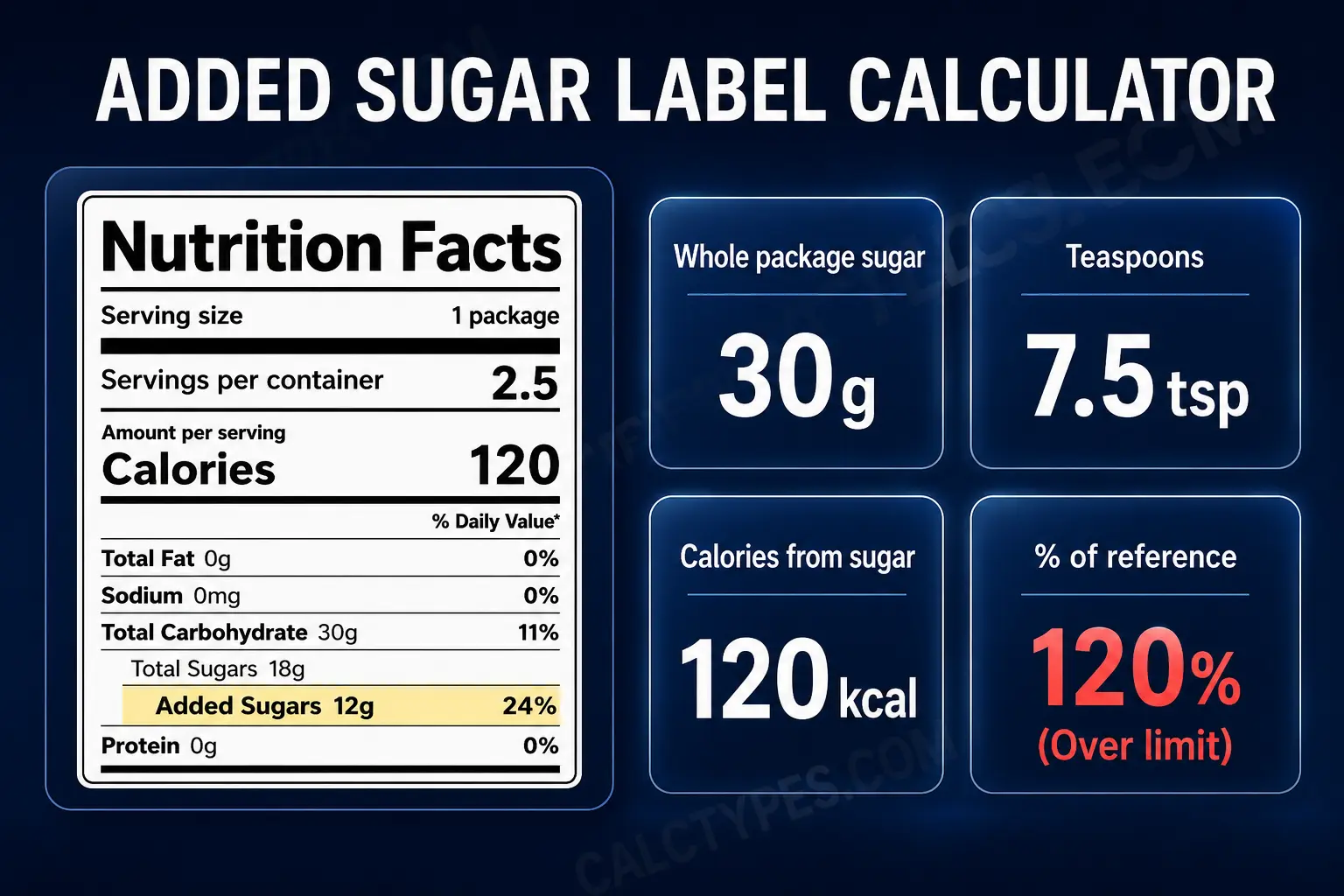
Calories from sugar is a math estimate using 4 kcal per gram (carbohydrate energy estimate).
% of daily reference compares your whole‑package grams to a selected reference (AHA/WHO/FDA/custom). It’s not a medical judgment.
Related reading (HWVibes): How to read sugar on labels.
Common Mistakes (and How to Avoid Them)
- Using “per serving” when you actually consumed the whole package: always check “servings per container.”
- Mixing up added sugar and total sugar: choose the option that matches your label line.
- Using the wrong %DV/%RI basis: if you only have a percent value, make sure the DV/RI basis matches your label region.
- Forgetting labels can round: totals are estimates; small differences are normal.
Related reading (HWVibes): Hidden added sugar foods, Sugary drinks vs solid sweets.
Limitations (Important)
- This tool does not diagnose, treat, or predict symptoms. It is label math.
- It does not account for the food context (fiber/protein/fat), timing, or individual variation.
- Different guidelines (AHA/WHO/FDA) are different by design; this calculator lets you choose for comparison.
Educational context (HWVibes): How long does sugar stay in your body.
Questions People Ask (Sugar Labels)
These answers explain label math only. No diagnosis, treatment, or personal medical guidance is provided.
How do I calculate sugar in the whole package?
Math: whole-package sugar (g) = sugar per serving (g) × servings per container.
Example: 12g per serving × 2.5 servings = 30g in the whole package.
If you’d like to understand food labels better, see our guide to reading sugar on nutrition labels.
How does %DV/%RI convert to grams?
This calculator uses: grams = (% ÷ 100) × (basis grams).
That’s why you select a DV/RI basis (e.g., FDA 50g or EU/UK 90g). The conversion is purely arithmetic and depends on choosing the correct basis for your label.
Need to convert values directly? Try our %DV to grams calculator.
Why show teaspoons and calories?
Teaspoons and calories are shown to help you compare products using familiar units.
Teaspoons (approx.) ≈ grams ÷ 4.
Calories from sugar ≈ grams × 4.
You can also use our sugar grams to teaspoons calculator or sugar calories calculator for quick conversions.
How do I compare two products fairly?
Use the calculator for each product and compare:
• Whole-package grams
• % of the same daily reference (AHA/WHO/FDA/custom)
For a side-by-side comparison, visit our sugar comparison calculator.
Does “Over limit” mean it’s unsafe for me?
No. In this tool, “Over limit” only means the whole-package sugar exceeds the reference you selected.
It’s not a safety or medical judgment.
To learn how different recommendations compare, read our guide to daily added sugar limits.
Sources & Further Reading
These sources support label definitions and the reference options offered in the calculator.