Concrete Calculator (Volume, Bags & Cost)
🧱 Concrete Volume Calculator
Concrete slab calculator, concrete bag calculator, and concrete yard calculator in one tool — with step-by-step math.
✅ Planning estimate only. Always round up and confirm bag yield/ready-mix minimums with your supplier.
Concrete Volume & Bag Calculator
Project details
US defaults to yd³ pricing + lb bags. Others defaults to m³ pricing + kg bags. You can still select ft/in/m/cm/mm per input.
Each dimension field has its own unit dropdown beside it (ft/in/m/cm/mm) to avoid confusion.
Choose a preset (like M20) or enter your own cement:sand:aggregate parts. This is an estimate (not a strength/grade guarantee).
Tip: If your pour isn’t a simple shape, split it into smaller shapes and add the volumes.
Results
Convert common units instantly (lb ↔ kg, ft³ ↔ m³, yd³ ↔ m³, cm³ ↔ m³, L ↔ m³).
Assumptions & Warnings
- Waste default: 10% if blank (change for uneven base, spillage, pump priming, complex formwork).
- Bag yields: planning estimates only—verify the yield printed on your bag label.
- Rounding: suggested order rounds up (US: 0.25 yd³, Others: 0.05 m³). Supplier increments may differ.
- Cost: uses your price × suggested (rounded) order; excludes delivery/pump/short-load/taxes/finish labor.
- Mix materials: estimated using dry-volume factor and bulk densities; not a strength/grade guarantee.
🧮 Calculation steps (your values)
- Enter your dimensions, then click Calculate.
🔗 Share & Export
Create a prefilled link, download a share image, or embed this calculator on your site.
Questions People Ask
These answers are general guidance. For exact ordering rules, confirm with your local supplier.
How much concrete do I need?
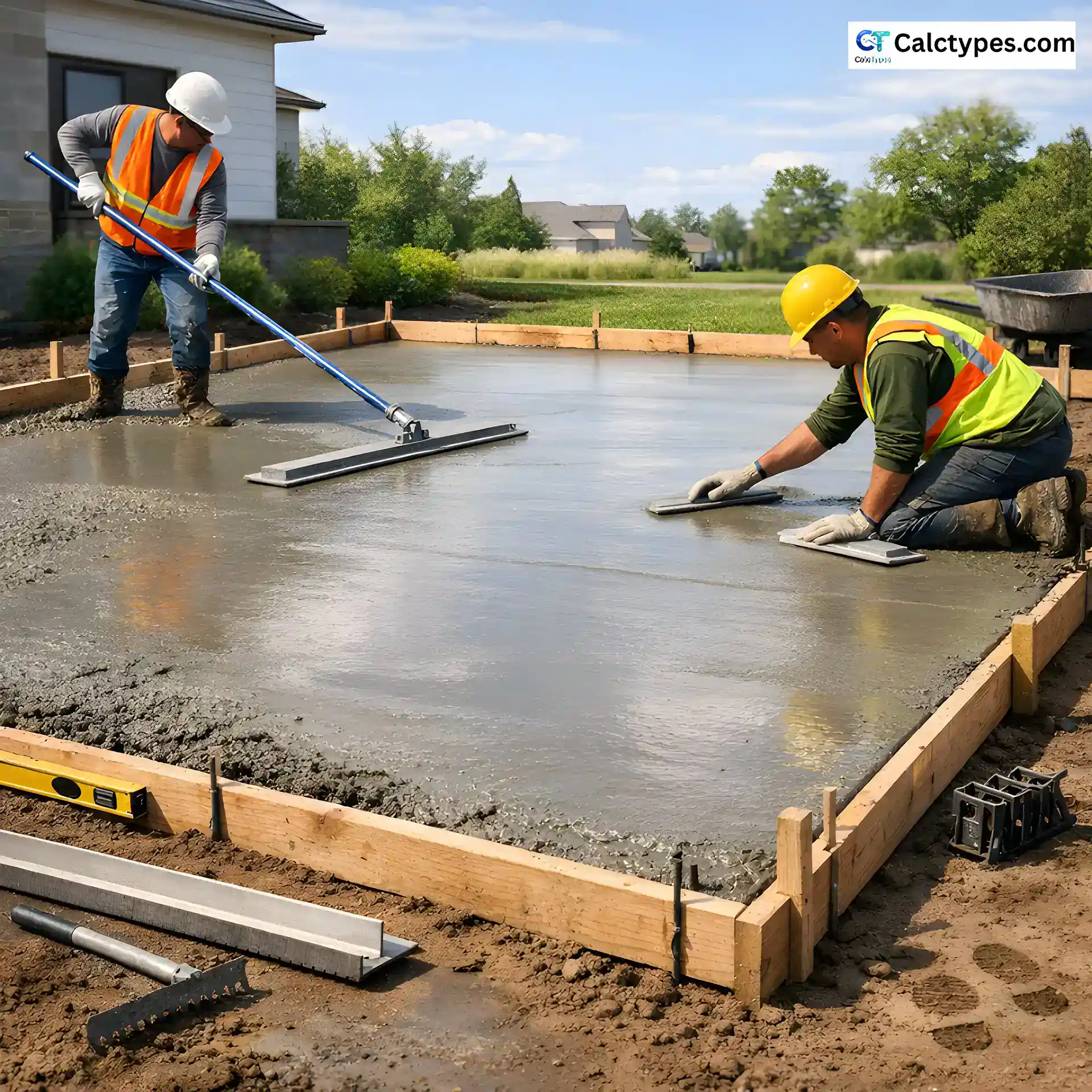
Concrete ordering starts with one thing: volume. Volume is “how much space the concrete will occupy after it is placed and finished.” For most residential projects, the base calculation is simple geometry:
- Slab/footing: V = Length × Width × Thickness
- Circular column: V = π × (Diameter/2)² × Height
- Stairs (approx.): V ≈ (steps × tread × riser × width) ÷ 2
The most common mistake is mixing units. For example, if length and width are in feet but thickness is in inches, you must convert thickness to feet first (inches ÷ 12). This calculator does those conversions internally.
Next, add a waste/overage buffer. A typical planning buffer is 10%, but you may need more if your sub‑base is uneven, edges thicken, forms leak, or you expect spillage/pump priming. Then round up—a short load is worse than leftover concrete, because running short can force a cold joint or delay finishing.
Finally, think like a supplier: ready‑mix is often delivered in increments (for example 0.25 yd³ or 0.5 yd³), and many plants have minimum load fees. Your “suggested order” should reflect that reality, not just the raw math.
How many bags of concrete do I need?
Bag count is a volume problem too. Each bag produces a certain yield (finished volume), usually printed on the bag label. The correct approach is:
Bags needed = Adjusted total volume ÷ Bag yield, then round up.
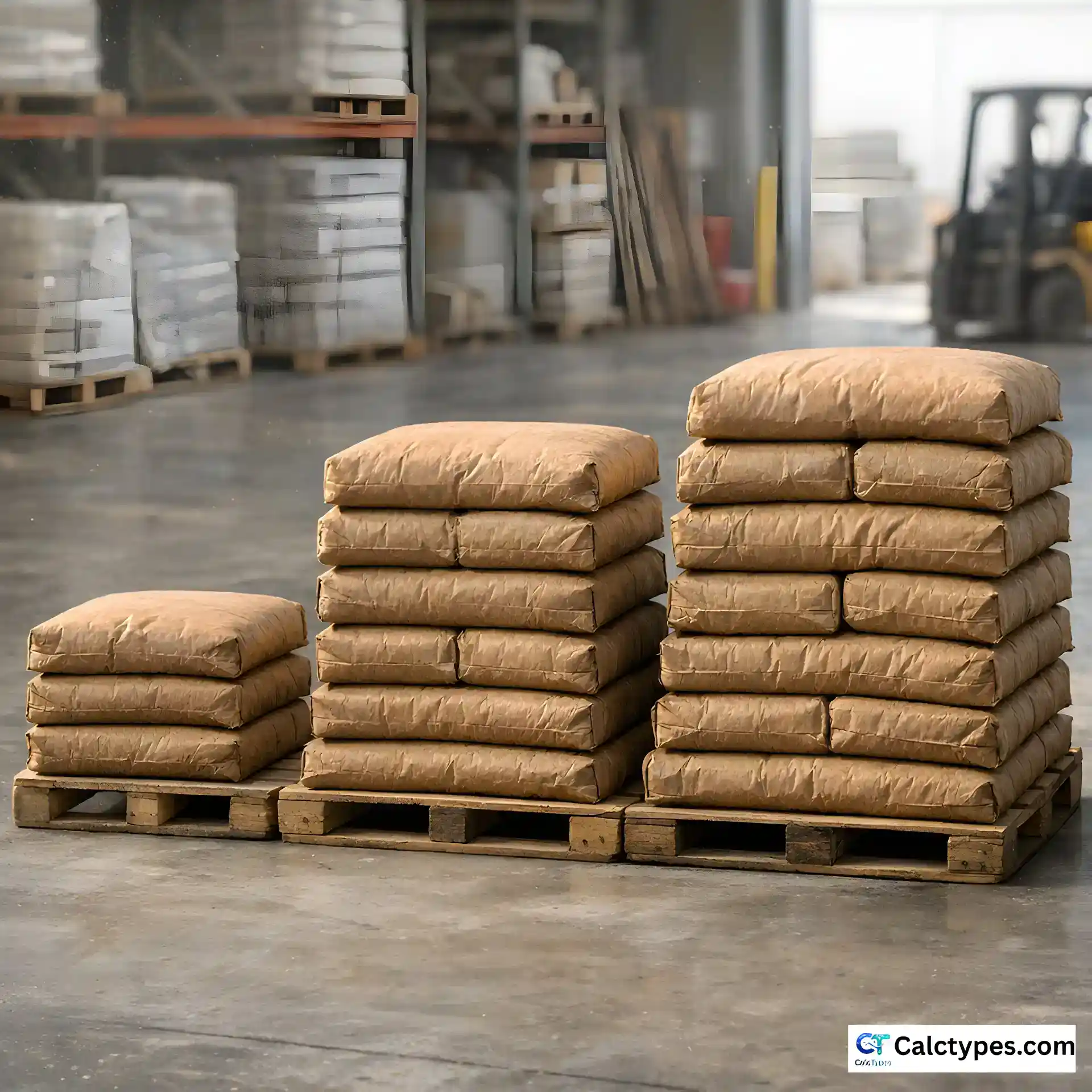
Yields vary by product type (standard mix vs high‑strength, fast‑set, fiber‑reinforced), and also by how much water you add. Too much water can increase workability but can reduce strength and increase shrinkage cracking.
Practically, bagged concrete is best for small pours where delivery is inconvenient (posts, small pads, repairs). If your project volume grows, labor and consistency become the limiting factors: mixing dozens of bags takes time, and if you can’t place and finish continuously, you can end up with visible seams or weak interfaces.
Use bag counts as a planning tool, then confirm your bag’s stated yield and adjust your order upward if you expect waste.
What is the difference between bagged and ready-mix concrete?
Bagged concrete is dry, pre‑blended material you mix on site with water. It’s flexible and widely available, but your final consistency depends on your water measurements, mixing time, and batch‑to‑batch uniformity.
Ready‑mix concrete is batched at a plant with controlled proportions (cement, aggregates, admixtures, water), then delivered to the job wet. It is typically more consistent and better suited for larger pours, structural work, or any job where you must place continuously and finish on schedule.
The decision is usually driven by: total volume, access, time, crew size, and required strength. Bagged mixes are convenient until labor becomes the hidden cost. Ready‑mix may include delivery/short‑load fees, but it can reduce risk and speed up the job dramatically.
How do I calculate concrete for stairs?
Straight stairs can be estimated as a triangular prism because the stair profile “ramps up” over the run. A common estimating shortcut is:
V ≈ (steps × tread × riser × width) ÷ 2
This is a planning approximation. It works well for typical formed stairs, but it may undercount if: you have a landing, thickened base, solid risers, extra returns/curbs, or complex geometry. The best professional approach is to break the job into parts: compute the stair run volume, add any landing slabs, add curbs/edges, then apply waste.
Stairs often justify a slightly higher waste factor because formwork is complex and finishing can require extra material at edges. If you’re ordering ready‑mix, confirm placement time and access (chute reach, pump requirements, wheelbarrow distance).

What is a concrete mix ratio?
A concrete “mix ratio” expresses the relative parts of cement : sand : aggregate. For example, an M20 planning ratio might be shown as 1 : 1.5 : 3. This ratio is commonly used as a field estimate, especially when batching by volume (buckets).
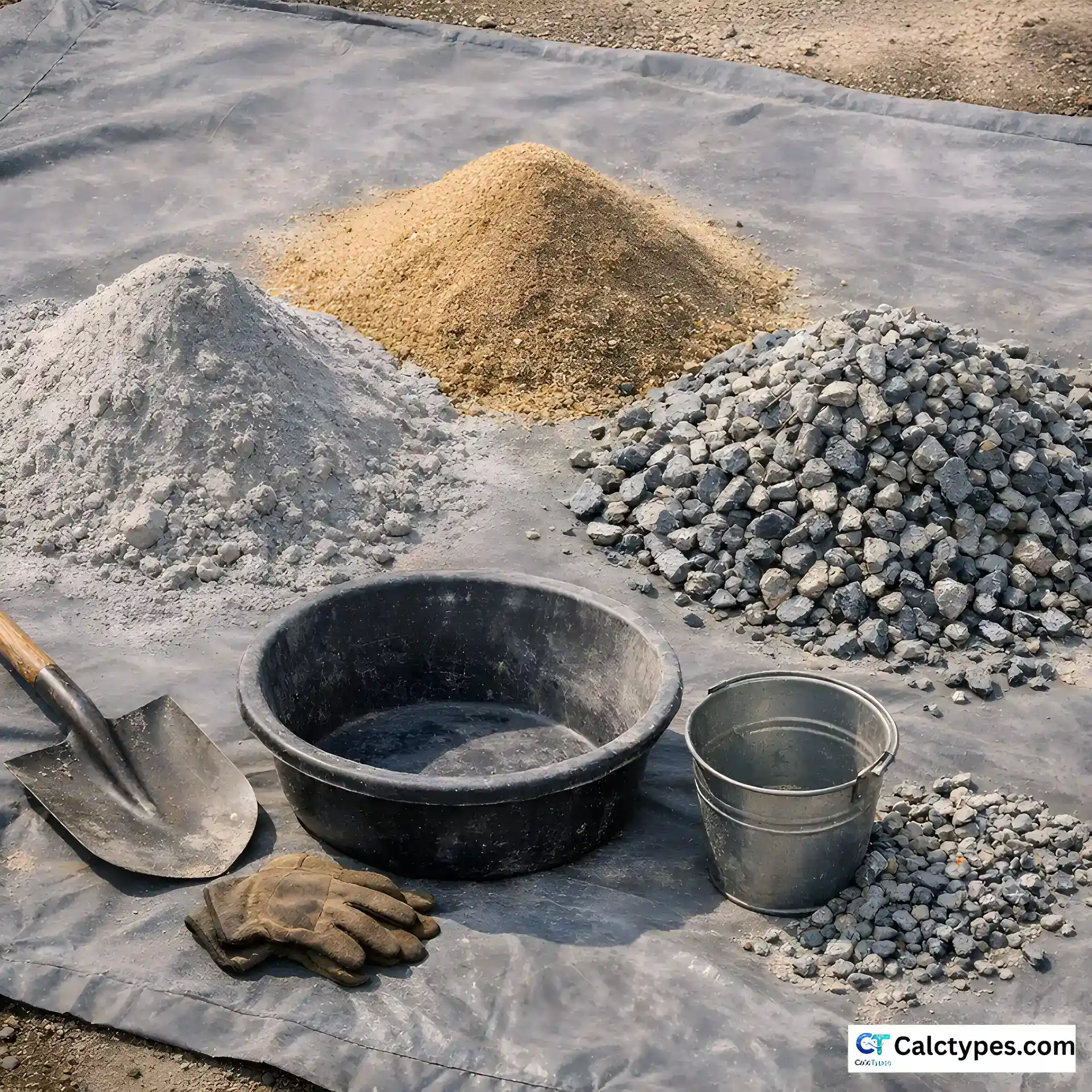
In real engineering practice, concrete strength is not determined by ratio alone. Strength is heavily influenced by: water–cement ratio (W/C), cement type, aggregate grading, admixtures, air content, curing, and placement quality. Even with the same “parts,” changing water content can significantly change performance.
That’s why this calculator’s mix feature is labeled as a planning estimate. It helps you approximate material quantities (cement, sand, aggregate, and water) so you can plan purchasing and logistics. For structural elements, follow code requirements and use a supplier mix design or engineer specification.
Methodology
What this calculator computes
This tool converts your inputs into a consistent internal unit (feet), calculates base volume in ft³, applies waste, converts to yd³ and m³, then rounds suggested order up to common supplier increments.
1) Geometry formulas (base volume)
- Slab / footing: V = L × W × T
- Circular column: V = π × (D/2)² × H
- Stairs (approx.): V ≈ (steps × tread × riser × width) ÷ 2
2) Unit conversion
Each dimension can be entered in ft/in/m/cm/mm. The calculator converts everything to feet before applying the formula. Output conversions:
- yd³ = ft³ ÷ 27
- m³ = ft³ × 0.0283168
3) Waste and suggested order rounding
Adjusted volume: Vadj = Vbase × (1 + waste%/100). Suggested order rounds up by default:
- US: round up to 0.25 yd³
- Others: round up to 0.05 m³
Supplier increments vary; confirm your local policy (some deliver in 0.5 yd³ or 0.25 m³ steps).
4) Bag yield assumptions (planning estimates)
Bag yields differ by product and water content. This calculator uses common planning yields:
- 80 lb ≈ 0.60 ft³
- 60 lb ≈ 0.45 ft³
- 40 lb ≈ 0.30 ft³
- 50 kg and 25 kg estimated equivalents are used for metric display
5) Mix ratio materials estimate (optional)
If you select a mix ratio preset/custom parts, the calculator estimates dry material quantities using a dry-volume factor (default 1.54) and typical bulk densities (cement ~1440 kg/m³, sand ~1600 kg/m³, aggregate ~1500 kg/m³). This is for planning only and is not an engineered mix design.
Planning estimate only. For structural work, follow local code/specifications and consult a qualified professional.
Limitations & Disclaimers
What can make real-world volume differ from calculated volume?
- Uneven sub-base and varying thickness (common on patios and driveways).
- Over-excavation or edge thickening that isn’t captured in simple dimensions.
- Spillage, pump priming, or extra finishing needs.
- Stair/landing complexity beyond the triangular approximation.
Bag yield and strength
Bag yields vary by manufacturer and water content. Strength depends on mix design, curing, and placement. Always verify bag label yield and follow curing guidance.
Cost estimate
Cost uses your entered price multiplied by suggested (rounded) order quantity. It does not include delivery/pump fees, short-load fees, taxes, or finishing labor.
This tool is for estimation and planning. Confirm requirements with your supplier and local building code.
Sources
Important Disclaimer
This calculator provides planning estimates only. Actual concrete quantity, bag yield, strength, and cost can vary based on product type, water content, compaction, sub-base conditions, forms, reinforcement, and finishing practices.
- Always confirm bag yield and mixing instructions on the bag label.
- Always confirm minimum ready-mix order, rounding increments, and delivery fees with your supplier.
- For structural work, follow local code/specifications and consult a qualified professional.
Read the full disclaimer here: Full Disclaimer