Added Sugar Percent of Calories Calculator
Added Sugar Percent of Calories Calculator
See what percent of your calories come from added sugar—useful for WHO-style “keep sugars under 10% of energy” guidance.
Some guidelines discuss sugar in percent of calories rather than grams. For example, the WHO recommends keeping free sugars below 10% of total energy (and ideally below 5%). This calculator converts sugar grams into sugar calories and shows what percentage of your total calories that represents.
If you’re starting from a label, you can get grams using the added sugar label calculator or convert %DV using %DV to grams. Need help locating the right line? See how to read the added sugar label.
Calculator
Tip: if you’re doing a label-based per-serving check, use the product’s calories per serving here.
Quick examples:
Result
Want the calorie math only? Use sugar calories calculator. Want teaspoons? Use grams to teaspoons.
On this page
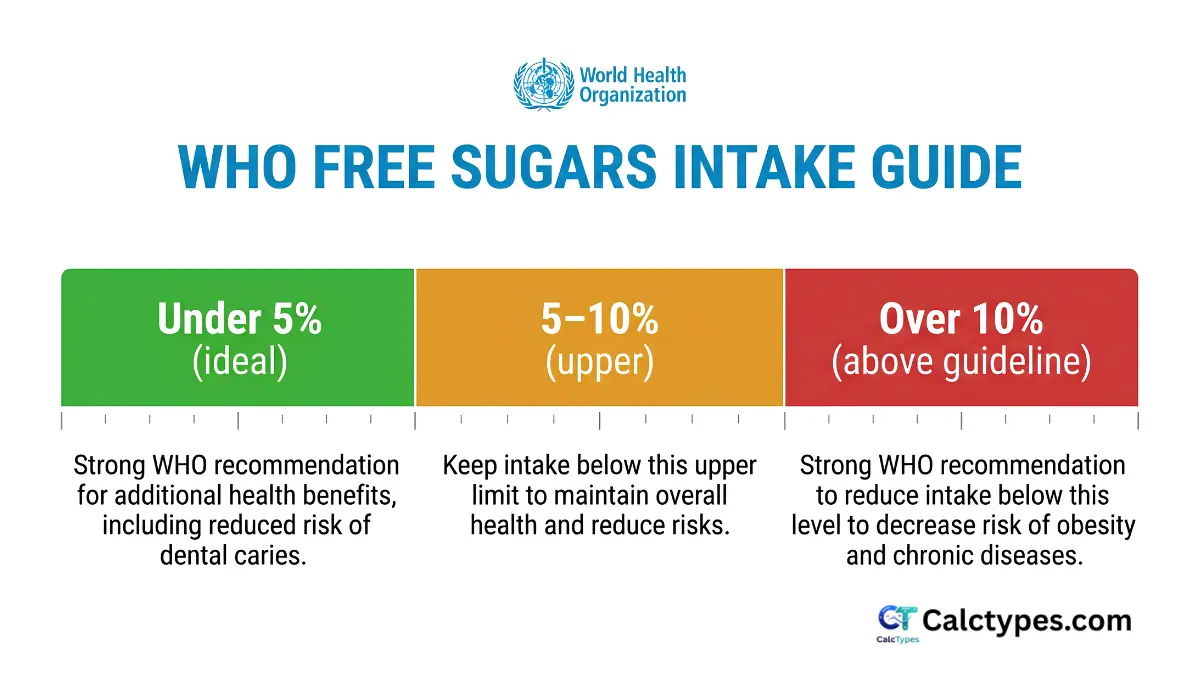
WHO “Free Sugars” Energy Bands (5% Ideal, 10% Upper)
The WHO guideline is framed as a percentage of total energy (calories), not just grams. The calculator uses your sugar grams to compute sugar calories (4 kcal/g), then reports the % of total calories. WHO refers to free sugars (which includes sugars in juices, honey, syrups). Labels report added sugars, so treat this as educational context.
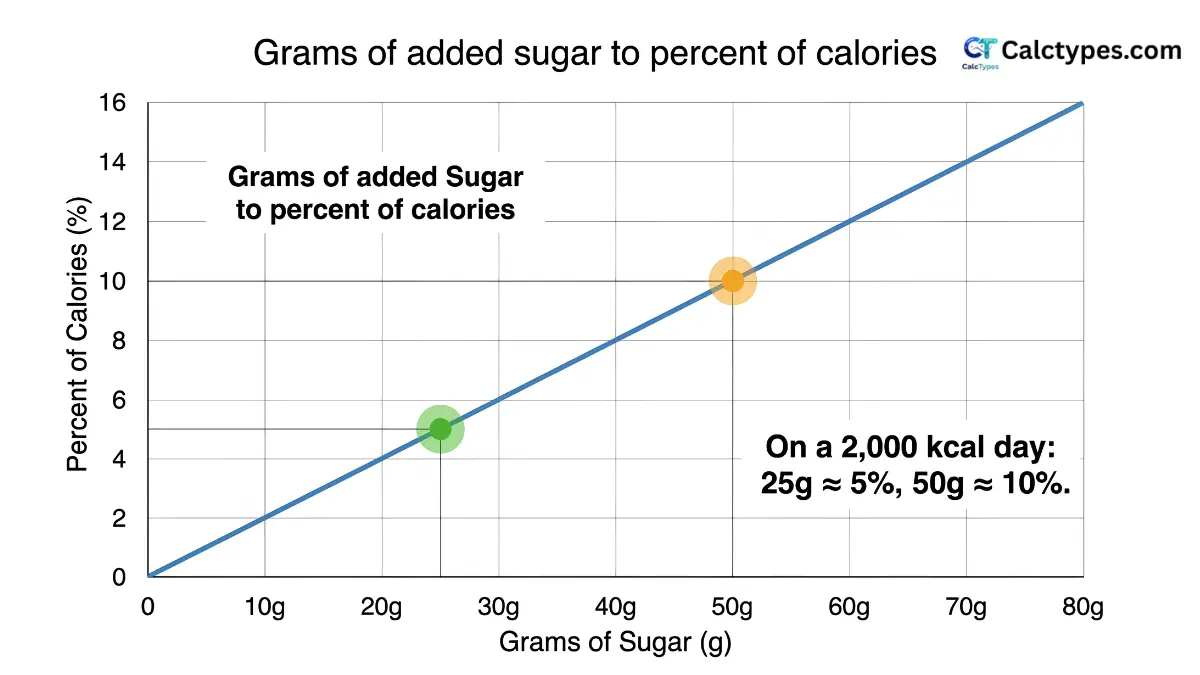
Quick Reference: Sugar Grams at 2,000 Calories
On a 2,000 kcal day, 5% energy from sugar equals 25g and 10% equals 50g (because 10% of 2,000 = 200 kcal, and 200 ÷ 4 = 50g).
| Sugar grams | Sugar calories | % of 2,000 kcal | WHO band | Teaspoons |
|---|---|---|---|---|
| 25g | 100 kcal | 5% | Ideal target | 6.25 tsp |
| 40g | 160 kcal | 8% | Upper band | 10 tsp |
| 50g | 200 kcal | 10% | Upper limit | 12.5 tsp |
| 60g | 240 kcal | 12% | Above guideline | 15 tsp |
Worked Examples (Load buttons)
Click a button to autofill the calculator inputs (sugar grams + total calories).
Example 1 — 25g sugar on a 2,000 kcal day
25g × 4 = 100 kcal. 100 ÷ 2,000 = 5% (WHO ideal target). Teaspoons = 6.25.
Example 2 — 50g sugar on a 2,000 kcal day
50g × 4 = 200 kcal. 200 ÷ 2,000 = 10% (WHO upper limit). Teaspoons = 12.5.
Example 3 — 12g sugar in a 180 kcal snack
12g × 4 = 48 kcal. 48 ÷ 180 = 26.7% (high share of snack calories). Teaspoons = 3.
Questions People Ask
Why does WHO talk about percent of calories from sugar?
Percent-of-energy scales with your diet. 10% of 1,600 kcal is a smaller sugar allowance than 10% of 2,500 kcal. This calculator makes that framing easy.
How many calories are in 1 gram of sugar?
About 4 calories per gram. Sugar calories = grams × 4.
What is the WHO 10% limit in grams?
On a 2,000 kcal diet, 10% = 200 kcal from sugar. 200 ÷ 4 = 50g (about 12.5 tsp).
Is “added sugar” the same as “free sugar”?
Not exactly. WHO uses “free sugars” (includes sugars in juices, honey, syrups). Labels provide “added sugars.” The percent-of-energy result is still useful as a practical approximation.
How do I get added sugar grams from a label?
Use the added sugar label guide or the added sugar label calculator.
Important Disclaimer (Read Before Using)
This calculator is educational and math-based. It does not provide medical advice, diagnosis, or treatment. WHO guidance refers to “free sugars,” while labels report “added sugars.” Use the result as general context, not a personal prescription. Read the full policy here: Full Disclaimer.
Key takeaways
- Sugar calories ≈ grams × 4.
- Percent of calories from sugar ≈ (sugar calories ÷ total calories) × 100.
- WHO bands: <5% ideal, 5–10% upper band, >10% above guideline.
- On a 2,000 kcal day, 25g = 5% and 50g = 10%.
- For grams from labels, use added sugar label calculator and %DV to grams.