Sugar Grams to Sugar Cubes Calculator
How Many Grams Are in a Sugar Cube?
Most standard sugar cubes weigh about 4 g, though cubes range from about 2.3 g to 4 g depending on brand and size.
Convert grams of sugar into sugar cubes (visual), plus teaspoons, calories, and %DV.
Quick answer: A “standard” sugar cube is commonly treated as about 4 grams of sugar, but cube weights vary by brand and region (mini/small cubes are often closer to 2.5–3g). This calculator lets you pick the cube size so your result is more realistic.
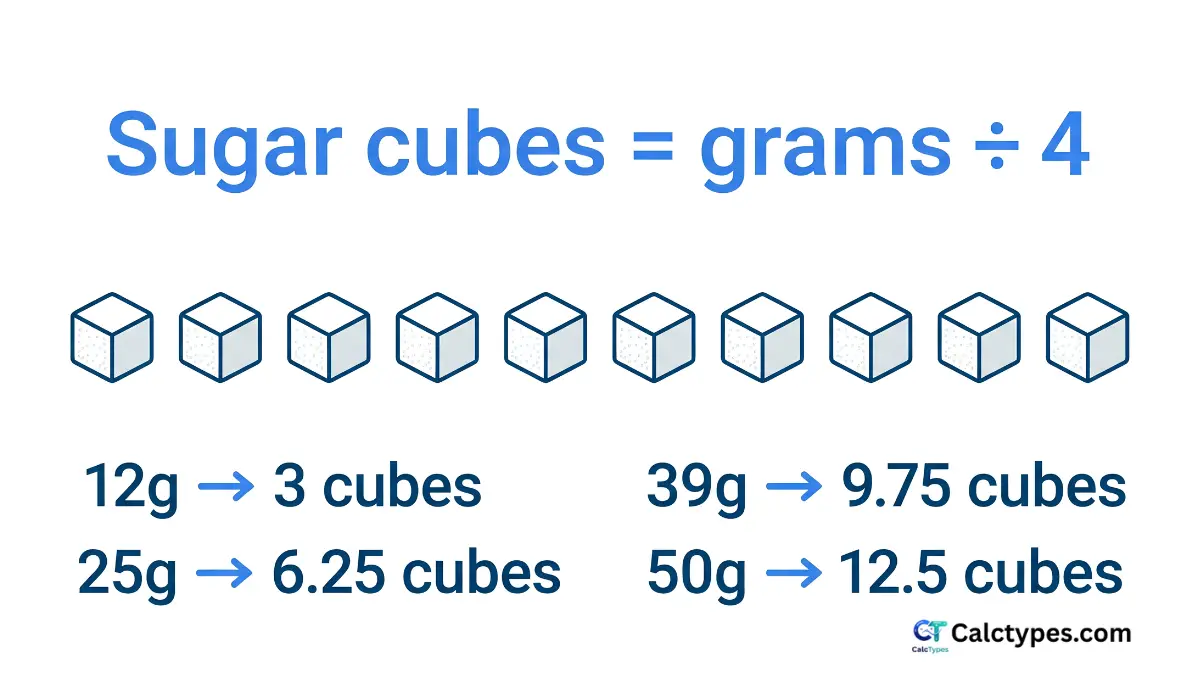
Formula: sugar cubes = grams of sugar ÷ grams per cube. For example, 39g ÷ 4g ≈ 9.75 cubes (about 10).
If you’re working from a nutrition label, look for “Added Sugars” using how to read the added sugar label (or calculate it with the Added Sugar Label Calculator). Then compare your result to daily guidelines with daily added sugar limit.
For spoons instead of cubes, use grams to teaspoons. For label %DV conversion, use % Daily Value to grams. For calories, use sugar calories calculator.
Calculator
Tip: If you only have %DV, convert it with %DV to grams.
Quick examples:
Result
For spoon visualization, use grams to teaspoons.
On this page
How many grams are in a sugar cube?
Most “standard” sugar cubes are around 4 grams, but there isn’t one universal cube weight.
Cafés, restaurants, and different countries may use smaller or mini cubes—so the most accurate option is to check the package or weigh a cube and use the custom setting.
| Cube type (common) | Typical grams per cube | When you might see it |
|---|---|---|
| Standard cube | ~4g | Many packaged cubes and general conversions |
| Small cube | ~3g | Some brands/regions; smaller cubes on a saucer |
| Mini cube | ~2.5g | Mini cubes, portion-controlled packs |
Real box examples (US labels): a 1 lb box of Domino Dots holds 198 cubes, about 2.3 g each (the box lists 1 cube = 2.29 g, about ½ teaspoon). The 126-count 1 lb boxes from Domino and C&H list a serving of 2 cubes = 7 g, so about 3.5 g per cube. The easiest check for any brand: divide the box weight in grams by the number of cubes.
Are sugar cubes always 4 grams?
No. 4g per cube is a useful reference, but cube weight varies. If you need precision, use the package info or weigh a cube and enter a custom value.
How much does a sugar cube weigh (in calories)?
Pure sugar provides about 4 calories per gram. So a 4g cube is roughly 16 calories (and a 3g cube is about 12 calories).
Are sugar cubes the same as teaspoons?
Roughly: a standard 4 g cube holds about the same sugar as a level teaspoon, but smaller cubes hold less.
They’re both visual tools. A teaspoon is often treated as ~4g sugar for quick conversions. Cubes can be close to that, but cube weights vary more—so cubes are best used as an approximation.
Quick Reference: Grams to Sugar Cubes (4g Cube)
This table uses a common reference of 4g per cube. If your cube size differs, use the selector in the calculator (3g, 2.5g, or custom).
| Grams | Cubes (÷ 4g) | Teaspoons | Calories from sugar | DV% (FDA 50g) |
|---|---|---|---|---|
| 10g | 2.5 | 2.5 tsp | 40 kcal | 20% |
| 12g | 3 | 3 tsp | 48 kcal | 24% |
| 25g | 6.25 | 6.25 tsp | 100 kcal | 50% |
| 35g | 8.75 | 8.75 tsp | 140 kcal | 70% |
| 36g | 9 | 9 tsp | 144 kcal | 72% |
| 39g | 9.75 | 9.75 tsp | 156 kcal | 78% |
| 40g | 10 | 10 tsp | 160 kcal | 80% |
| 50g | 12.5 | 12.5 tsp | 200 kcal | 100% |
| 72g | 18 | 18 tsp | 288 kcal | 144% |
Worked Examples (Load buttons)
How many sugar cubes is 25g of sugar?
Using a 4g cube: 25 ÷ 4 = 6.25 cubes (about 6–7 cubes).
How many sugar cubes is 39g of sugar?
39 ÷ 4 = 9.75 cubes (about 10 cubes).
This is close to a typical cola can’s sugar.
Custom cube size example (3g cubes): 30g sugar
30 ÷ 3 = 10 cubes. Use the cube size selector to match your cubes.
Key takeaways
- Common reference: 1 sugar cube ≈ 4g, but cube sizes vary—use the selector or custom input.
- Quick math: cubes = grams ÷ (grams per cube).
- Teaspoons: grams ÷ 4 (common label conversion).
- Calories from sugar: grams × 4.
- DV% estimate (US): (grams ÷ 50) × 100.
- If you’re tracking daily totals, try the Added Sugar Intake Calculator.
Important Disclaimer (Read Before Using)
This calculator is educational and performs mathematical conversions. Sugar cube weights vary by brand, packing, and region, so cube counts are approximate. This tool does not provide medical advice, diagnosis, or treatment. Read the full policy here: Full Disclaimer.
Methodology: How This Calculator Works
The converter divides the grams of sugar by the weight of one cube you select (about 2.5, 3 or 4 g, or your own value). It also shows teaspoons at 4 g per teaspoon, calories at 4 kcal per gram, and the percentage of the FDA 50 g Daily Value.
Assumptions and Limitations
Assumptions
- Label values are accurate, and 1 g of sugar ≈ 4 kcal and 4 g ≈ 1 teaspoon, the usual label conventions.
- Limits used are the AHA (25 g women and children, 36 g men) and WHO (under 10%, ideally 5% of energy) guidance.
- Added sugars are counted separately from sugars naturally present in milk and whole fruit.
- Cube weight depends on brand and country.
Limitations
- Labels are rounded and serving sizes vary between brands and countries.
- Children, pregnancy and conditions such as diabetes may need different limits set by a clinician.
- Sugar content is one part of a healthy diet, not a full measure of how healthy a food is.
Disclaimer
Please read before relying on this page. Sugar cube weights vary by brand and country (about 2.5–4 g each), so cube counts are approximate. This tool is for visualising sugar on labels, not for precise measurement or medical diet planning. People managing diabetes should follow the advice of their care team.
Health. This is not medical, nutritional or diagnostic advice. In an emergency, call your local emergency number.
Your responsibility. Results are estimates for general information and education only, and nothing here is professional advice. You use this page at your own risk; to the fullest extent permitted by law, CalcTypes, its authors and reviewers accept no liability for loss, injury or damage arising from reliance on it. Spotted an error? Use “Report an issue” or our contact page. Full terms: Disclaimer · Terms of use.