How to Calculate BMR Manually
How to Calculate BMR Manually (Step-by-Step)
Learn how to calculate basal metabolic rate (BMR) by hand using the Mifflin–St Jeor, Harris–Benedict revised, and Katch–McArdle equations. Includes unit conversions, worked examples, and a practical workflow to turn BMR into maintenance calories (TDEE).
Department of Pathology, Aligarh Muslim University (A.M.U.), Aligarh
Reviewed this educational guide for appropriate definitions, formula representations, limitations, and safe interpretation of BMR calculation methods. No diagnostic or treatment claims are made.
Quick takeaway
- All three main equations need metric inputs. Convert lb→kg and ft/in→cm before you start; unit errors are the most common manual calculation mistake.
- Mifflin–St Jeor is the recommended default for most adults who do not know their body fat percentage.
- Katch–McArdle is better for body-composition-aware planning, but only when your body fat percentage estimate is accurate.
- BMR is a baseline, not an intake target. Multiply by an activity factor to get TDEE, then adjust from maintenance using multi-week trends.
On this page
What you need to calculate BMR manually
Before you pick up a pen or open a spreadsheet, gather the correct measurements. Each equation has slightly different input requirements. Using the wrong units is the single most common source of error in manual BMR calculations.
- Mifflin–St Jeor: biological sex, age (years), weight (kg), height (cm)
- Harris–Benedict revised: biological sex, age (years), weight (kg), height (cm)
- Katch–McArdle: body weight (kg) and body fat percentage — to derive lean body mass (LBM) in kg
Unit conversions you may need
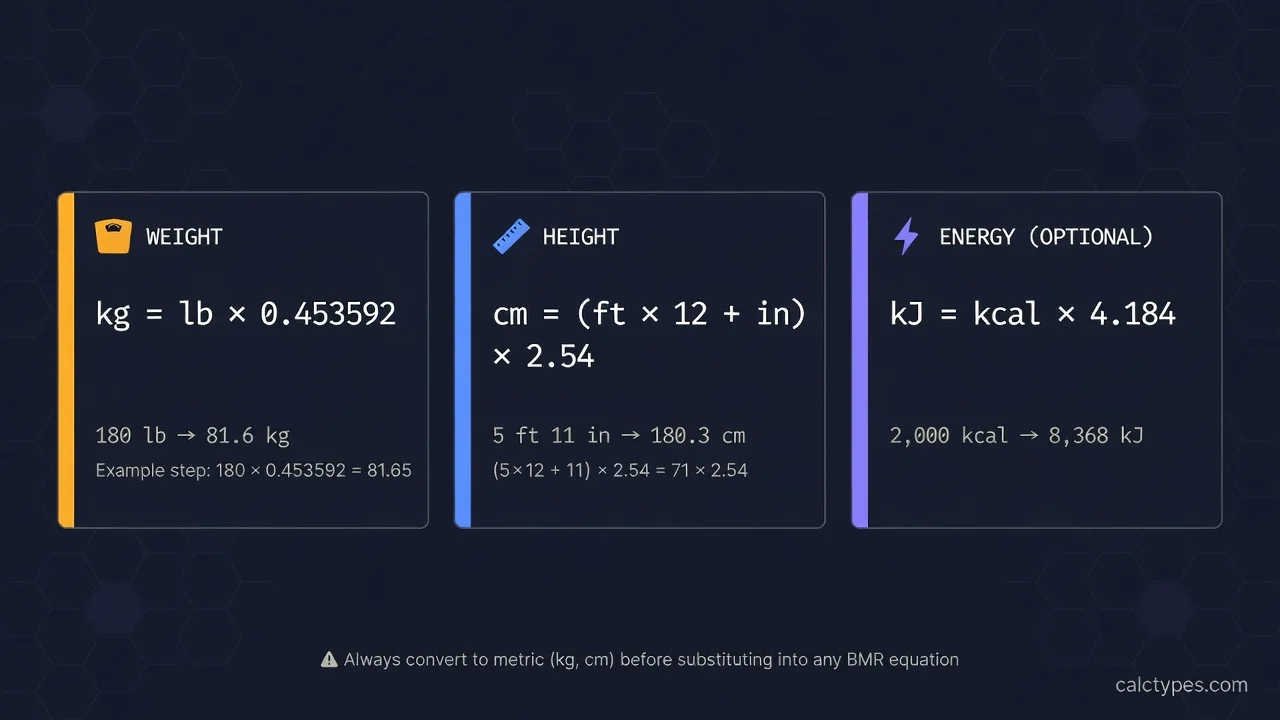
All three equations expect metric inputs. If your measurements are in imperial units, convert them first. Below are the three conversions you are most likely to need.
ft/in → cm: cm = (ft × 12 + in) × 2.54
kcal → kJ: kJ = kcal × 4.184
Example: 180 lb = 180 × 0.453592 = 81.6 kg. Example: 5 ft 11 in = (5×12 + 11) × 2.54 = 71 × 2.54 = 180.3 cm.
Mifflin–St Jeor equation (manual)
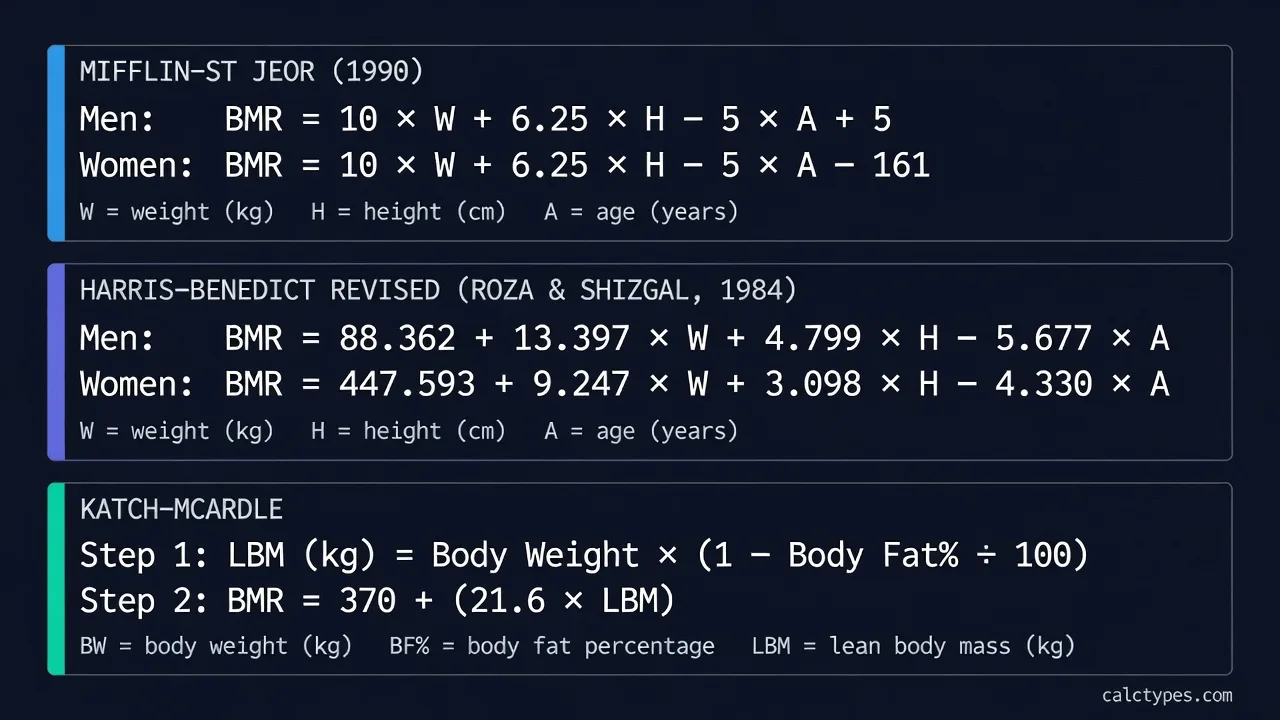
The Mifflin–St Jeor equation (1990) is the most widely recommended predictive BMR formula for the general adult population. It was derived from a study of 498 men and women and outperforms the original Harris–Benedict equation in most validation studies. Use weight in kg, height in cm, and age in years.
For men
For women
W = weight (kg) · H = height (cm) · A = age (years). The only difference between the two versions is the sex constant (+5 vs −161).
Worked example — male, 81 kg, 173 cm, 30 years
Step 1 — weight term: 10 × 81 = 810
Step 2 — height term: 6.25 × 173 = 1,081.25
Step 3 — age term: 5 × 30 = 150
Step 4 — sex constant (male): +5
Result: 810 + 1,081.25 − 150 + 5 = 1,746 kcal/day
Verify instantly using the Mifflin–St Jeor calculator.
Worked example — female, 65 kg, 163 cm, 28 years
Step 1 — weight term: 10 × 65 = 650
Step 2 — height term: 6.25 × 163 = 1,018.75
Step 3 — age term: 5 × 28 = 140
Step 4 — sex constant (female): −161
Result: 650 + 1,018.75 − 140 − 161 = 1,368 kcal/day
Verify using the Mifflin–St Jeor calculator.
Harris–Benedict revised equation (manual)
The revised Harris–Benedict equations (Roza and Shizgal, 1984) updated the original 1919 Harris–Benedict work using a larger and more varied dataset. They remain widely used as a comparison reference. The coefficients differ from Mifflin–St Jeor and tend to produce slightly higher estimates for many adults. Use weight in kg, height in cm, and age in years.
For men
For women
W = weight (kg) · H = height (cm) · A = age (years). Unlike Mifflin–St Jeor, each sex has a completely different set of coefficients.
Worked example — female, 65 kg, 163 cm, 28 years
Step 1 — constant: 447.593
Step 2 — weight term: 9.247 × 65 = 601.055
Step 3 — height term: 3.098 × 163 = 504.974
Step 4 — age term: 4.330 × 28 = 121.24
Result: 447.593 + 601.055 + 504.974 − 121.24 = 1,432 kcal/day
Verify using the Harris–Benedict calculator.
Worked example — male, 81 kg, 173 cm, 30 years
Step 1 — constant: 88.362
Step 2 — weight term: 13.397 × 81 = 1,085.157
Step 3 — height term: 4.799 × 173 = 830.227
Step 4 — age term: 5.677 × 30 = 170.31
Result: 88.362 + 1,085.157 + 830.227 − 170.31 = 1,833 kcal/day
Verify using the Harris–Benedict calculator.
Katch–McArdle equation (manual)
The Katch–McArdle equation differs from the other two by using lean body mass (LBM) rather than total body weight. This makes it theoretically more accurate for people who know their body fat percentage accurately — for example, those who have had a DEXA scan or hydrostatic weighing. However, it is sensitive to body-fat-percentage errors: a 5-percentage-point error at 80 kg shifts the result by roughly 86 kcal/day.
Step 1 — Calculate lean body mass (LBM)
You can also calculate this instantly with our lean body mass (LBM) calculator.
Step 2 — Calculate BMR from LBM
Note: this equation produces a single result regardless of sex, because it accounts for sex indirectly through the LBM input.
Worked example — 80 kg at 20% body fat
Step 1 — LBM: 80 × (1 − 20 ÷ 100) = 80 × 0.80 = 64 kg
Step 2 — BMR: 370 + (21.6 × 64) = 370 + 1,382.4 = 1,752 kcal/day
Verify using the Katch–McArdle calculator.
Worked example — 65 kg at 28% body fat
Step 1 — LBM: 65 × (1 − 28 ÷ 100) = 65 × 0.72 = 46.8 kg
Step 2 — BMR: 370 + (21.6 × 46.8) = 370 + 1,010.88 = 1,381 kcal/day
Verify using the Katch–McArdle calculator.
Formula comparison: same person, three equations
The table below shows the estimated BMR for two consistent test subjects across all three equations, making it easier to see how the results differ in practice.
| Equation | Male, 81 kg, 173 cm, 30 yr | Female, 65 kg, 163 cm, 28 yr | Key requirement |
|---|---|---|---|
| Mifflin–St Jeor | 1,746 kcal/day | 1,368 kcal/day | Weight, height, age, sex |
| Harris–Benedict (revised) | 1,833 kcal/day | 1,432 kcal/day | Weight, height, age, sex |
| Katch–McArdle (assumes 20% / 28% BF) |
1,752 kcal/day | 1,381 kcal/day | Body weight + body fat % |
| Difference (range) | 87 kcal/day | 64 kcal/day | — |
Katch–McArdle body fat assumptions: 20% for the male example, 28% for the female example. Different body fat values would shift the Katch–McArdle result. Use the BMR calculator to compare all three with your own numbers. For a practical “which one should I use?” guide (with context), see BMR formula comparison.
How to go from BMR to maintenance calories (TDEE)
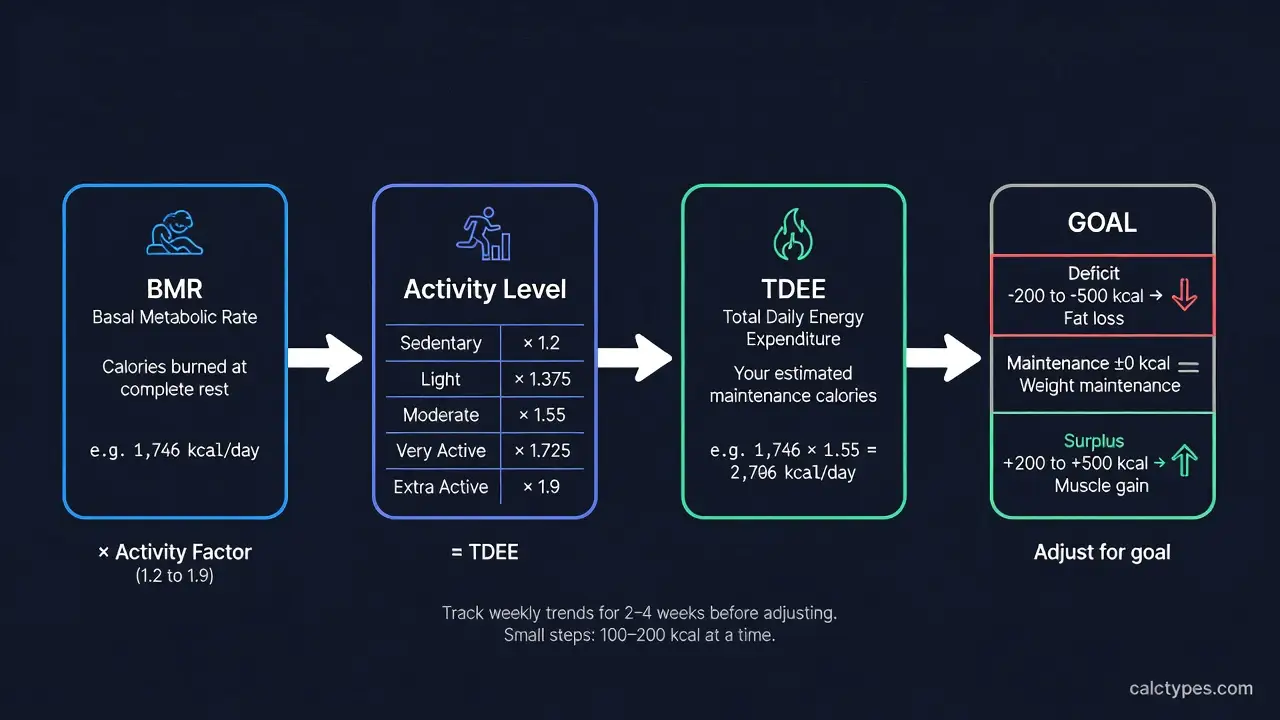
BMR only accounts for resting energy needs. To estimate how many calories you use in a real day — your total daily energy expenditure (TDEE) — multiply your BMR by an activity factor that reflects your typical daily movement and exercise.
Lightly active (light exercise 1–3 days/week): BMR × 1.375
Moderately active (moderate exercise 3–5 d/wk): BMR × 1.55
Very active (hard exercise 6–7 days/week): BMR × 1.725
Extra active (physical job + daily training): BMR × 1.9
Example using the Mifflin–St Jeor male result above (1,746 kcal): moderately active TDEE = 1,746 × 1.55 = 2,706 kcal/day. Use the TDEE calculator for a full breakdown.
Common calculation mistakes (and how to avoid them)
- Mixing units: Always convert lb→kg and ft/in→cm before substituting into any equation. A person’s weight entered in pounds instead of kilograms would produce a wildly wrong result.
- Using BMR as an intake target: BMR is a resting-only estimate. Use maintenance (TDEE) as your starting point, then adjust gradually based on real-world trends rather than eating at or below BMR.
- Overtrusting body fat percentage in Katch–McArdle: Consumer body fat measurement methods (bio-impedance scales, skin-fold calipers at home) carry meaningful error. A 5-percentage-point error shifts LBM by several kilograms and BMR by 60–100+ kcal.
- Expecting precision from a predictive equation: Real-world energy needs vary due to genetics, hormones, medications, sleep, and stress. Treat the output as a planning estimate and adjust slowly across weeks.
- Comparing across equations without context: Mifflin–St Jeor and Harris–Benedict can produce results that differ by 50–200 kcal/day for the same person. Neither result is “wrong”; they reflect different modelling choices and research populations.
Questions people ask
How do I calculate BMR manually?
Calculating BMR manually means substituting your measurements into a published predictive equation and working through the arithmetic step by step. The process is the same regardless of which equation you choose. First, gather your inputs — at minimum, your weight, height, age, and biological sex (for Mifflin–St Jeor and Harris–Benedict) or weight and body fat percentage (for Katch–McArdle). Second, convert everything to metric: weight in kilograms, height in centimetres, age in full years. Third, substitute each value into its respective position in the formula and compute the terms in order — weight term, height term, age term, sex constant — before summing them.
For Mifflin–St Jeor (men), as a concrete walkthrough: a 30-year-old man who weighs 81 kg and is 173 cm tall would compute 10 × 81 = 810, then 6.25 × 173 = 1,081.25, then 5 × 30 = 150, then add the male constant of +5. Summing: 810 + 1,081.25 − 150 + 5 = 1,746 kcal/day. This is his estimated BMR — the energy his body would use at complete rest over 24 hours. To use it for planning, he then multiplies by an activity factor to get maintenance calories. If the arithmetic feels error-prone, use the BMR calculator to verify your manual result.
Which BMR formula is most accurate?
No single equation is universally most accurate for every individual, but research comparing predictive equations to indirect calorimetry (a more direct measurement method) generally finds that Mifflin–St Jeor performs best across large, varied adult populations. It was developed in 1990 with a more representative dataset than the original Harris–Benedict work, and multiple validation studies have confirmed it produces lower average error for non-obese and moderately overweight adults.
However, “most accurate on average” does not mean “most accurate for you specifically.” For individuals who have a reliable body fat percentage estimate — from a DEXA scan, for example — Katch–McArdle may be more accurate because it directly accounts for lean body mass rather than using total body weight plus a sex constant as a rough proxy. If your body fat percentage estimate is from a consumer bio-impedance scale, the measurement error may be large enough to make Katch–McArdle less reliable than Mifflin–St Jeor in practice. The safest approach is to calculate both, note the range they give you, and then calibrate using multi-week trends in weight, energy, and performance rather than trusting any single number absolutely.
What should I do if my estimate doesn’t match real life?
This is common and expected. Predictive equations are built from group averages, not individual measurements. For any given person, the formula output can be 5–15% off in either direction, which at 2,000 kcal/day maintenance could mean a 100–300 kcal/day discrepancy between your estimated needs and your true needs. The result is that a plan based solely on the calculator may produce faster or slower changes than predicted, or may feel more or less satisfying than you expected.
The practical fix is to treat the calculator result as a starting hypothesis, not a fixed answer. Follow a consistent plan for two to four weeks while tracking weekly average body weight, simple measurements (e.g., waist), and subjective markers like energy levels, sleep quality, and hunger. Then compare your observed trend to your expected trend. If the trend is faster than intended, adjust by increasing intake slightly. If it is slower than intended, reduce intake slightly or increase activity. Make changes in small steps — 100–200 kcal increments — rather than large corrections, and give each change at least two weeks to produce a clear trend before reacting further. If you have underlying health conditions, medications that affect weight, or a history of disordered eating, work with a qualified professional rather than trying to self-calibrate using a calculator alone.
Should I use the same formula every time I recalculate?
For consistency in tracking, yes — it is generally better to stick with the same equation across recalculations rather than switching between them. Different equations may produce estimates that differ by 50–200 kcal/day for the same person, so switching midway through a tracking period introduces a jump in your estimated baseline that is not due to any real change in your physiology. This can make it harder to identify genuine trends.
A sensible approach is to pick Mifflin–St Jeor as your default if you do not know your body fat percentage with confidence, and to recalculate it whenever your weight or age changes meaningfully — for example, every few months or after a significant change in body composition. If you want to experiment with Katch–McArdle, run it in parallel as a comparison rather than replacing your existing baseline. Over time, what matters most is not the precision of any single calculation but the consistency with which you apply a plan and respond to the real-world trends it produces.
Can I calculate BMR without knowing my body fat percentage?
Yes — and for most people this is the default approach. Both Mifflin–St Jeor and the revised Harris–Benedict equation require only weight, height, age, and biological sex. They do not require any body fat measurement. Body fat percentage is only needed for the Katch–McArdle equation, which calculates lean body mass first and then uses it as the sole predictor of BMR.
If you do not know your body fat percentage, Mifflin–St Jeor is the recommended starting point for most adults. It works well even without body composition data because it uses weight and height as combined proxies for body size. The trade-off is that total body weight includes both lean and fat mass, so two people with the same weight and height but very different body compositions can receive the same Mifflin–St Jeor estimate even though their actual resting energy needs may differ. For typical adults without extreme body composition profiles, this limitation is unlikely to cause practically significant errors. But if body composition is a known variable in your planning — for example, if you are a competitive athlete or have lost or gained a substantial amount of lean mass recently — it may be worth getting a reasonably accurate body fat measurement and comparing the Katch–McArdle result alongside your Mifflin–St Jeor estimate.
Important disclaimer
Sources
- Mifflin MD et al. A new predictive equation for resting energy expenditure in healthy individuals. American Journal of Clinical Nutrition, 1990.
- StatPearls — Physiology, Basal Metabolic Rate. NCBI Bookshelf (continuously updated).
- Roza AM, Shizgal HM. The Harris Benedict equation reevaluated. American Journal of Clinical Nutrition, 1984.
Methodology
This is an educational guide explaining how to perform manual BMR calculations using three published equations. It does not run calculations internally.
- Formula constants are taken directly from the original published papers cited above (Mifflin et al. 1990; Roza and Shizgal 1984).
- Worked examples use consistent test cases (81 kg / 173 cm / male / 30 years; 65 kg / 163 cm / female / 28 years) to allow direct comparison across equations.
- Activity multipliers for TDEE are standard values widely used in nutrition science literature and validated against doubly labelled water studies.
- Accuracy ranges cited (5–15%, 100–300 kcal/day) reflect ranges reported in published validation studies comparing predictive equations to indirect calorimetry.
Limitations and disclaimers
- All three equations are predictive models based on group data; individual results may differ meaningfully from true resting energy expenditure.
- Equations were developed in specific study populations; accuracy may be lower for individuals outside those demographic ranges (e.g., elderly populations, clinical patient groups, elite athletes).
- Katch–McArdle is sensitive to body fat percentage accuracy; consumer measurement methods can introduce significant error into LBM estimates.
- No manual calculation can replace individualized assessment by a qualified dietitian, physician, or sports-science professional.
- This content is not appropriate as a primary decision-making tool for people under 18, pregnant individuals, those managing eating disorders, or those with complex metabolic conditions.