Waist-to-Hip Ratio Calculator (WHR)
Waist-to-Hip Ratio (WHR) Calculator
Calculate your Waist-to-Hip Ratio — a simple measurement that screens for abdominal fat distribution, which many researchers consider a stronger predictor of cardiometabolic risk than BMI alone. Enter your waist and hip circumference below.
Your Measurements
Your Results
What Is Waist-to-Hip Ratio and Why It Matters
Waist-to-Hip Ratio (WHR) is calculated as waist circumference ÷ hip circumference. Unlike BMI, which only considers overall weight relative to height, WHR specifically screens for how fat is distributed — particularly abdominal (“apple-shaped”) fat, which carries higher cardiometabolic risk than fat stored around the hips and thighs (“pear-shaped”).
| Risk Level | Women | Men |
|---|---|---|
| Low risk | < 0.80 | < 0.90 |
| Moderate risk | 0.80 – 0.85 | 0.90 – 0.99 |
| High risk | > 0.85 | ≥ 1.00 |
The World Health Organization’s 2008 expert consultation report identifies a single “increased risk” cutoff of WHR ≥ 0.90 for men and ≥ 0.85 for women; the three-tier table above is a commonly cited clinical simplification.
Questions People Ask
How do I measure my waist and hips correctly?
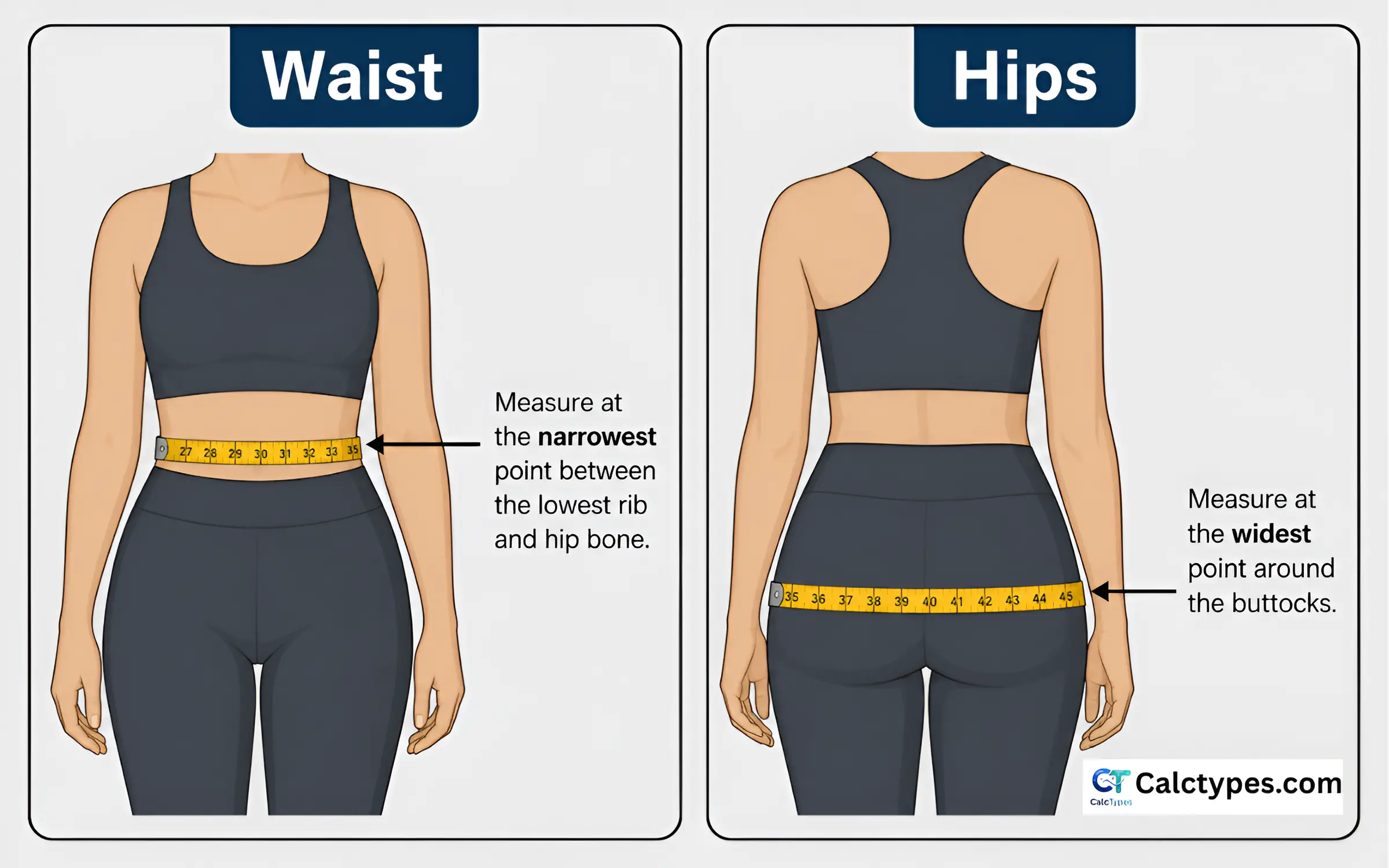
Measure your waist at the midpoint between your lowest rib and the top of your hip bone, and your hips at the widest part of your buttocks, keeping the tape level.
Accurate measurement matters more for WHR than for most other body metrics, because small errors in either number directly distort the ratio. For your waist, use a flexible tape measure and measure midway between the bottom of your lowest rib and the top of your hip bone, which is the point the WHO protocol uses. Some guides use the narrowest point of the torso instead; either is fine for tracking as long as you always use the same point. Measure standing, breathing out normally, without pulling the tape tight enough to compress the skin.
For your hip measurement, wrap the tape around the widest part of your buttocks and hips — this is usually a few inches below your waist. Keep the tape parallel to the floor all the way around, and avoid measuring over bulky clothing.
Take each measurement two to three times and use the average for the most reliable result. This calculator computes WHR the moment you enter both values, and the risk category updates automatically based on the sex toggle you select.
Is WHR more accurate than BMI?
WHR and BMI measure genuinely different things, so “more accurate” depends on what you’re trying to assess.
BMI estimates overall body size relative to height but says nothing about where fat is stored. WHR specifically captures fat distribution — and a growing body of research suggests that abdominal (visceral) fat carries disproportionately higher cardiometabolic risk than fat stored elsewhere, even at the same total body weight.
Some large studies, including research published in The Lancet, have found WHR to be a stronger predictor of heart attack risk across diverse populations than BMI alone, partly because WHR captures risk in people with “normal” BMI but high abdominal fat (sometimes informally called “skinny fat”).
In practice, the two metrics work best together rather than as competitors: BMI gives a quick overall-size screen, while WHR adds fat-distribution context. Check both your BMI and your WHR for a more complete risk picture.
What is a healthy waist-to-hip ratio?
Commonly cited low-risk ranges are below 0.80 for women and below 0.90 for men; the WHO links 0.85 or more (women) and 0.90 or more (men) with increased risk.
According to commonly cited clinical reference ranges, a “low risk” WHR is below 0.80 for women and below 0.90 for men. The World Health Organization’s official 2008 report uses a single increased-risk cutoff instead of three tiers: WHR at or above 0.85 for women, and at or above 0.90 for men, is classified as indicating increased risk of metabolic complications such as type 2 diabetes and cardiovascular disease.
The difference between men’s and women’s thresholds reflects normal biological differences in fat distribution patterns — women naturally tend to carry more fat around the hips and thighs (a “pear” pattern) prior to menopause, while men more often carry fat centrally around the abdomen (an “apple” pattern), which is why the risk thresholds are calibrated separately by sex.
If your WHR falls into the increased-risk category, it doesn’t mean an existing health problem — it’s a screening signal worth discussing with a healthcare provider, particularly alongside other risk factors like blood pressure and family history.
Can I improve my waist-to-hip ratio?
Yes, though it typically requires sustained lifestyle changes rather than a quick fix, and results vary by individual.
Since WHR is primarily driven by how much abdominal (visceral) fat you carry, reducing overall body fat through a combination of a modest calorie deficit and regular physical activity tends to reduce waist circumference specifically, since visceral fat often responds relatively well to consistent aerobic exercise and strength training compared to some other fat depots.
Notably, you cannot “spot reduce” fat from just the waist through targeted abdominal exercises alone — sit-ups and crunches build core muscle but don’t preferentially burn fat from that specific area. Overall fat loss, achieved gradually and sustainably, is what improves WHR over time.
For calorie planning to support gradual, sustainable fat loss, our TDEE Calculator can help estimate a reasonable starting point for a modest deficit.
How is WHR different from waist-to-height ratio?
Waist-to-hip ratio (WHR) compares your waist circumference to your hip circumference, screening specifically for fat distribution pattern (apple vs. pear shape).
Waist-to-height ratio (WHtR) instead compares waist circumference to your height, and some researchers argue it’s an even simpler, more universally applicable screening tool because it doesn’t require a separate hip measurement and applies a single easy-to-remember rule of thumb: keeping your waist circumference below half your height is associated with lower cardiometabolic risk across a wide range of body types and ages.
Both metrics aim to capture abdominal fat risk that BMI misses, but they use different reference points. If you want to compare both for yourself, try our Waist-to-Height Ratio Calculator alongside this WHR tool.
Sources & Further Reading
Limitations & Disclaimer
Methodology: How This Calculator Works
The waist-to-hip ratio is your waist circumference divided by your hip circumference, using the same unit for both. The result is compared with the three-band risk table shown on this page (low, moderate and high, with separate bands for men and women), and the WHO single cut-off of 0.90 for men and 0.85 for women is noted for reference.
Assumptions
- Waist is measured midway between the lowest rib and the top of the hip bone, and hips at the widest point.
- You are an adult; the bands were developed in adult populations.
- Both measurements use the same unit and are taken relaxed, after breathing out.
Related Calculators
Disclaimer
Please read before relying on this page. The Waist-to-Hip Ratio Calculator compares your measurements with commonly cited risk bands and the WHO cutoffs. Results depend heavily on where and how you measure, and the bands were developed in specific populations. A high ratio is a reason to talk to a doctor, not a diagnosis of heart disease or diabetes.
Health. This is not medical, nutritional or diagnostic advice. In an emergency, call your local emergency number.
Your responsibility. Results are estimates for general information and education only, and nothing here is professional advice. You use this page at your own risk; to the fullest extent permitted by law, CalcTypes, its authors and reviewers accept no liability for loss, injury or damage arising from reliance on it. Spotted an error? Use “Report an issue” or our contact page. Full terms: Disclaimer · Terms of use.