Body Composition Guide: Body Fat %, BMI, Lean Mass & TDEE Explained
Body Composition Guide: Body Fat %, BMI, Lean Mass & TDEE Tools
This body composition guide helps you choose the right tool—body fat percentage, lean body mass (LBM), BMI, BMR, or TDEE—and shows how to track results in a way that’s consistent, realistic, and safe.
Medical Review
Department of Pathology, Aligarh Muslim University (A.M.U.), Aligarh
Reviewed this guide for appropriate educational framing of body composition concepts, limitations, and safe interpretation. No diagnostic or treatment claims are made.
On This Page
Where to Start (Based on Your Goal)
I want to track body fat / body composition
Choose one measurement method you can repeat and stick with it for a few weeks. If you can use a tape measure, the most practical starting point is usually the Navy body fat calculator.
Once you have a body fat % estimate, you can convert it into lean mass with the LBM calculator. This is helpful because many energy equations and strength-focused goals make more sense when you think in terms of lean mass rather than scale weight alone.
Best practice: measure under similar conditions (same time of day, similar hydration) and compare weekly averages.
I want to plan calories for weight change
Start with TDEE to estimate your maintenance calories. That number is the “planning anchor” most people actually need for day-to-day decisions.
You can also use the BMR calculator to compare formulas, but think of BMR as a component of the estimate— not a calorie target. Your real maintenance depends on movement, training, job activity, and consistency.
Use your estimate as a baseline and adjust gradually based on 2–3 week trends.
I only want a quick reference number (IBW/BMI)
Use BMI for a simple screening metric and IBW for a formula-based reference estimate.
These tools can be useful for a fast “where do I sit on a chart?” check, but they don’t directly measure fat, muscle, or health status. If you train, have higher muscle mass, or your body stores fat differently, BMI/IBW may not reflect your reality well.
What Each Tool Measures (and What It Doesn’t)
Body fat % (Navy / methods hub)
Body fat percentage is an estimate of how much of your body weight is fat mass. It’s popular because it feels more “real” than scale weight—especially when your weight isn’t changing much.
Good for: consistent trend tracking, pairing with waist measurements, and estimating lean body mass (LBM).
Not good for: treating a single number as precision. Different methods can disagree—sometimes by a lot.
Tools: Body fat % methods hub and Navy body fat.
Example: if your Navy estimate drops from 24% to 22% over 6–8 weeks with similar measuring conditions, that trend is usually more meaningful than whether the “true” value is 21% or 26%.
Lean body mass (LBM)
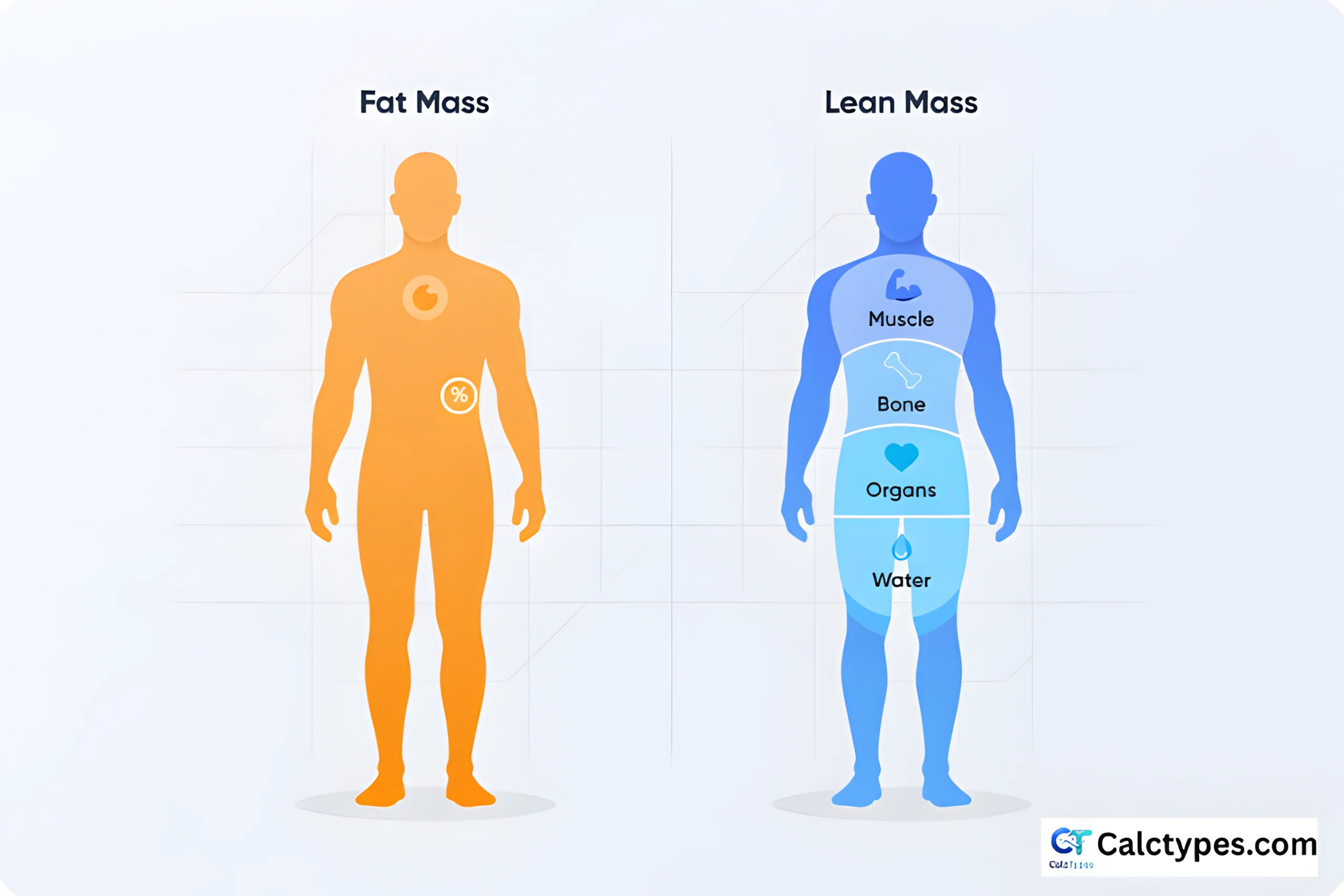
Lean body mass (LBM) is your body weight minus estimated fat mass. It includes muscle, bone, organs, and water. It’s useful because many performance and calorie-planning decisions relate more closely to lean mass than total weight.
Good for: understanding “recomposition” (fat down, lean tissue up), using LBM-based equations, and sanity-checking progress.
Not good for: over-interpreting small week-to-week changes—LBM is influenced by hydration and glycogen too.
Tool: LBM calculator.
Example: if weight stays flat but waist trends down and your estimated LBM trends slightly up, it may indicate recomposition rather than “no progress.”
BMR and TDEE
BMR is your estimated energy use at rest. TDEE is your estimated total daily energy use after activity, training, and day-to-day movement are accounted for. In real life, TDEE is usually the number you plan around.
Good for: setting a starting calorie baseline and making controlled adjustments.
Not good for: expecting a formula to match your exact daily burn—your real TDEE can vary based on sleep, stress, steps, training load, and adherence.
Tools: BMR calculator and TDEE calculator.
Example: if your estimated TDEE is 2,400 kcal/day, you might start a modest deficit at ~2,200 kcal/day and adjust after 2–3 weeks based on trends.
BMI and IBW
BMI is a height-to-weight ratio used as a population screening metric. IBW is a formula-based “reference weight” concept. Both can be useful for quick context, but neither measures composition.
Good for: fast comparisons and education.
Not good for: deciding what your body “should” weigh, especially if you lift, carry higher muscle mass, or have individual health considerations.
Tools: BMI calculator and IBW calculator.
A Practical Body Composition Tracking Workflow (With Examples)
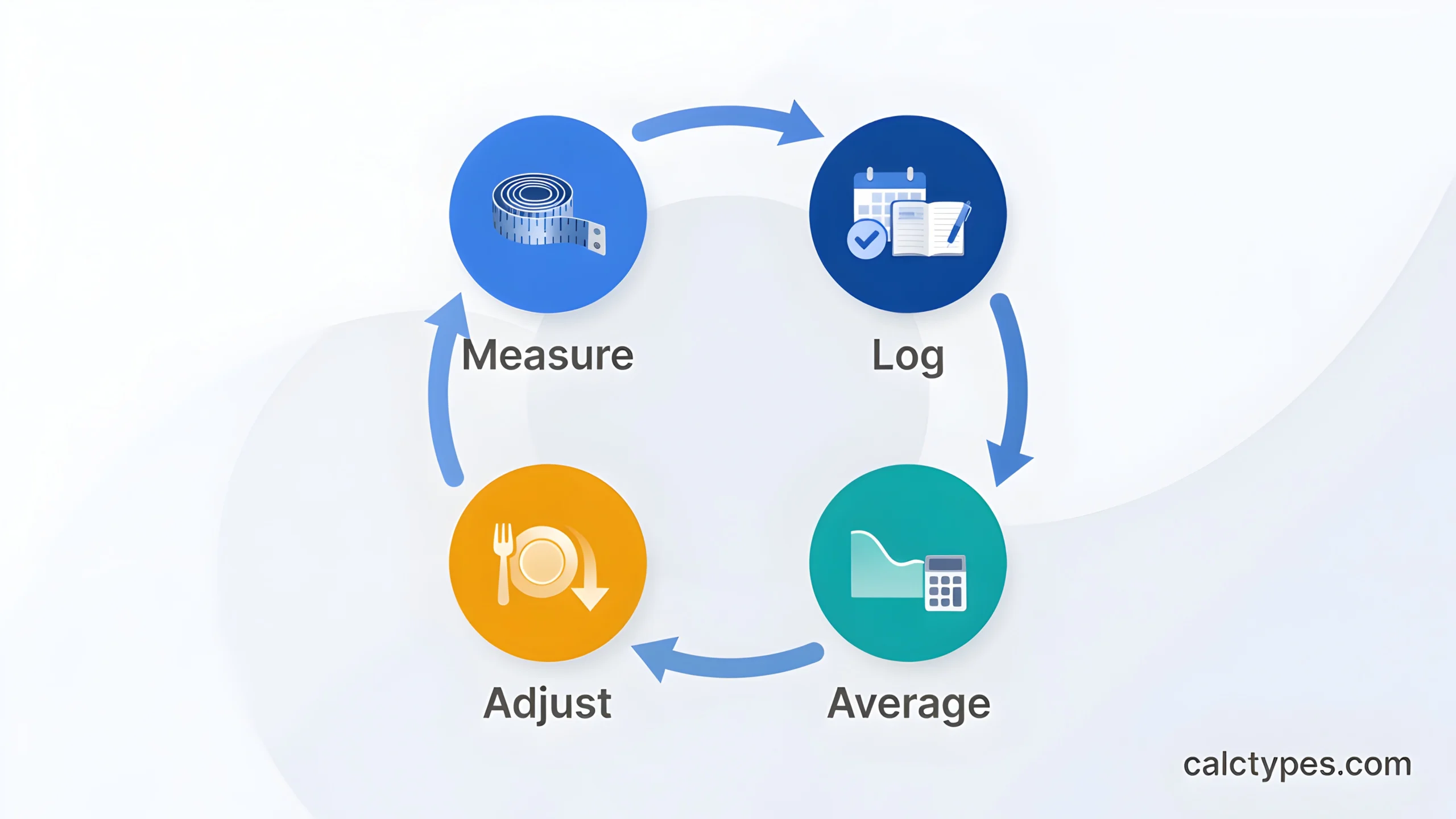
The best tracking system is the one you can follow consistently. The goal is to reduce noise (daily fluctuations) and focus on the direction of change. A good workflow combines one repeatable measurement method with simple trend rules and a slow feedback loop (usually 2–3 weeks before making major changes).
Step-by-step workflow
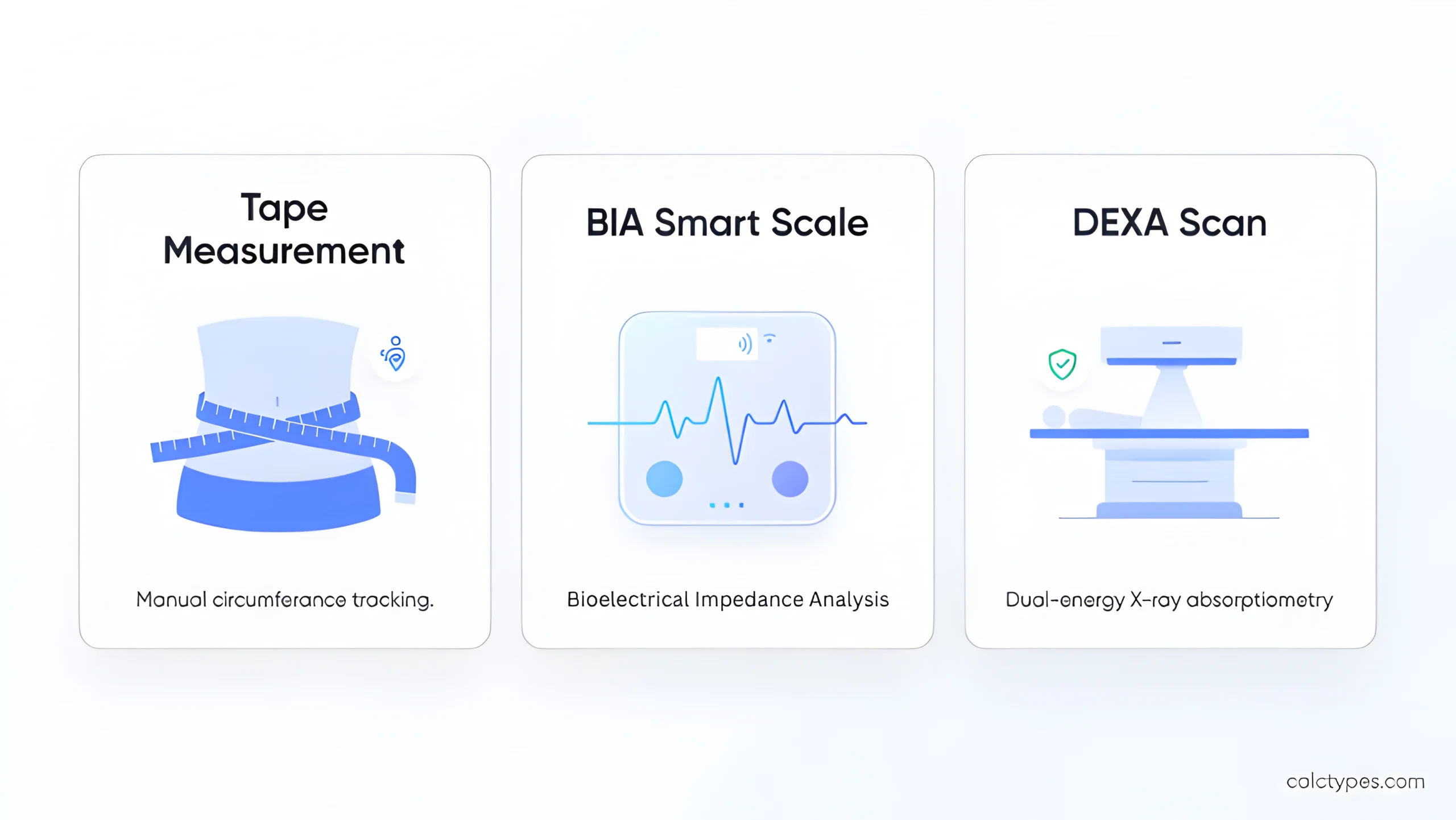
- Pick one method (Navy tape, consistent BIA scale, etc.) and commit for at least 6–8 weeks.
- Set a schedule: measure 1–2 times per week under similar conditions (morning, after bathroom, before food is a common choice).
- Track a weekly average instead of single readings (weight, waist, and your chosen body fat % method).
- Use TDEE for planning: start with TDEE, then make small adjustments only after trends are clear.
- Review every 2–3 weeks: decide whether to keep, nudge, or stop changes based on data + how you feel.
Example (simple and realistic)
Suppose your estimated TDEE is 2,400 kcal/day and you want slow fat loss. You start at 2,200 kcal/day. Your scale weight bounces day to day, but your weekly average moves from 80.2 kg → 79.7 kg → 79.3 kg over three weeks, and your waist drops slightly. That’s a consistent trend—so you keep going, rather than changing the plan based on one noisy day.
If after three weeks your weekly average is flat and waist measurements aren’t changing, you make a small change: reduce by ~100–150 kcal/day or increase daily steps. Then you run the same review cycle again.
For deeper detail on method error and why different tools disagree, see Body fat percentage guide.
Common Body Composition Mistakes to Avoid (And What to Do Instead)
-
Switching methods too often.
If you move from tape → BIA → a different tape technique, you may create fake “progress” or fake “regress.”Do instead: pick one method and keep it the same for 6–8 weeks before deciding if it’s useful.
-
Reacting to single readings.
Hydration, sodium, sleep, stress, and glycogen can move the scale (and BIA) without meaningful fat change.Do instead: use weekly averages and compare 2–3 week blocks.
-
Using BMR as a calorie target.
BMR is “at rest.” Most people live above it, so eating near BMR can be unnecessarily aggressive.Do instead: plan using TDEE and adjust gradually.
-
Treating IBW as a requirement.
IBW is a formula reference, not your personal “should weigh.”Do instead: focus on function, health markers, and trends—and seek professional guidance if needed.
Questions People Ask
What is body composition?
Body composition is the breakdown of your body into major components—most commonly fat mass and fat-free mass (which includes muscle, bone, organs, and water). The reason it matters is simple: two people can weigh the same but look, perform, and feel very different depending on how much of that weight is fat versus lean tissue.
This is also why the scale can be confusing. If you start resistance training, you might gain some lean mass while losing fat mass. Your body weight could stay similar even though your waist measurement, photos, and strength improve. On the other hand, short-term weight changes can be driven by water, glycogen, sodium intake, stress, and sleep—none of which necessarily reflect “fat loss” or “fat gain.”
Practical example: Suppose your weight is unchanged for 3 weeks, but your waist measurement trends down and your calculated LBM trends up slightly. That can be consistent with recomposition (fat down, lean tissue up), even if the scale is “stuck.” Tools like Navy body fat and LBM are most useful when you repeat the same method under similar conditions and focus on the trend rather than any single reading.
Is body fat % better than BMI?
“Better” depends on the question you’re trying to answer. BMI is a simple height/weight screening metric used for population-level risk patterns. It’s quick, but it does not measure body fat directly—so it can be misleading for people with higher muscle mass, atypical fat distribution, or certain health conditions.
Body fat % attempts to estimate composition, which is closer to what many people actually care about. However, body fat % is also method-sensitive: the number you get depends on whether you used tape, a BIA scale, calipers, or a clinical method. That means you can’t always compare numbers across methods or devices.
Practical approach: use BMI as a quick reference and body fat % as a trend metric. If you choose body fat %, pick one method you can repeat (e.g., tape/Navy) and track weekly or biweekly averages. If BMI and body fat % disagree, the “best” next step is usually context: waist measurement trend, strength/performance, and (if needed) clinician input—rather than chasing one metric as truth.
How do I use body fat % to plan calories?
Body fat % can help you estimate lean body mass (LBM), which can be used in LBM-based equations like Katch–McArdle. The common workflow is: estimate body fat % → calculate LBM → estimate BMR (optional comparison) → plan intake using TDEE and real-world tracking.
The key is that even a good equation is still an estimate. Your daily energy expenditure changes with activity, sleep, stress, training load, and adherence—so your best “calorie plan” is usually anchored to TDEE and then adjusted based on multi-week outcomes. Think of body fat % and LBM as tools to improve your starting point and interpretation, not as a guaranteed precision lever.
Practical example: If your TDEE estimate is 2,400 kcal/day and you want slow fat loss, you might start around 2,150–2,250 kcal/day. Then track a 2–3 week average of scale weight (and optionally tape measurements). If your trend is flat, adjust by a small step (e.g., 100–150 kcal). If your trend drops too quickly and performance or recovery suffers, step calories up slightly. This approach usually outperforms chasing a “perfect” BMR number.
Sources
Methodology
This guide groups CalcTypes tools by common goals: (1) estimating body fat % and lean body mass, (2) using composition inputs in calorie equations, and (3) using quick reference metrics (BMI/IBW). Recommendations prioritize repeatability, trend tracking, and conservative interpretation.
Limitations & Disclaimer
Educational content only. Not medical or nutritional advice. Do not use these tools for diagnosis/treatment decisions or compliance/clearance requirements. If you are under 18, pregnant, have an eating disorder history, or manage a medical condition, seek professional guidance. Read the full disclaimer.