Ideal Body Weight (IBW) Calculator
Ideal Body Weight (IBW) Calculator
Ideal Body Weight calculator uses common reference formulas (Devine, Robinson, Miller, Hamwi) to calculate the ideal body weight. This is an educational estimate, not a personal medical target.
Related tools: BMI calculator, BMR calculator, and TDEE calculator.
Your Details
Your Results
✅ Next Steps
Assumptions & Warnings
📊 IBW vs Current Weight
🧾 Calculation Steps
These steps show the exact workflow the calculator uses: convert height → apply your selected formula → convert units (if needed) → optionally compare to your current weight.
📋 Detailed Breakdown
| Parameter | Value |
|---|---|
| Enter your details to see the breakdown. | |
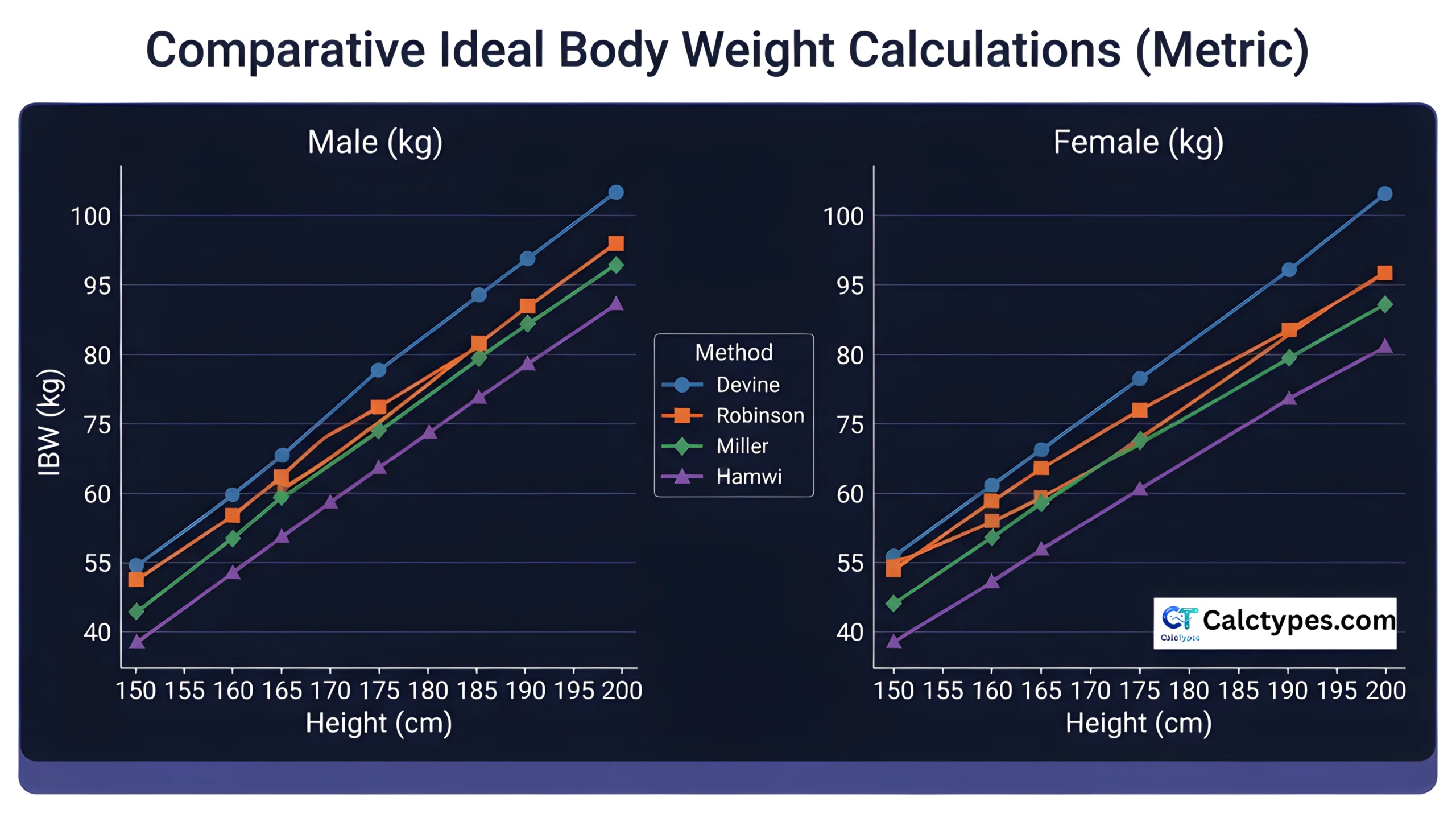
IBW formulas explained (Devine, Robinson, Miller, Hamwi)
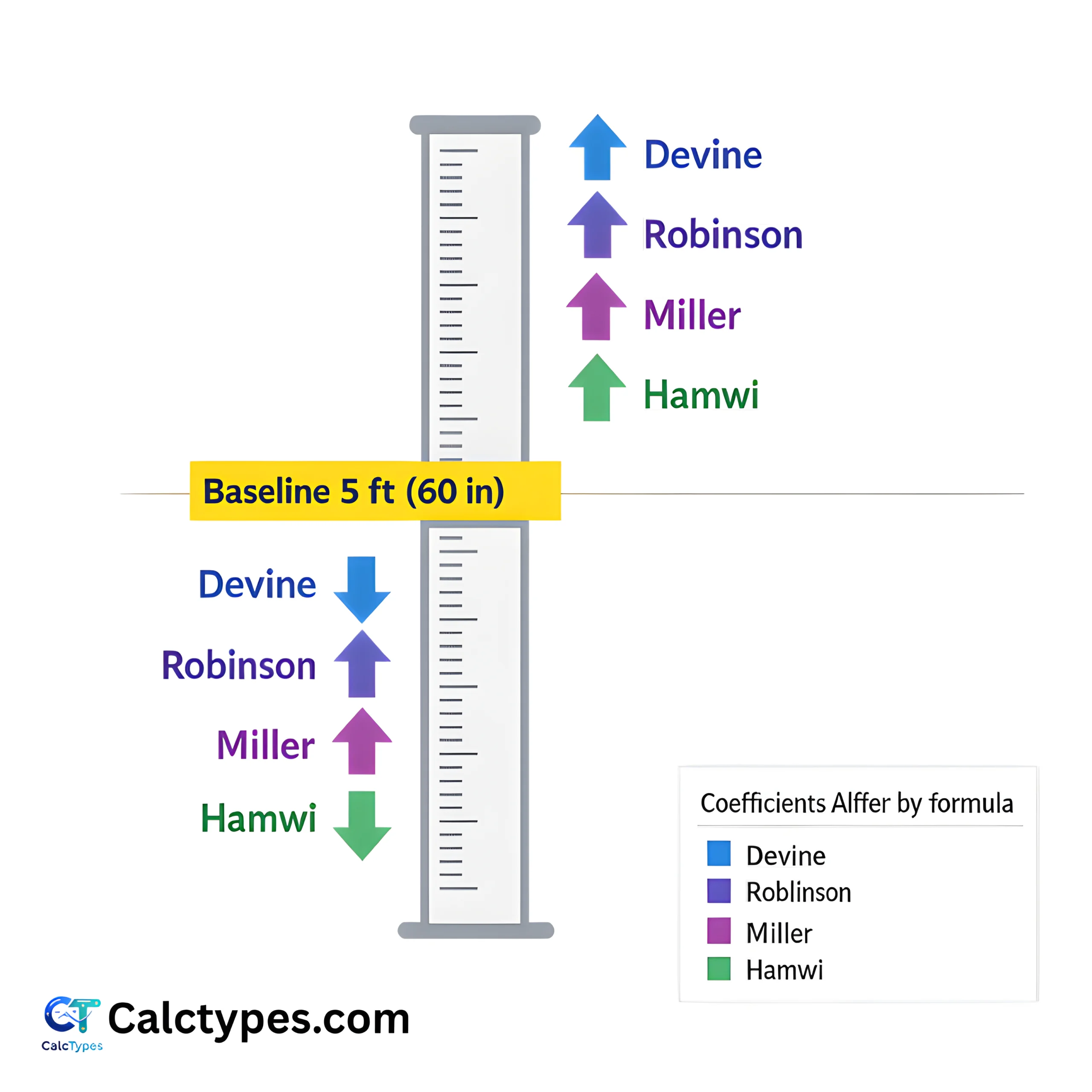
“Ideal body weight” (IBW) formulas are reference equations that estimate a typical weight from height (and sex) using a baseline at 5 ft (60 inches) plus an adjustment for each inch above (or below) that baseline. They were created decades ago as quick, practical tools—not as modern personalized targets.
Practical takeaway: use IBW as a reference range and combine it with context (body composition, health markers, goals), rather than treating one formula as “the truth.”
Devine formula (1974) — why it’s often the default
Devine is the most commonly referenced IBW formula in clinical and health-tool contexts, largely because it’s simple and became widely adopted. It uses a baseline at 60 inches (5 ft) and adds a fixed kg-per-inch value above that. Many calculators use Devine as the default because it’s a familiar reference point—but that doesn’t automatically make it “more accurate” for every person.
How to use it well: treat Devine as a quick benchmark, then compare against Robinson/Miller/Hamwi to see how much the estimate can vary. If those formulas cluster closely, your “reference range” is tighter. If they spread out, that’s a sign you should lean more on individualized context.
Robinson formula (1983) — a different coefficient set
Robinson modifies the baseline and per-inch coefficients compared with Devine. In practice, this often produces a slightly different IBW estimate for the same height—sometimes a bit lower or higher depending on sex and height range.
Why it matters: seeing Robinson alongside Devine helps you avoid anchoring bias. If your goal is education and planning, viewing multiple formulas is usually more informative than “picking the right one.”
Miller formula (1983) — commonly used in tools for comparison
Miller is another widely cited IBW equation that uses different baselines and per-inch increments. Depending on your height, it can produce an estimate that is meaningfully different from Devine and Robinson.
Best use: treat Miller as another point in the “IBW range.” If Miller is consistently higher (or lower) than the others for your inputs, it’s a reminder that IBW is not a single fixed truth—it’s a reference framework.
Hamwi formula (1964) — originally expressed in pounds
Hamwi is one of the older references and was traditionally taught in pounds (lb) using a baseline at 5 ft and a per-inch addition above that. This calculator computes it in lb first and then converts to kg when needed.
Why include it: many educational and dietetics contexts still reference Hamwi, so it’s useful for cross-checking and historical continuity— but, like the others, it does not account for body composition or modern individualized assessment.
Limitations (important)
- Not a medical target: IBW is a reference estimate and may not match an individual’s healthiest weight.
- Doesn’t measure body composition: athletes or muscular people can be “above IBW” and still be very healthy.
- Edge heights: very short or very tall heights may reduce formula fit.
- Not for clinical decisions: do not use as a standalone basis for diagnosis, treatment, medication dosing, or clearance/compliance decisions.
Read: CalcTypes Disclaimer.
Methodology (how we calculate IBW)
This calculator follows the classic IBW workflow used in most educational tools:
- Normalize height into inches (because most IBW formulas are inch-based).
- Compute inches over 5 ft using: inchesOver = heightInches − 60.
- Apply the selected formula using its baseline and “per inch” coefficient (Devine/Robinson/Miller), or Hamwi’s lb-based rule.
- Convert units for display (kg ↔ lb) depending on your selected unit system.
- If current weight is entered, compute difference and % of IBW for an educational comparison.
Rounding: display values are rounded for readability; internal math uses standard floating-point arithmetic.
Questions people ask
What is ideal body weight (IBW)?
Ideal body weight (IBW) is a reference estimate produced by simple equations that use your height and—depending on the formula—your sex. The key word is “reference.” IBW is not a diagnosis, not a measure of health, and not a personalized medical target. It’s best understood as a quick benchmark that can help you compare results across different formulas and get a general sense of how those formulas “expect” weight to scale with height.
Historically, IBW formulas were designed for practicality: they convert height into inches, anchor on a baseline at 5 ft (60 inches), then apply a per-inch adjustment above (or below) that baseline. Because the input is limited to height (and sex), IBW cannot account for the biggest variables that shape a healthy weight in real life: body composition (muscle vs fat), frame size, training status, age-related changes, and medical context. Two people can have the same height and the same calculated IBW while having very different physiques and health profiles.
A good way to use IBW is to treat it as “reference range + context.” If multiple formulas cluster close together, the reference range is tighter. If they diverge, that’s useful information too: it signals that “IBW” depends on the model, and you should rely more on individualized context and professional guidance when needed.
What is the Devine formula (and why do many calculators use it)?
The Devine formula is one of the most widely cited IBW equations in educational and clinical-adjacent tools. Like most IBW formulas, it uses a baseline at 5 ft (60 inches) and then adds (or subtracts) a fixed amount per inch above (or below) that baseline. Many calculators use Devine as the default not because it is “perfect,” but because it is simple, well-known, and consistently implemented across many references.
It’s important to separate “common” from “best.” Devine is often used as a starting point—especially when someone wants a quick reference estimate—but different formulas were published with different coefficients and assumptions, so you can get different numbers for the same height. That’s why your calculator allows switching between Devine, Robinson, Miller, and Hamwi: it encourages you to think in terms of a range, not a single “correct” number.
Practical example (conceptual): suppose one formula gives an IBW near 70 kg and another gives an IBW near 67 kg for the same height. The more responsible takeaway is “my reference range is roughly high-60s to low-70s kg,” then you interpret that range with factors IBW ignores (strength training, body fat, health markers, goals), instead of trying to force your body into a single-point target.
Which IBW formula is most accurate?
There is no single “most accurate” IBW formula for every person, because accuracy depends on what you mean by accurate. These equations were not built to measure your body fat percentage, your muscle mass, your frame size, or your health risk. They were designed to produce a quick reference estimate from limited inputs. As a result, Devine, Robinson, Miller, and Hamwi are best viewed as models—and different models can reasonably output different numbers.
A practical way to evaluate “accuracy” on an IBW calculator page is to treat each formula as a reference point and look at how tightly they cluster. If all four results are close, you can say the formulas broadly agree for your height. If they differ more, that is valuable information too: it means your “IBW” depends on the chosen model, so you should be cautious about treating any single output as a goal.
For planning, it often helps to shift from “What weight should I be?” to “What input can I adjust sustainably?” For example, you can estimate energy needs using the BMR calculator and TDEE calculator, then adjust based on real-world trends. IBW can provide context, but it should not replace individualized assessment.
Is IBW the same as a healthy weight range or BMI?
No—IBW is not the same as a healthy weight range, and it is not the same as BMI. IBW formulas produce a reference estimate (often a single number per formula) from height and sex. BMI, on the other hand, is calculated from height and weight and is used to categorize weight status at the population level. Neither method directly measures body composition, and neither automatically tells you what is best for your body.
Conceptually, BMI is often used to produce a range of weights because BMI categories (or “healthy BMI” bands) span multiple values. IBW formulas often feel more “precise” because they output one number—yet that precision can be misleading. A single IBW number can create unnecessary pressure even though the method is fundamentally approximate.
A safer interpretation workflow is: (1) calculate IBW as a reference estimate, (2) compare it with broader indicators (BMI category, waist measurements if relevant, fitness/performance, clinical markers when appropriate), and (3) interpret it through your real-world context (training, medical history, goals). IBW can support education, but it shouldn’t be treated as a personal prescription.
Should I aim to reach my IBW?
Not necessarily. One of the most common pitfalls with IBW calculators is turning a reference estimate into a strict personal goal. Because IBW formulas do not account for muscle mass, frame size, age, training status, or medical context, aiming to “hit” the number can be inappropriate for many people—especially athletes, strength trainees, and individuals whose healthy weight naturally sits outside the formula’s assumptions.
A more responsible way to use IBW is as a conversation starter or a planning reference. If you’re thinking about weight change, outcomes that are more directly tied to health and function (energy, sleep, strength, endurance, relevant lab markers, mental wellbeing, and clinician guidance when needed) typically matter more than any single formula output.
Example (only when needed): if your current weight differs from IBW by a small amount, that difference may be meaningless without context. Even a larger difference does not, by itself, tell you whether weight change is appropriate. IBW can help you organize questions—but it should not override individualized medical or nutrition advice.
Why does IBW differ between Devine, Robinson, Miller, and Hamwi?
The formulas differ because each one uses a different combination of baseline weight at 5 ft (60 inches) and a different per-inch adjustment above (or below) that baseline. Those coefficients were published in different eras and contexts and were not meant to produce identical results. When you switch formulas, you are switching the model—and it’s expected that the estimate can change.
Think of it like using different map projections: each projection is valid for certain purposes but can distort distances differently. Similarly, IBW formulas can be “reasonable” in a broad sense while still disagreeing at the individual level. That’s why this calculator includes multiple methods: it encourages you to view IBW as a range of reference estimates, not a single definitive truth.
Practical use: if the spread between formulas is small for your height, you can treat the result as a tighter reference range. If the spread is larger, interpret IBW more cautiously and lean more on individualized context and professional guidance.
Can athletes or muscular people use IBW?
Athletes and muscular individuals can use IBW calculators, but they should do so with extra caution. IBW formulas do not measure or “credit” lean mass, and muscle is dense. This means someone who strength trains may appear “above IBW” while being metabolically healthy, highly fit, and within a perfectly appropriate weight for their body composition.
For athletes, IBW is often more useful as an educational contrast—showing why single-number targets can be misleading—than as a goal. If you train, performance outcomes (strength numbers, endurance, recovery, injury resilience), along with body composition assessment (if available) and health markers, are typically more informative than a height-only estimate.
Practical approach: treat IBW as a reference point you can compare against other indicators (how you perform, how you feel, medical context). If you notice tension between IBW and your performance/health indicators, it’s usually IBW—not your performance—that is the limited metric.
What is adjusted body weight (and is it the same as IBW)?
Adjusted body weight is a separate concept sometimes used in certain clinical calculations when a person’s actual body weight is far from IBW and a “blended” estimate is needed for a specific equation. It is not the same as IBW. IBW is produced directly from height (and sex) using an IBW formula. Adjusted body weight, when used, is typically derived by combining IBW with actual body weight using a factor.
The key point is context: adjusted body weight is not a general fitness or lifestyle tool, and it should not be used casually as a “better goal weight.” Outside of the specific scenarios where a clinician or dietitian chooses it for a defined calculation, it can easily be misapplied or misunderstood.
If you encountered the term “adjusted body weight” because of a clinical situation, the safest interpretation is to treat it as calculation-specific and ask a qualified professional how and why it is being used. For general planning, a simpler and more actionable workflow is usually to estimate needs with BMR → TDEE and adjust using trends.
What are common mistakes when using an IBW calculator?
The most common mistake is treating IBW as a strict requirement—something you “must” reach—rather than a reference estimate. This can create unnecessary pressure and can encourage unhelpful comparisons, especially when the formula output doesn’t reflect your real body composition or life context.
Other frequent mistakes include ignoring body composition (IBW cannot tell muscle from fat), using the number for clinical decisions without professional oversight, and assuming the “difference vs current weight” is a prescription. That “difference” is only the distance between your current weight and a formula estimate; it does not tell you whether changing weight is appropriate, safe, or necessary.
A more responsible approach is:
Sources & Further Reading
- Ideal Body Weight: What You Need to Know
- Statement on Ideal Body Weight
- For planning calories instead of target weights, see: BMR calculator and TDEE calculator.
Disclaimer (read before use)
Educational estimate only — not medical advice. This calculator provides reference estimates based on historical IBW formulas. Do not use results for diagnosis, treatment, medication dosing, medical clearance, legal/compliance requirements, or as a substitute for professional care.
If you are under 18, pregnant, have an eating disorder history, or are managing a medical condition, discuss any weight-related decisions with a qualified clinician. Read the full policy: CalcTypes Disclaimer.
Report an Issue
Spotted an error or have feedback on this calculator? Let us know below.