Ideal Weight vs Healthy Weight: What’s the Difference?
Ideal Weight vs Healthy Weight
“Ideal weight” is typically a formula-based reference number (often called IBW). “Healthy weight” is broader—shaped by body composition, metabolic health markers, physical function, lifestyle, and sustainability. This guide explains the difference and how to use each tool responsibly.
Medical review
What “ideal weight” usually means
In most online tools—and in some clinical shorthand—“ideal weight” refers to a formula-based reference estimate derived primarily from height (and sometimes sex). One of the most commonly cited equations is the Devine formula (1974), which was developed in the context of medication dosing discussions rather than as a holistic definition of health. Other well-known equations include Robinson (1983), Miller (1983), and Hamwi (1964).
These formulas share a common feature: they take height as the main input and return a single-number output. That simplicity is useful for reference and education, but it also means the number cannot represent the full clinical picture for an individual.
What IBW formulas do not account for
- Lean muscle mass and body composition (athletes and sedentary individuals can share the same output)
- Bone density and frame size (only some approaches attempt rough adjustments)
- Medical history and health conditions (IBW is not diagnostic)
- Age-related body changes and demographic differences in reference populations
- Psychological wellbeing and sustainability (a formula number may not be achievable or desirable)
Use the Ideal Body Weight (IBW) calculator to see your formula reference—but treat the result as a reference point for planning and discussion, not a “required target.”

What “healthy weight” means (more than a number)
“Healthy weight” is not one precise target—it is typically best understood as a range plus context. Clinically, it’s often described as the weight range associated with lower risk of weight-related health conditions while remaining sustainable and compatible with good physical and psychological function.
Many public health organizations define healthy weight ranges using BMI categories (for adults, 18.5–24.9 is commonly described as “normal”), while also noting BMI’s limitations: it is a population screening tool and does not directly measure fat mass, lean mass, or individual-level risk.
What contributes to a healthy weight (beyond the scale)
- Body composition: lean mass vs fat mass
- Metabolic health markers: blood pressure, glucose, lipid profile (interpreted with a clinician)
- Physical function: strength, endurance, mobility, daily activity capacity
- Fat distribution: waist circumference / central adiposity as a separate risk signal
- Sleep and stress: influences appetite regulation and recovery
- Dietary patterns: consistency and sustainability matter more than short-term restriction
- Psychological wellbeing: a “healthy” weight is maintainable without distress or disordered behaviors
Ideal weight vs healthy weight: side by side
| Feature | Ideal Weight (IBW) | Healthy Weight |
|---|---|---|
| How it’s determined | Formula from height (often includes sex) | Multiple clinical and personal factors |
| Accounts for body composition | No | Yes (when assessed) |
| Individualized | No—population-derived shortcut | More individualized and context-driven |
| Includes metabolic markers | No | Yes |
| Best used for | Reference / education | Health planning (often with professional guidance) |
| Tools | IBW calculator | BMI, BMR, TDEE |
Which tools to use (and what they’re good for)
No single calculator replaces professional assessment. Used correctly, these tools help you understand reference ranges, estimate energy needs, and create practical starting points for planning.
IBW calculator — formula reference
The IBW calculator applies standard formulas (commonly Devine, Robinson, Miller, and Hamwi) to produce a height-based reference weight. It’s best used for education and comparison—not as a stand-alone health target. In clinical settings, IBW may also appear in medication dosing conversations (to be guided by a pharmacist/physician).
BMI calculator — population screening
The BMI calculator computes BMI from height and weight. BMI is widely used at the population level, but it is not a direct measure of body fat and can misclassify muscular individuals (higher BMI due to lean mass). Use BMI as one data point—not a conclusion.
BMR + TDEE calculators — energy needs
The BMR calculator estimates energy needs at rest. The TDEE calculator adds activity to estimate maintenance calories. For many people, energy needs are more actionable than chasing a single target weight: you can plan a modest, sustainable deficit/surplus and evaluate progress over weeks.
LBM + composition-aware tools — context (when you have body fat %)
The Lean Body Mass (LBM) calculator and the Katch–McArdle BMR calculator incorporate body fat percentage into estimates, helping explain why two people at the same weight can have different energy needs and different risk profiles.
A safer planning workflow (education-first)
If you’re using weight tools for personal planning, this workflow puts reference numbers in proper context and keeps the focus on actionable, sustainable habits.
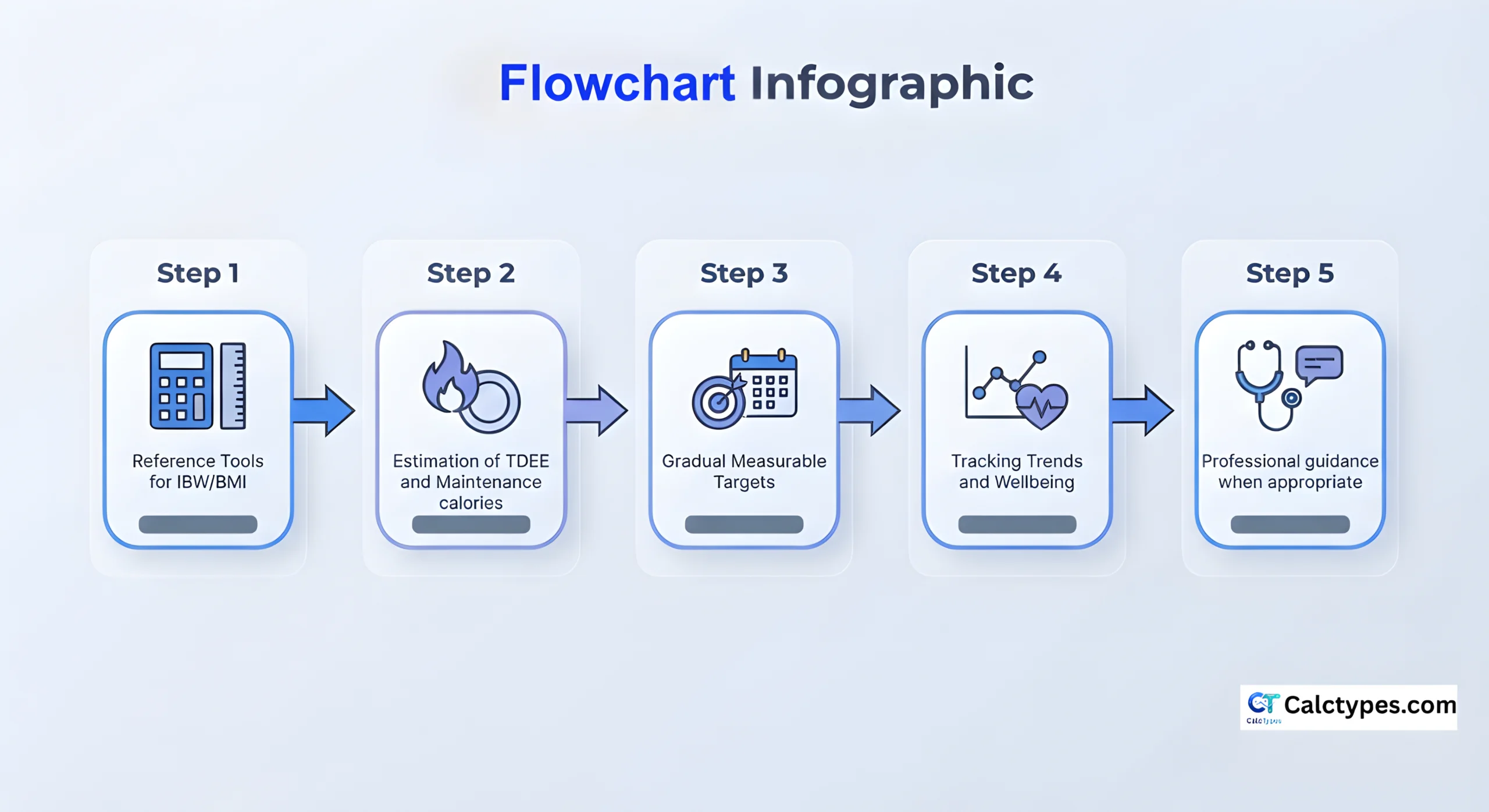
Step 1 — Use IBW and BMI as reference, not requirements
Check your formula reference using the IBW calculator and your BMI range using the BMI calculator. Note where you fall relative to population ranges, but don’t treat these numbers as goals by themselves.
Step 2 — Estimate daily calorie needs (maintenance)
Use the TDEE calculator to estimate maintenance calories. This often becomes more actionable than a target scale number: you can work with “maintenance is about Y calories” and make a small, consistent adjustment over time.
Step 3 — Set gradual, measurable targets
Sustainable change is typically measured in weeks and months, not days. Track trends using weekly average weight (not single weigh-ins), and pair scale data with performance, recovery, and adherence signals.
Step 4 — Adjust based on real-world wellbeing
Monitor energy, sleep quality, training performance, and plan adherence. If these deteriorate significantly, reconsider timeline and intensity. “Pushing harder” toward a number is not the same as moving toward better health.
Step 5 — Seek professional input when appropriate
Consult a qualified professional if you’re under 18, pregnant/breastfeeding, managing conditions like diabetes/thyroid/cardiovascular disease, have an eating disorder history, or if weight concerns affect mental health.
Questions people ask
Is ideal weight the same as healthy weight?
No—and the distinction matters. “Ideal weight” in most online tools refers to a formula-based reference number derived from height (and sometimes sex). A common example is the Devine (1974) equation, which is often discussed in the historical context of clinical dosing rather than being designed as a personal health goal. The output is a single number; it cannot reflect your body composition, fat distribution, training status, medical history, or sustainability.
“Healthy weight,” by contrast, is a range with clinical and personal context. It’s associated with lower risk of weight-related conditions, while also considering physical function and psychological wellbeing. Two people can share the same scale weight but have very different health profiles depending on body composition, metabolic markers, and lifestyle habits.
Practical approach: use the IBW calculator for a reference number, then interpret it alongside broader tools (BMI/TDEE and body-composition context when available). Neither an IBW result nor a BMI category is a diagnosis.
Should I try to reach my IBW?
Not necessarily—and sometimes aiming for an IBW target can be counterproductive. IBW formulas are population-derived shortcuts and don’t account for lean mass, frame size, age-related changes, or the metabolic adaptations that occur during significant weight change.
Example: a strength-trained person may sit well above formula-derived IBW while having excellent cardiometabolic markers and high functional capacity. Pushing toward an IBW number in that context may mean losing lean mass—which is often not desirable.
For most people, a more practical plan is to use the TDEE calculator to estimate maintenance calories, set a modest deficit or surplus based on goals, and track trends over 4–8 weeks. Monitor recovery, performance, sleep, and adherence—these often reflect progress better than chasing a single formula output. If you have clinical requirements, follow your clinician’s guidance.
What if my BMI says I’m overweight but I’m muscular?
This is a known limitation of BMI. BMI is calculated from height and weight only and cannot distinguish fat mass from lean mass. A kilogram of muscle and a kilogram of fat contribute equally to BMI even though their health implications differ.
As a result, muscular individuals can fall into “overweight” or even higher BMI categories despite low body fat and strong health markers. This doesn’t mean BMI is “wrong”—it means BMI is a population screening metric, not an individual diagnostic tool.
In these cases, additional context matters: waist circumference, body fat percentage, blood pressure, glucose/lipids, and functional capacity. If you have body fat % available, tools like the LBM calculator and Katch–McArdle BMR calculator provide more composition-aware estimates.
What’s a better goal than a scale number?
For many people, habit-based and function-based goals produce better long-term outcomes than scale-only targets. Daily weight can fluctuate with hydration, food volume, sodium, stress, and hormonal cycles—so a daily number can create unnecessary pressure.
Practical alternatives include: waist circumference trends, strength/endurance benchmarks, consistency with a calorie target relative to TDEE, weekly average weight trends, improvements in markers like blood pressure/glucose, and better sleep/energy.
Use the BMR calculator and TDEE calculator to anchor a plan, and use the scale as one data point among several—tracked over time.
Methodology
This guide synthesizes commonly cited IBW formula context and widely used public health framing for BMI and healthy weight. No proprietary data or original research is presented. Calculator links provide estimate outputs; each tool has its own assumptions and limitations.
Limitations
- IBW is a formula reference; it does not individualize for body composition, age, or medical context.
- BMI does not distinguish lean mass from fat mass and may misclassify muscular individuals.
- BMR/TDEE are estimates; real-world trends and wellbeing should guide adjustments.
- Educational content only—see the full disclaimer.
Sources
- World Health Organization — Obesity and Overweight (Fact Sheet)
- Centers for Disease Control and Prevention — About Adult BMI
- Universal equation for estimating ideal body weight and body weight at any BMI
Note: Source links open in a new tab. External content may change over time.