BMI Calculator (Adult)
BMI Calculator — Body Mass Index & Healthy Weight Range
Calculate your Body Mass Index (BMI) instantly using the standard BMI formula. Enter your height and weight in metric (kg/cm) or imperial (lb/ft/in) units to see your BMI category, healthy weight range, and how much you may need to gain or lose. For adults 18 years and older.
This tool is part of our Health Calculators collection. For kids and teens ages 2–19, use our child BMI calculator. For body composition beyond BMI, try our Body Fat Calculator.
Quick takeaway
For most adults, a BMI between 18.5 and 24.9 falls in the WHO “healthy weight” range. BMI is a fast screening number, not a diagnosis — it doesn’t distinguish muscle from fat. Athletes, older adults, and some ethnic groups (e.g., South Asian populations, where risk can rise from ~23) should interpret their number with extra context. Pair BMI with a body fat percentage estimate or waist measurement for a fuller picture.
Your Measurements
Your Results
✅ Next Steps
Assumptions & Limitations
📊 BMI Category Comparison
📋 Calculation Breakdown
| Item | Value |
|---|---|
| Enter your measurements to see the breakdown. | |
How to Use This BMI Calculator
Using this BMI calculator is simple:
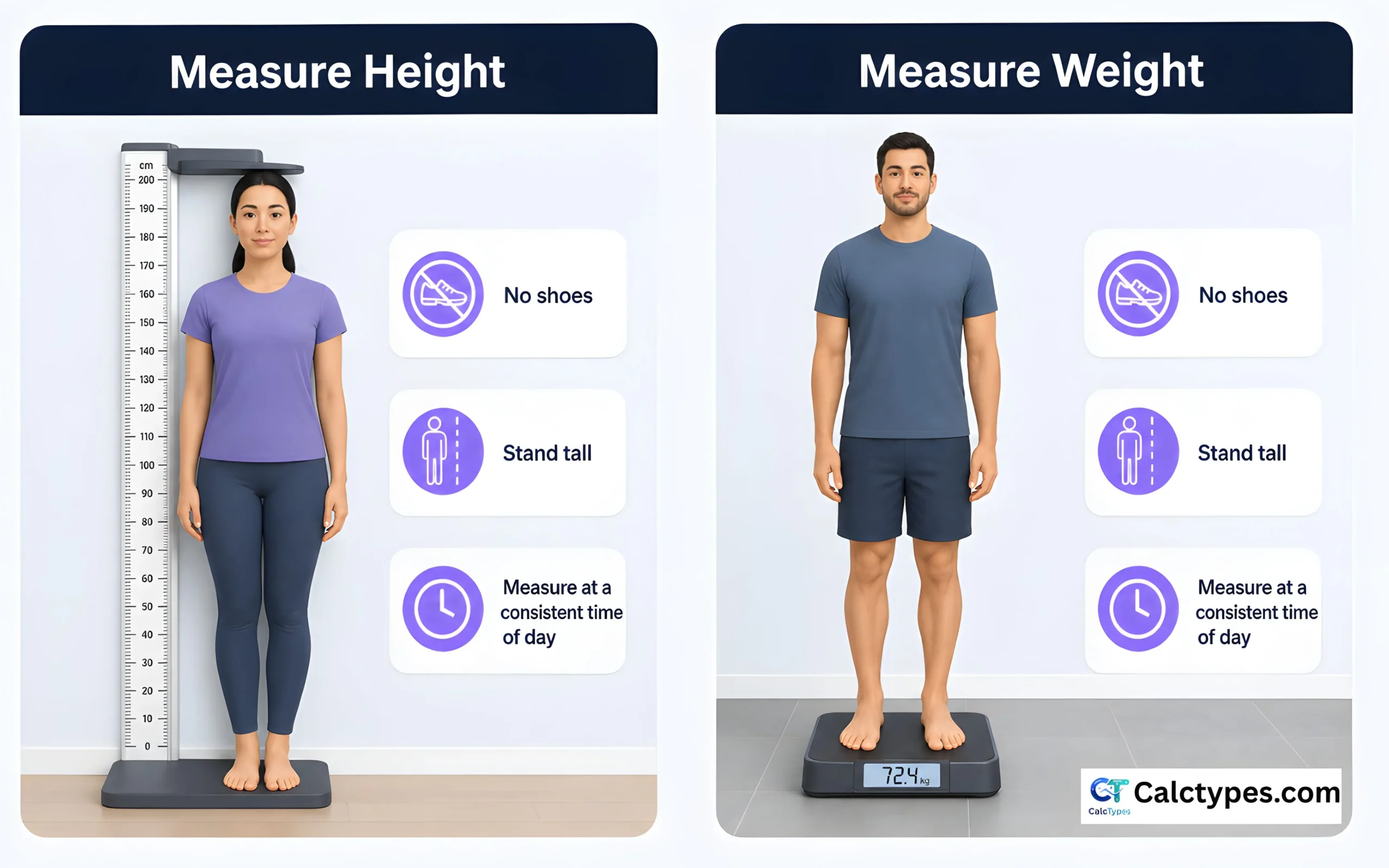
- Select your preferred unit system — Metric (kg/cm) or Imperial (lb/ft/in).
- Enter your weight — your current body weight.
- Enter your height — cm for metric, or feet and inches for imperial.
- View your results — BMI, category, healthy weight range, and any recommended adjustment appear instantly.
The calculator updates automatically as you type. If you’re calculating for someone under 20, use our child & teen BMI calculator, which interprets results by age and sex percentile instead of fixed cutoffs.
What is BMI? The BMI Formula Explained
Body Mass Index (BMI) is a numerical value calculated from your weight and height. It’s a quick screening method — not a diagnostic tool — used to flag weight categories that may carry higher health risk.
The BMI formula is:
BMI = Weight (kg) ÷ Height² (m²)
For imperial units: BMI = 703 × Weight (lb) ÷ Height² (in²).
Worked example: a person weighing 70 kg with a height of 1.75 m has a BMI of 70 ÷ (1.75 × 1.75) = 70 ÷ 3.0625 = 22.9 — within the healthy range. Want to do this by hand for your own numbers step by step? See how to calculate BMI manually.
BMI Categories Explained (WHO Classification)
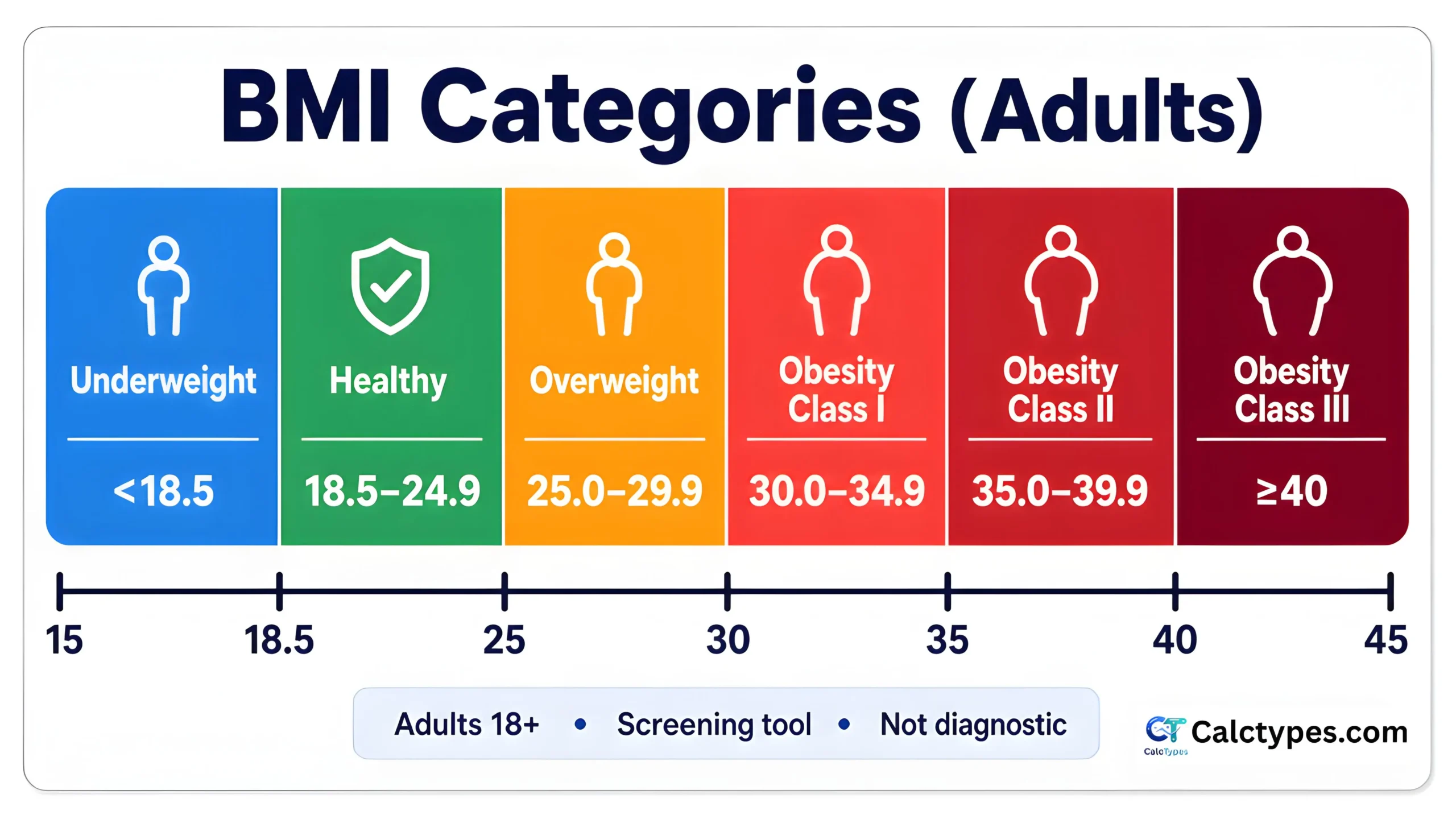
The World Health Organization (WHO) defines the following BMI categories for adults:
- Underweight (BMI < 18.5): May indicate nutritional deficiency or underlying health issues.
- Healthy weight (BMI 18.5–24.9): Generally associated with lower risk of weight-related health problems.
- Overweight (BMI 25.0–29.9): May increase risk for certain health conditions.
- Obesity (BMI ≥ 30.0): Associated with higher risk for heart disease, diabetes, and joint problems.
Want the exact BMI Prime and Ponderal Index numbers alongside your category? See our BMI Prime calculator.
BMI Alternatives & Related Body Composition Metrics
BMI is a useful starting point, but it’s just one lens. These related metrics can give you a fuller picture — especially if your BMI result surprises you:
Healthy Weight Range: How It’s Calculated
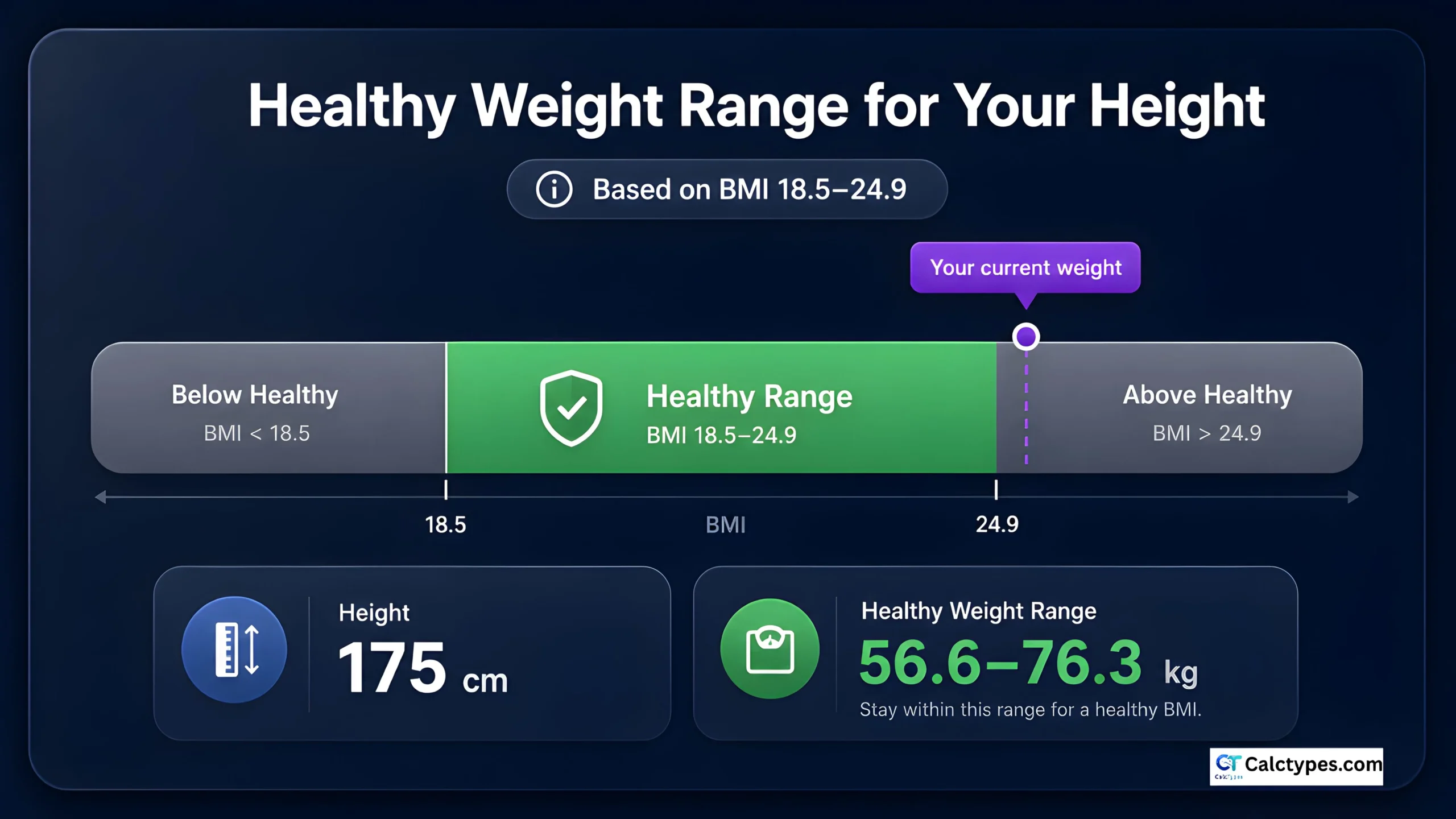
This calculator shows your healthy weight range based on the BMI range of 18.5 to 24.9 — the weight boundaries that would keep your BMI within the “healthy” category at your current height.
If your current weight falls outside this range, the calculator shows how much weight you may need to gain or lose to reach the healthy BMI zone. These are general population-level guidelines — your individually appropriate weight depends on muscle mass, frame size, age, and overall health.
Questions People Ask
Detailed, plain-English answers covering the BMI formula, accuracy limits, and related metrics — everything you need in one place.
How do I calculate my BMI manually?
Calculating BMI by hand is straightforward once you know the formula and keep your units consistent. In metric units, the formula is BMI = weight (kg) ÷ height² (m²). First, convert your height from centimeters to meters by dividing by 100 (for example, 175 cm becomes 1.75 m). Next, square that height value (1.75 × 1.75 = 3.0625). Finally, divide your weight in kilograms by that squared height value.
Worked example: a person weighing 68 kg at a height of 1.65 m would calculate BMI as 68 ÷ (1.65 × 1.65) = 68 ÷ 2.7225 = 24.98, which sits right at the upper edge of the healthy range.
If you’re working in imperial units (pounds and inches), the formula changes slightly to include a conversion constant: BMI = 703 × weight (lb) ÷ height² (in²). For someone weighing 154 lb at 69 inches tall: 703 × 154 ÷ (69 × 69) = 108,262 ÷ 4,761 = 22.7.
For a full worked breakdown with more examples across different heights and weights, see our dedicated guide: how to calculate BMI manually. Or, to skip the manual math entirely, use the calculator at the top of this page — it applies the same formula instantly and shows you the full calculation in the breakdown table.
What is the BMI formula for adults (metric and imperial)?
The BMI formula was originally developed in the 1830s by Belgian mathematician Adolphe Quetelet, which is why BMI is sometimes still called the “Quetelet Index.” The modern adult formula comes in two equivalent versions depending on your unit system.
Metric version: BMI = weight in kilograms ÷ (height in meters)². This is the version used internationally and by the WHO.
Imperial (US) version: BMI = 703 × weight in pounds ÷ (height in inches)². The 703 constant exists purely to convert pounds and inches into an equivalent kg/m² result, so both formulas produce the same BMI number for the same person.
Importantly, this formula is identical for men and women, and identical across all adult ages (18+) — the WHO adult cutoffs (18.5, 25, 30) don’t change based on sex or age within the adult range, unlike the percentile-based system used for children and teens. This calculator applies the exact same formula automatically once you enter your measurements, and shows the formula substitution with your actual numbers in the “Calculation Breakdown” table above.
What is a healthy BMI for my height and weight?
A “healthy” BMI for an adult of any height is anywhere between 18.5 and 24.9 — this range doesn’t change based on how tall or short you are, because BMI already accounts for height by dividing weight by height squared. What does change with height is the actual weight in kilograms or pounds that corresponds to that healthy range.
For example, someone who is 1.60 m (5’3″) tall has a healthy weight range of roughly 47.4–63.7 kg, while someone who is 1.85 m (6’1″) tall has a healthy weight range of roughly 63.3–85.2 kg — both fall into the exact same BMI category (18.5–24.9), just at very different absolute weights because of the height difference.
This calculator computes your personal healthy weight range automatically the moment you enter your height, shown as “Healthy Weight Range” in your results card. If your current weight falls outside that range, the “Weight Adjustment” figure shows roughly how much you’d need to gain or lose to reach the boundary of the healthy category — though remember this is a population-average guideline, not an individually prescribed target.
Is BMI accurate for athletes and muscular people?
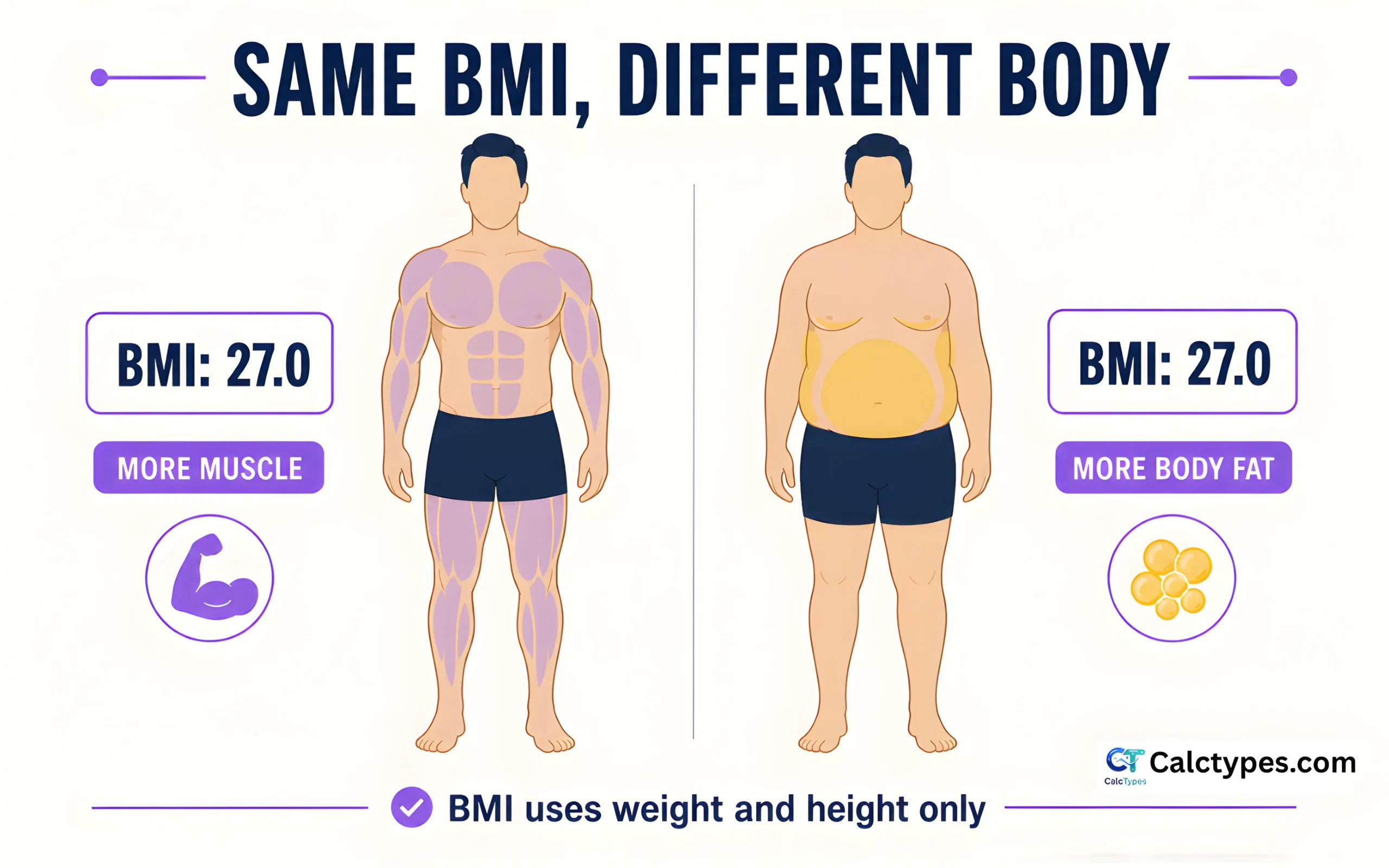
Not always. BMI is calculated purely from weight and height, and it has no way of distinguishing between the weight contributed by muscle, bone, water, and fat. Muscle tissue is significantly denser than fat tissue, meaning a kilogram of muscle takes up much less space than a kilogram of fat. The practical consequence is that a muscular, lean athlete can weigh more than expected for their height purely because of muscle mass, which pushes their BMI number upward even though their actual body fat percentage may be quite low.
For example, a rugby player who is 1.80 m tall and weighs 95 kg (largely muscle) would calculate to a BMI of roughly 29.3 — technically landing in the “overweight” category — despite having a body fat percentage that might sit comfortably in the athletic or healthy range.
If you train seriously, lift weights, or have a naturally muscular build, it’s worth pairing your BMI result with a body fat percentage estimate. Our Body Fat Calculator uses tape-measurement or BMI-based estimation methods that can give you a more complete picture alongside your BMI number, rather than relying on BMI alone.
Does BMI apply to all age groups, including children?
No — this calculator, and the standard adult BMI cutoffs (18.5, 25, 30), are designed specifically for adults aged 18 and older. Children and teenagers are still growing, and their proportion of body fat naturally changes as they age and progress through puberty, which means a single fixed BMI number doesn’t mean the same thing at every age.
Instead, pediatric and adolescent BMI is assessed using age- and sex-specific percentile charts. A child’s BMI value is plotted against a growth curve for children of the same age and sex, and their position on that curve (their percentile) determines their category — a BMI that would be “overweight” for an adult male might be perfectly normal for a 10-year-old boy, and vice versa.
If you’re assessing BMI for someone between 2 and 19 years old, use our BMI-for-age calculator for kids and teens instead of this adult tool — it applies the correct percentile methodology rather than the fixed adult thresholds used here.
Why might BMI be less accurate for certain ethnicities?
The standard WHO BMI cutoffs were developed largely from data on European populations, and a growing body of research shows that the relationship between BMI and actual health risk is not identical across all ethnic groups. Some populations tend to carry more visceral (internal, around-the-organs) fat at a given BMI, and visceral fat is more strongly linked to metabolic disease risk than fat stored elsewhere.
South Asian populations are the most frequently cited example: research summarized by institutions such as Harvard T.H. Chan School of Public Health suggests South Asian individuals may face elevated health risks starting at BMI values around 23 — still within the “healthy” range under standard WHO cutoffs. Some health organizations have proposed lower, ethnicity-adjusted thresholds for screening purposes in these populations.
Practically, if you are of South Asian, or certain other Asian, descent, it may be worth discussing your BMI result with a healthcare provider even if it falls within the “healthy” range here, particularly if you have other risk factors like a family history of diabetes or a larger waist circumference. A waist-to-hip ratio calculator can add useful context in this situation.
What is the difference between BMI and body fat percentage?
BMI is a ratio of weight to height squared — it tells you nothing directly about what your body is made of. Body fat percentage measures the proportion of your total body weight that is fat tissue, as opposed to muscle, bone, organs, and water. This is a fundamentally more direct measure of body composition.
The two metrics can disagree substantially. A bodybuilder might have a BMI of 28 (overweight by BMI) but a body fat percentage of 12% (very lean). Conversely, someone often called “skinny fat” might have a completely normal BMI of 22 but a body fat percentage of 28%, indicating relatively low muscle mass and higher-than-ideal fat despite a “healthy” BMI number.
Because of this, health professionals increasingly recommend using BMI as a fast initial screen, then following up with a body fat percentage estimate — via skinfold calipers, bioelectrical impedance scales, tape-measurement formulas, or DEXA scanning for the most accurate result — when a more complete picture is needed. Try our Body Fat Calculator to estimate yours using the tape method or a BMI-based approximation.
Is BMI outdated? Why do some experts criticize it?
BMI has faced growing criticism in recent years, and it’s worth understanding why, without dismissing it entirely. The core critique is that BMI was developed in the 1830s as a population-level statistical tool for European men, not as an individual diagnostic instrument — Adolphe Quetelet himself never intended it to assess individual health.
Modern criticisms include: it cannot distinguish muscle from fat, it doesn’t account for fat distribution (visceral vs. subcutaneous fat carry different risks), it uses ethnicity-blind cutoffs despite documented differences in risk thresholds, and it doesn’t factor in age-related changes in body composition. In 2023, the American Medical Association adopted a policy statement acknowledging these limitations and recommending BMI be used alongside other measures rather than as a standalone metric.
That said, BMI remains widely used because it is free, fast, requires no special equipment, and does correlate with health risk at a population level — which is why it still appears on this page and in clinical settings worldwide. The practical takeaway: use BMI as a starting screen, not a verdict, and combine it with waist circumference, body fat percentage, and clinical judgment for a fuller picture. If you want a broader alternative, see our waist-to-height ratio calculator, which some researchers argue better predicts cardiometabolic risk.
What is BMI Prime, and how is it different from standard BMI?
BMI Prime is a simple variation of standard BMI that expresses your BMI as a ratio relative to the upper healthy cutoff (24.9 kg/m²). It’s calculated as: BMI Prime = your BMI ÷ 25. A BMI Prime of exactly 1.0 means you’re sitting right at the upper edge of the healthy range; below 1.0 means you’re under that threshold, and above 1.0 means you’ve exceeded it.
The advantage of BMI Prime is that it gives an immediate, intuitive sense of “how far” you are from the healthy boundary as a percentage, without needing to remember the exact category cutoffs. For example, a BMI Prime of 1.20 tells you your BMI is 20% above the healthy-range ceiling — useful shorthand some clinicians and researchers prefer for tracking change over time.
A related but distinct metric is the Ponderal Index, which uses height cubed rather than height squared (Weight ÷ Height³), making it less sensitive to extreme height differences — it’s sometimes preferred in pediatric and neonatal research. If you want both figures calculated automatically alongside your standard BMI, see our dedicated BMI Prime calculator.
Can I have a normal BMI but still be unhealthy (“skinny fat”)?
Yes — this is a real and increasingly studied phenomenon sometimes called “normal weight obesity” or informally, “skinny fat.” It describes someone whose BMI falls comfortably within the 18.5–24.9 healthy range, but who has a relatively high body fat percentage and low muscle mass for their size — often as a result of low physical activity, poor muscle-building nutrition, or age-related muscle loss (sarcopenia).
Research has found that individuals with normal-weight obesity can carry cardiometabolic risk factors — such as elevated blood pressure, unfavorable cholesterol profiles, and insulin resistance — that are comparable to, or in some studies close to, those seen in individuals with obesity by BMI, despite their “healthy” BMI number. This happens because it’s specifically excess fat mass (particularly visceral fat) and insufficient muscle mass that drive much of the metabolic risk — not body weight or BMI directly.
This is one of the clearest illustrations of why BMI shouldn’t be used in isolation. If your BMI is healthy but you have limited muscle tone, a sedentary lifestyle, or a family history of metabolic conditions, it’s worth checking your body fat percentage and waist circumference rather than assuming a “good” BMI means everything is fine.
What should I do if my BMI is outside the healthy range?
A BMI outside the 18.5–24.9 healthy range is a signal to look closer, not a diagnosis. The first practical step is to consult a healthcare provider, who can assess your overall health picture — including waist circumference, blood pressure, cholesterol, blood sugar, family history, and activity level — rather than relying on BMI in isolation.
If lifestyle changes are recommended, the evidence consistently favors small, sustainable adjustments over aggressive short-term measures. For someone in the overweight or obesity range, a commonly recommended pace is losing about 0.5–1 kg (roughly 1–2 lb) per week through a modest calorie deficit combined with regular physical activity. Conversely, someone in the underweight range may need a structured, gradual calorie surplus alongside resistance training to build healthy tissue rather than just body fat.
To plan either direction, our TDEE Calculator can help estimate your daily calorie needs as a starting point for building a sustainable, personalized plan alongside professional guidance.
Can BMI predict health problems?
BMI is best understood as a population-level screening tool, not an individual diagnostic tool. At a population scale, large studies consistently show statistical associations between higher BMI and increased risk of conditions such as type 2 diabetes, cardiovascular disease, certain cancers, and joint problems.
However, at the individual level, BMI doesn’t directly measure the things that actually drive those health risks — body fat percentage, fat distribution, cardiovascular fitness, blood sugar regulation, and genetics. Two people can share an identical BMI of 27 while one has excellent metabolic health from regular exercise and the other has significant metabolic risk factors; BMI alone cannot tell them apart.
For this reason, BMI works best as one data point among several. Combining it with waist circumference, blood pressure, lipid panels, and general fitness level gives a far more reliable picture of actual health risk than BMI viewed in isolation.
How often should I check my BMI?
For most adults who are not actively managing their weight, checking BMI a few times a year is more than sufficient — there’s little practical benefit to daily or even weekly recalculation. Body weight naturally fluctuates from day to day due to hydration status, food intake, sodium levels, hormonal cycles, and even the time of day you weigh yourself, none of which reflect real changes in body fat.
If you are actively working on a weight management goal, tracking your weight weekly (ideally at the same time of day, under similar conditions) and looking at the overall trend over several weeks is far more informative than obsessing over single-day numbers.
Ultimately, focus on building sustainable habits — consistent activity, balanced nutrition, adequate sleep — rather than frequent number-checking. Revisit your BMI periodically (every few months, or after a significant lifestyle change) as one simple checkpoint among the broader health indicators discussed above.
Methodology — How We Calculate BMI
This calculator applies the standard adult BMI formula (weight ÷ height²) and classifies results using WHO adult BMI cutoffs (18.5 / 25.0 / 30.0). Healthy weight range is derived by solving the same formula for weight at BMI 18.5 and BMI 24.9 for your entered height.
- Unit conversion: Imperial inputs (lb, ft/in) are converted to kg and meters internally before applying the metric formula, ensuring identical results regardless of unit system.
- Rounding: BMI, healthy weight range, and weight adjustment are rounded to one decimal place for readability.
- Category cutoffs: Underweight <18.5; Healthy 18.5–24.9; Overweight 25.0–29.9; Obesity ≥30.0 (WHO standard adult classification).
- Scope: This formula and these cutoffs apply to adults 18+ only; children/teens require the separate percentile-based methodology used in our child BMI calculator.
Limitations of BMI & Disclaimer
While BMI is a useful screening tool, it has important limitations:
- Doesn’t measure body composition: BMI cannot distinguish between muscle mass, bone density, and fat. Athletes with high muscle mass may have elevated BMI despite low body fat.
- Age considerations: Older adults may have more body fat than younger adults with the same BMI.
- Ethnic variations: Health risks associated with BMI may vary by ethnicity. South Asian populations may face elevated health risks at lower BMI values (around 23+).
- Not suitable for everyone: Pregnant individuals, children, teens, and people with certain medical conditions require different assessment methods.
BMI doesn’t measure body fat directly—try our Body Fat Calculator for a body fat % estimate (tape method or BMI-based).
BMI should be considered alongside other health indicators such as waist circumference, blood pressure, cholesterol levels, and overall lifestyle factors.
🔧 Embed This Calculator
Add this free BMI calculator to your site — no sign-up required.
The embed code includes an iframe with attribution to this page.
Sources & Further Reading
This calculator uses standard BMI formulas and WHO adult BMI categories.