How to Calculate BMI Manually (Step-by-Step)
How to Calculate BMI Manually (Step-by-Step, With Worked Examples)
Learn the exact BMI formula for metric and imperial units, walk through fully worked examples, and see the most common calculation mistakes — so you can compute your Body Mass Index by hand with confidence, or double-check any calculator’s output.
Quick takeaway
Metric: BMI = weight (kg) ÷ height² (m²). Imperial: BMI = 703 × weight (lb) ÷ height² (in²). Convert height to meters (or keep in inches) before squaring — that’s where most manual calculation errors happen. Prefer not to do the math by hand? Use our BMI Calculator for instant results with the full working shown.
Metric BMI Formula, Step by Step
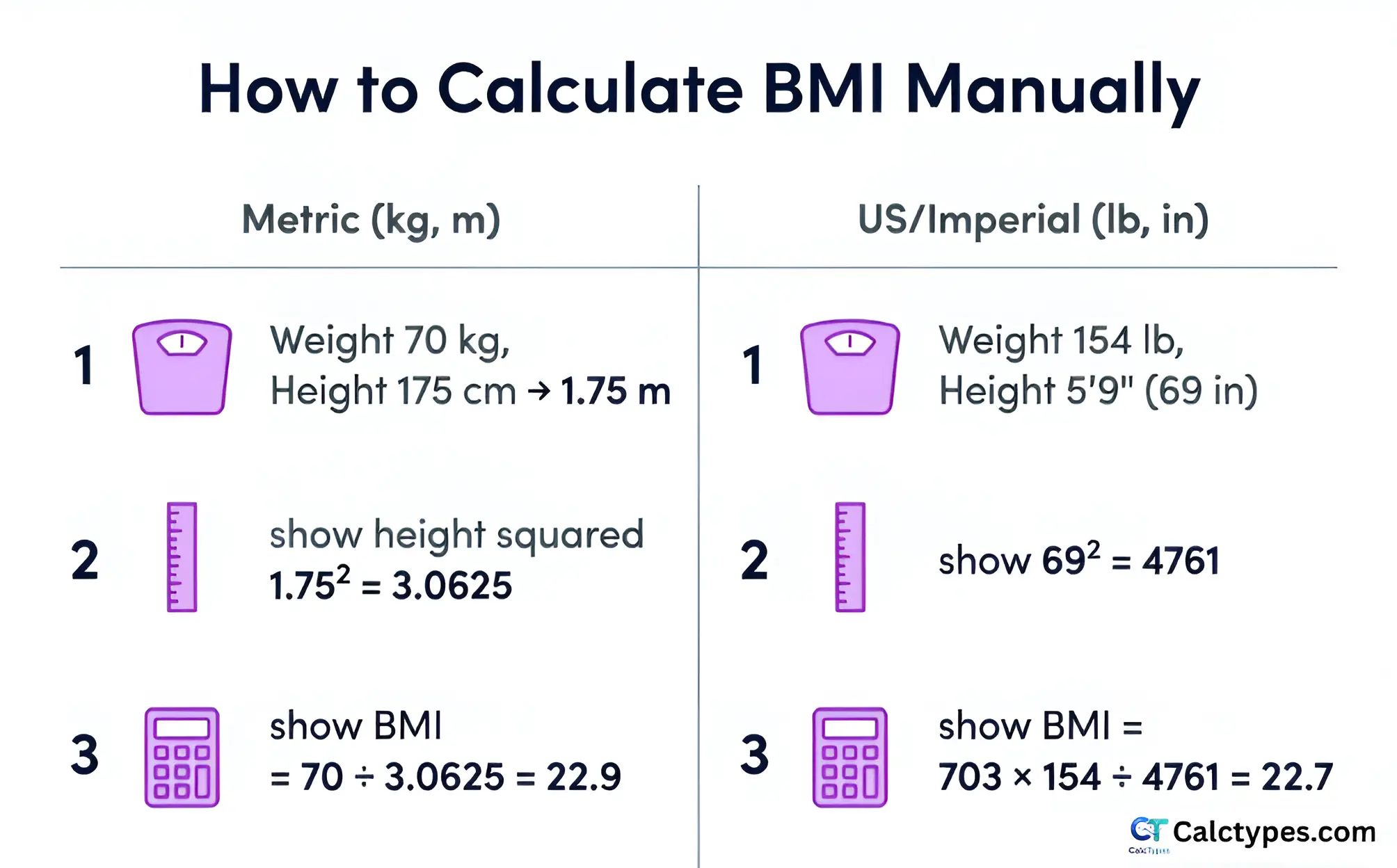
The metric BMI formula is: BMI = weight (kg) ÷ height² (m²).
- Convert height to meters. If your height is in centimeters, divide by 100 (e.g., 172 cm ÷ 100 = 1.72 m).
- Square the height. Multiply the height-in-meters value by itself (1.72 × 1.72 = 2.9584 m²).
- Divide your weight by that squared value. If you weigh 68 kg: 68 ÷ 2.9584 = 22.98.
- Round to one decimal place for readability: BMI ≈ 23.0.
Imperial (US) BMI Formula, Step by Step
The imperial formula includes a conversion constant so the result matches the metric formula: BMI = 703 × weight (lb) ÷ height² (in²).
- Convert height to total inches. For 5 ft 8 in: (5 × 12) + 8 = 68 inches.
- Square the height in inches. 68 × 68 = 4,624 in².
- Multiply weight by 703. For 150 lb: 150 × 703 = 105,450.
- Divide by the squared height. 105,450 ÷ 4,624 = 22.8.
Worked Examples Table
| Height | Weight | Calculation | BMI | Category |
|---|---|---|---|---|
| 1.60 m (5’3″) | 55 kg (121 lb) | 55 ÷ (1.60×1.60) | 21.5 | Healthy |
| 1.75 m (5’9″) | 70 kg (154 lb) | 70 ÷ (1.75×1.75) | 22.9 | Healthy |
| 1.80 m (5’11”) | 95 kg (209 lb) | 95 ÷ (1.80×1.80) | 29.3 | Overweight |
| 1.65 m (5’5″) | 48 kg (106 lb) | 48 ÷ (1.65×1.65) | 17.6 | Underweight |
Want your own number calculated instantly with the full breakdown shown? Use the BMI Calculator.
Common Manual Calculation Mistakes
- Forgetting to convert cm to meters before squaring — using 172 instead of 1.72 gives a wildly wrong result.
- Squaring weight instead of height — the height is what gets squared, not the weight.
- Mixing unit systems — using pounds with the metric formula (or vice versa) without converting first.
- Rounding too early — round only the final BMI value, not the intermediate height-squared figure.
- Forgetting the 703 constant in the imperial formula, which produces a BMI roughly 2.2× too low.
Questions People Ask
Detailed answers on manual BMI calculation and common points of confusion.
What is the exact formula to calculate BMI by hand?
The exact metric formula is BMI = weight in kilograms ÷ (height in meters)². The exact imperial formula is BMI = 703 × weight in pounds ÷ (height in inches)². Both formulas are mathematically equivalent — they simply express the same underlying weight-to-height-squared ratio using different starting units, with the 703 constant in the imperial version compensating for the unit conversion.
To use either formula correctly, always convert your height into the correct unit first: meters for the metric formula (divide centimeters by 100), or total inches for the imperial formula (multiply feet by 12 and add remaining inches). Skipping this conversion step is the single most common source of manual calculation errors, often producing a BMI that’s off by a factor of 100 or more.
Once you have height in the correct unit, square it (multiply it by itself), then divide your weight by that squared value. Round the final result to one decimal place. If you’d rather skip the arithmetic, our BMI Calculator performs this instantly and shows the full substitution with your actual numbers in its calculation breakdown table.
Why do I get a different BMI when I switch between kg/cm and lb/inches?
If you’re getting meaningfully different BMI results between unit systems for the same person, it almost always means a conversion error occurred somewhere — not that the formulas themselves disagree. The metric and imperial BMI formulas are mathematically designed to produce identical results for the same physical measurements.
The most frequent cause is a rounding mismatch: converting 70 kg to pounds using an imprecise conversion factor (like 2.2 instead of the more precise 2.20462) introduces small errors that compound when squared in the height calculation. Another frequent cause is entering height in centimeters into a calculator field expecting inches, or vice versa, without converting.
To verify consistency, use precise conversion factors: 1 kg = 2.20462 lb, and 1 inch = 2.54 cm. Our BMI Calculator handles these conversions internally with full precision, so switching between Metric and Imperial toggles on that page will always produce a consistent result for the same physical measurements.
Do I need to use my exact height, or can I round it?
Small rounding in height has a bigger effect on BMI than you might expect, because height is squared in the formula — meaning any rounding error gets amplified. For example, rounding 172.5 cm down to 170 cm (a seemingly small 2.5 cm difference) can shift a calculated BMI by roughly 0.5 to 0.7 points, which is sometimes enough to cross a category boundary.
For the most accurate manual calculation, use your height to at least the nearest half-centimeter (or quarter-inch), measured without shoes, standing straight, in the morning if possible (height can decrease very slightly by the afternoon due to spinal compression from daily activity).
For weight, use a value from a calibrated scale, ideally at a consistent time of day (morning, after using the bathroom, before eating) to reduce day-to-day fluctuation from water retention and food intake. Precision in your inputs directly improves the reliability of your BMI output, whether calculated manually or through our BMI Calculator.
Is there a simpler shortcut formula for estimating BMI quickly?
There isn’t a truly simpler accurate shortcut, but there are quick mental-math approximations some people use for rough estimates. One common approach: for someone of average height (around 1.70 m / 5’7″), each 3 kg (about 6.5 lb) of weight change shifts BMI by roughly 1 point. This is only a rough heuristic for a specific height and shouldn’t replace the actual formula for anything beyond a ballpark sense.
A more useful “shortcut” in practice is memorizing your own healthy weight range once, calculated using the actual formula, so you don’t need to recalculate BMI from scratch every time you check your weight — you can simply compare your current weight to your known healthy range boundaries.
For anything beyond casual estimation, use the exact formula or a calculator. Our BMI Calculator also displays your personal healthy weight range in kg or lb, so you have that reference number readily available for quick future comparisons.
Can I calculate BMI Prime or Ponderal Index manually too?
Yes, both are straightforward extensions once you have your standard BMI. BMI Prime is calculated as your BMI divided by 25 (the upper boundary of the healthy BMI category): BMI Prime = BMI ÷ 25. A BMI Prime under 1.0 means you’re below the overweight threshold; above 1.0 means you’ve exceeded it.
Ponderal Index (also called the Corpulence Index) uses height cubed rather than squared: PI = weight (kg) ÷ height³ (m³). It’s less commonly used for adults but appears occasionally in research and pediatric contexts because it’s less sensitive to extreme height differences than standard BMI.
Both of these are calculated automatically, alongside your standard BMI, on our dedicated BMI Prime Calculator, which also explains how to interpret each metric in more depth.
Why calculate BMI manually if free calculators exist?
There are a few legitimate reasons people want to calculate BMI by hand rather than relying solely on a tool. First, understanding the formula helps you sanity-check any calculator’s output — if you know roughly what to expect, you can spot an obvious data-entry error (like accidentally entering height in the wrong unit).
Second, some contexts require showing your work — students learning the formula for health or nutrition coursework, or professionals who need to demonstrate the calculation method in a report rather than just citing a black-box result.
Third, knowing the formula lets you quickly estimate BMI changes without needing a device or internet connection, which can be genuinely useful when planning gradual weight changes over time. That said, for day-to-day tracking, our BMI Calculator is faster, reduces arithmetic error, and additionally shows your healthy weight range and category automatically.