BMR vs RMR: What’s the Difference Between Basal and Resting Metabolic Rate?
BMR vs RMR: What’s the Difference?
Quick answer: BMR is measured under strict “basal” conditions, while RMR is measured under less strict resting conditions. Online calculators use equations, so the result is best treated as a resting energy estimate for planning—not a lab measurement.
Definitions: BMR vs RMR (plain English)
What is BMR?
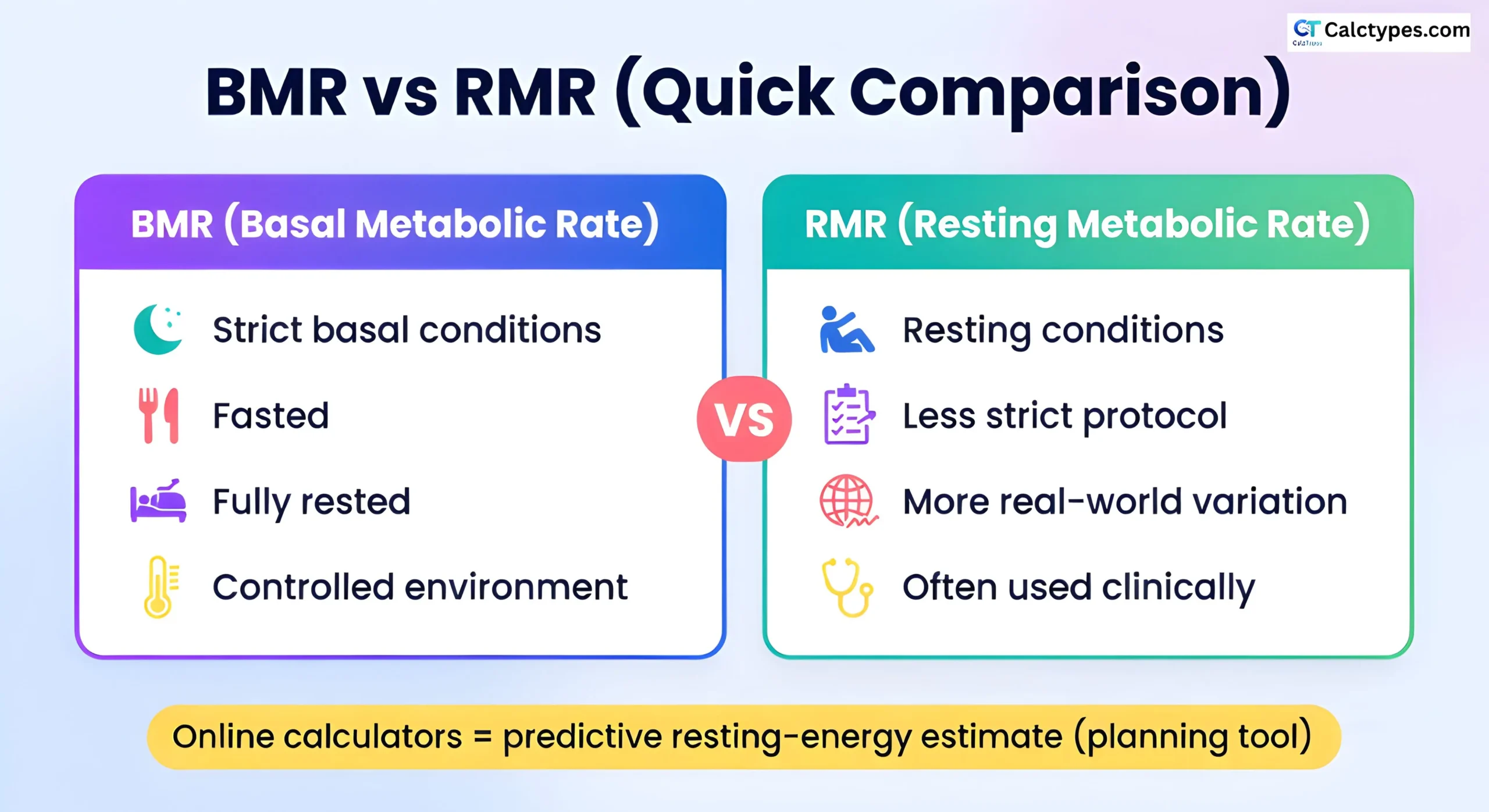
BMR (Basal Metabolic Rate) refers to energy expenditure measured under strict “basal” conditions—typically fasted, fully rested, minimal prior activity, and a controlled environment designed to reduce noise (temperature, movement, and recent exercise effects). In other words, BMR is meant to be a tightly controlled baseline.
What is RMR?
RMR (Resting Metabolic Rate) refers to energy expenditure measured at rest but under less strict conditions than true BMR testing. Because real-world testing is rarely “perfect basal,” RMR is often the more realistic label for what many clinics and sports labs measure.
Quick comparison: BMR vs RMR
Definition in one sentence
BMR is the strict baseline (measured under controlled “basal” conditions), while RMR is a resting measurement under less strict conditions—often closer to real-world testing.
| Term | What it describes | Typical testing conditions | What online calculators provide |
|---|---|---|---|
| BMR | Basal energy use (strict baseline) | Fasted, fully rested, minimal movement, controlled environment | Predictive resting-energy estimates (best used for planning) |
| RMR | Resting energy use (less strict baseline) | Rested, but protocol varies more than true BMR |
Why do online calculators call it BMR even if it’s closer to RMR?
Most people search for “BMR calculator,” so websites use “BMR” as the common label. But calculators typically apply an equation (for example, Mifflin–St Jeor or Harris–Benedict) that predicts resting energy expenditure from inputs like age, height, weight, and sex. That output is best interpreted as a resting-energy estimate—useful for planning, but not identical to a lab-measured BMR.
- Search behavior: “BMR” is the public-facing term.
- Equation vs measurement: equations estimate; indirect calorimetry measures.
- Planning focus: most people need maintenance calories (TDEE), not a perfect basal protocol.
Which number should you use for planning?
For meal planning and weight-change planning, most people should focus on maintenance calories (TDEE) because it reflects daily life (movement, training, digestion). A BMR/RMR estimate is the baseline starting point—not the final target.
A practical workflow that works in real life
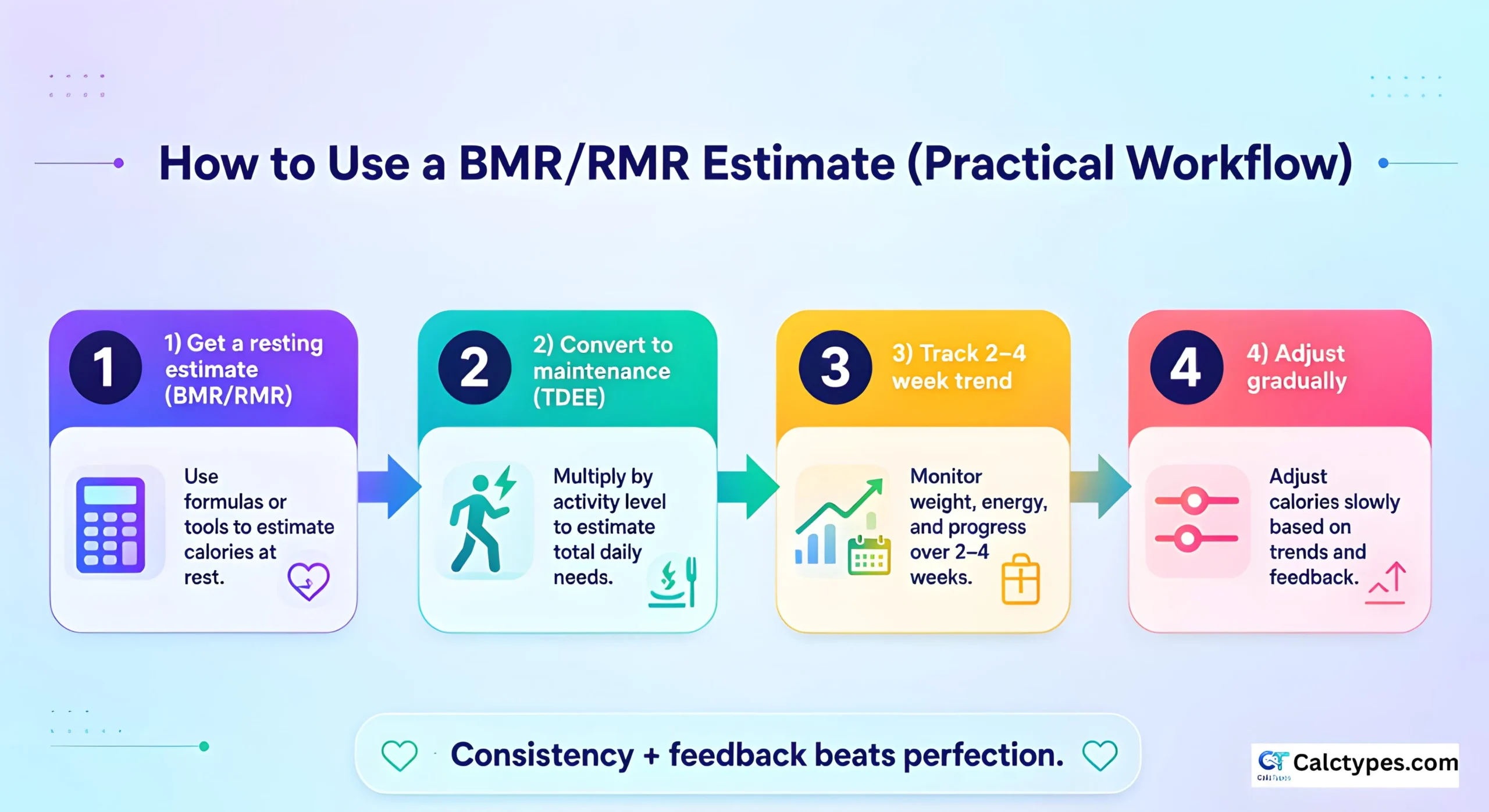
- Estimate resting needs using a calculator (treat it as a resting estimate).
- Convert to maintenance using an activity factor or the TDEE calculator.
- Track multi-week trends and adjust gradually (small changes beat dramatic swings).
Questions people ask
Is RMR always higher than BMR?
Often, RMR can be slightly higher than true BMR, but it’s not a universal rule—and it’s usually not the detail that determines whether your plan works.
The “RMR is higher” idea mostly comes from testing conditions. BMR is defined under strict basal conditions (fully rested, fasted, minimal movement, controlled environment).
RMR is still measured at rest, but the protocol is often less strict in real-world settings (differences in resting period, recent exercise, caffeine intake, sleep debt, and room temperature).
Practical example: if your calculator shows “BMR” = 1,600 kcal/day, it doesn’t mean your true lab-measured basal value is exactly 1,600. The most useful next step is to estimate
maintenance (TDEE), then check whether that maintenance estimate maintains your weight over 2–4 weeks. If not, you adjust—because that feedback loop is more actionable
than debating labels.
Do online BMR calculators estimate BMR or RMR?
Most online “BMR calculators” are best understood as providing a predictive resting-energy estimate from an equation, not a lab measurement.
They use population-based models and your inputs (age, sex, height, weight, or sometimes body composition) to produce a number that’s useful as a starting point—but it can be meaningfully
off for an individual.
Why do they still say “BMR”? Because that’s the term people search for, and because for most planning purposes, the bigger sources of error are lifestyle and adherence factors:
daily movement (NEAT), training volume, recovery, sleep, and consistent tracking. Use the estimate consistently, convert to maintenance calories, and adjust based on outcomes.
If you want to see what the calculators are doing behind the scenes, here’s a step-by-step guide: how to calculate BMR manually.
How do labs measure RMR/BMR?
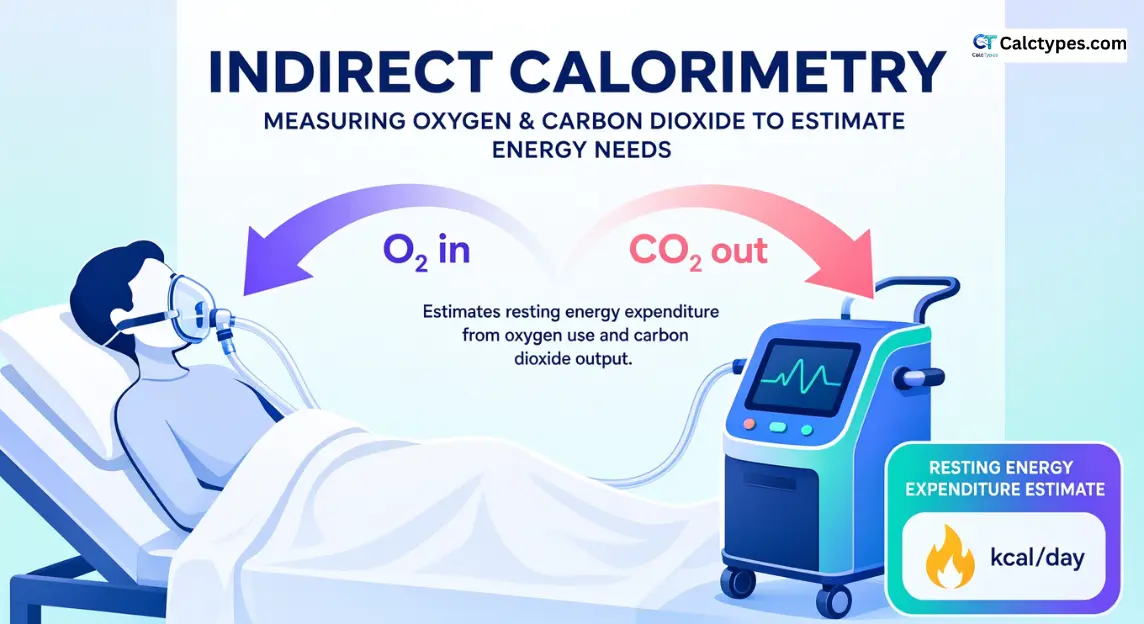
A common lab method is indirect calorimetry, which estimates resting energy expenditure by measuring oxygen consumption and carbon dioxide production while you rest.
It’s more direct than an equation because it’s based on respiratory gas exchange rather than population averages.
Even with lab testing, preparation matters (resting period, fasting state, recent exercise, stimulants, and protocol consistency). For many people, lab measurement isn’t required to get good results.
A realistic plan using a calculator + careful tracking + gradual adjustments often works well.
What if my calculator estimate doesn’t match real life?
That mismatch is common and doesn’t automatically mean something is “wrong” with your metabolism. Predictive equations are averages, and real-world expenditure changes with activity,
sleep, stress, and consistency.
A practical approach: pick one method and use it consistently for 2–4 weeks. If weight is trending up when you expected maintenance, reduce calories slightly; if trending down, increase slightly.
Example: if you expected maintenance at 2,200 kcal/day but you’re slowly gaining, you might try 2,050–2,150 and reassess after two more weeks. If you have concerning symptoms or a medical condition,
consult a qualified clinician.
Methodology
This page explains BMR vs RMR using standard definitions and practical interpretation guidance. It emphasizes safe use of predictive estimates: use a resting estimate as a baseline, convert to maintenance calories (TDEE-style), and adjust based on multi-week trends.
- Focus: practical planning and safe interpretation (not diagnosing metabolic conditions).
- Language choice: “BMR calculator” is treated as a common label for predictive resting-energy estimates.
- Measurement note: indirect calorimetry is described as a common lab approach for resting expenditure.
Limitations (important)
- Not a lab test: predictive estimates can be off for individuals.
- Not for medical decisions: educational content only.
- Special populations: teens, pregnancy/lactation, elite athletes, and many health conditions may require professional guidance.
Sources and Further Reading
- Mifflin MD et al. (1990) — A new predictive equation for resting energy expenditure in healthy individuals — American Journal of Clinical Nutrition
- Roza AM, Shizgal HM (1984) — The Harris Benedict equation reevaluated — American Journal of Clinical Nutrition
- Compher C et al. (2006) — Best practice methods to apply indirect calorimetry in clinical practice