Mifflin–St Jeor BMR Calculator (Age, Sex, Height & Weight)
Mifflin–St Jeor BMR Calculator
Calculate your Basal Metabolic Rate (BMR) using the widely validated Mifflin–St Jeor equation. This page is locked to Mifflin–St Jeor for consistency. To compare all formulas side by side, use the main BMR calculator.
Your Details
Your Results
Assumptions & Warnings
📊 BMR vs Maintenance Comparison
🧾 Calculation Steps
📋 Detailed Breakdown
| Parameter | Value |
|---|---|
| Enter your details to see the breakdown. | |
🔧 Embed this calculator
Add this free standards-based calculator to your site — no signup required.
The embed code includes an iframe (height 1020px) and visible attribution to: calctypes.com/mifflin-st-jeor-bmr-calculator/
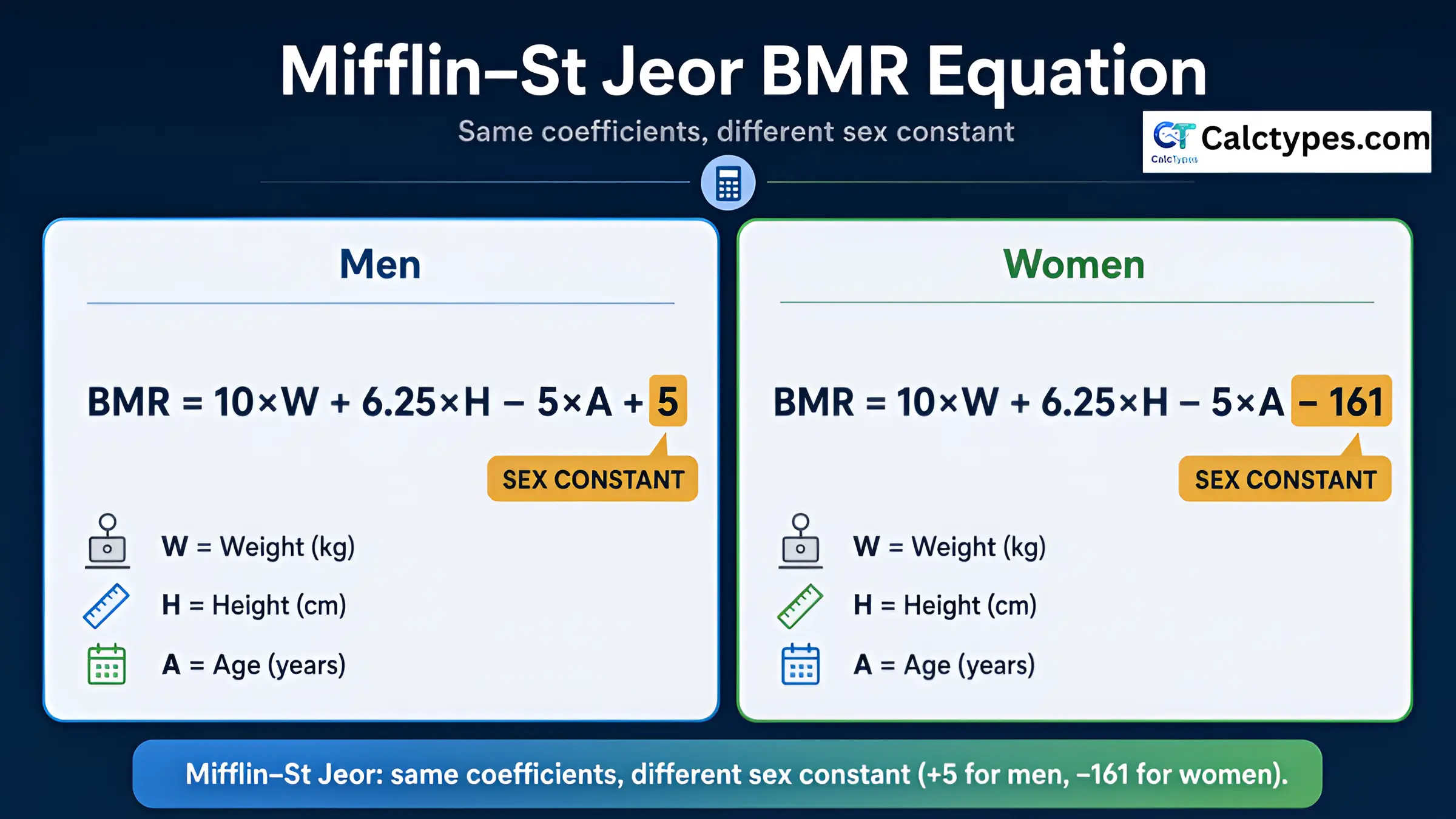
Mifflin–St Jeor Equation — Men and Women
The Mifflin–St Jeor equation estimates BMR using four inputs: body weight, height, age, and sex. It was published in 1990 and has since become the most widely validated predictive equation for resting energy expenditure in healthy adults.
Men
BMR = (10 × weight in kg) + (6.25 × height in cm) − (5 × age in years) + 5
Women
BMR = (10 × weight in kg) + (6.25 × height in cm) − (5 × age in years) − 161
The only difference between the male and female equations is the sex-specific constant (+5 for males; −161 for females). All other coefficients are identical. If you only have US units (lb, ft/in), this calculator converts them automatically.
Mifflin–St Jeor Worked Examples
Each example shows the full arithmetic so you can verify the calculator output. If you want to do the math yourself, see how to calculate BMR manually.
Example 1: Male, 30 years, 81 kg, 173 cm
BMR = (10 × 81) + (6.25 × 173) − (5 × 30) + 5
BMR = 810 + 1081.25 − 150 + 5 = 1,746 kcal/day
kJ equivalent: 1,746 × 4.184 ≈ 7,305 kJ/day
Example 2: Female, 35 years, 65 kg, 163 cm
BMR = (10 × 65) + (6.25 × 163) − (5 × 35) − 161
BMR = 650 + 1018.75 − 175 − 161 = 1,333 kcal/day
kJ equivalent: 1,333 × 4.184 ≈ 5,577 kJ/day
Example 3: Male, 55 years, 95 kg, 180 cm (with activity)
BMR = (10 × 95) + (6.25 × 180) − (5 × 55) + 5
BMR = 950 + 1125 − 275 + 5 = 1,805 kcal/day
Maintenance (Moderately Active × 1.55): 1,805 × 1.55 = 2,798 kcal/day
This is a planning starting point. Track actual body weight trend over 3–4 weeks and adjust intake by 100–200 kcal if weight is drifting unexpectedly.
Example 4: Female, 17 years, 59 kg, 157 cm (teen caution)
BMR = (10 × 59) + (6.25 × 157) − (5 × 17) − 161
BMR = 590 + 981.25 − 85 − 161 = 1,325 kcal/day
Important: Mifflin–St Jeor is designed for adults (18+). For ages under 18, the equation may underestimate BMR because adolescent metabolic rates are also driven by growth. This calculator will show a warning for ages under 18. Consult a paediatric dietitian for age-appropriate guidance.
How Accurate Is the Mifflin–St Jeor Equation?
Mifflin–St Jeor is the most validated predictive equation for healthy adults. A landmark systematic review by Frankenfield et al. (2005, Journal of the American Dietetic Association) found it was within 10% of measured RMR in approximately 82% of non-obese subjects — outperforming both the original and revised Harris–Benedict equations. However, it remains a population-level estimate applied to an individual, and real-world variation is significant (commonly ±10–15% versus indirect calorimetry).
- Best for: healthy adults aged 18–80 without significant body composition extremes.
- Less reliable for: elite athletes (may underestimate due to high lean mass), individuals with metabolic conditions, very low or very high body weight ranges.
- Clinical gold standard: indirect calorimetry measures actual oxygen consumption and CO₂ production — not a predictive equation.
Limitations (Important)
- Estimate only: equation-based results can differ by 10–15%+ from indirect calorimetry.
- Does not use body composition: two people of the same weight/height/age can have different lean mass — Katch–McArdle may be more informative if body fat % is known.
- Age range: designed for adults aged 18+; results may underestimate energy needs in adolescents and overestimate in very elderly individuals.
- Special populations: pregnancy, lactation, eating disorder recovery, cancer, thyroid conditions, and severe obesity all require clinical assessment — not predictive equations.
- Not medical advice: not for diagnosis, treatment, or compliance decisions.
Full policy: CalcTypes Disclaimer.
Methodology — How This Page Calculates
This page calculates BMR using the Mifflin–St Jeor equation and optionally estimates maintenance calories using a Physical Activity Level (PAL) multiplier.
- Male BMR: (10 × kg) + (6.25 × cm) − (5 × years) + 5
- Female BMR: (10 × kg) + (6.25 × cm) − (5 × years) − 161
- US unit conversion: lb × 0.453592 = kg; (ft × 12 + in) × 2.54 = cm
- Maintenance: BMR × PAL multiplier
- kJ conversion: kcal × 4.184
- Rounding: to nearest whole kcal/kJ for readability
Questions People Ask — Mifflin–St Jeor
Detailed, lecture-style answers for the most common search queries, calculation confusion points, and practical planning decisions about the Mifflin–St Jeor equation.
What is the Mifflin–St Jeor equation and why is it considered the most accurate BMR formula?
The Mifflin–St Jeor equation is a predictive formula for estimating Basal Metabolic Rate (BMR) — the number of kilocalories your body burns at complete rest in a 24-hour period. It was derived by Mifflin MD, St Jeor ST, and colleagues in 1990 from regression analysis on 498 subjects (264 normal-weight and 234 obese) whose resting energy expenditure was directly measured using indirect calorimetry.
The equations:
Male: BMR = (10 × kg) + (6.25 × cm) − (5 × age) + 5
Female: BMR = (10 × kg) + (6.25 × cm) − (5 × age) − 161
Why it outperforms alternatives: A systematic review by Frankenfield et al. (2005, JADA) compared four major predictive equations against measured RMR. Mifflin–St Jeor predicted measured values within 10% in approximately 82% of non-obese subjects — a meaningfully higher success rate than the Harris–Benedict equations (which were derived from a smaller, older dataset in 1919 and revised in 1984). This is why Mifflin–St Jeor became the default recommendation in clinical dietetics practice.
What “most accurate” actually means: Mifflin–St Jeor is the most accurate population-level predictive model for healthy adults without unusual body composition. For any individual, the true measured BMR can differ by 10–15% or more from the prediction. This is not a flaw of the equation — it reflects real biological variability in metabolic rate that no weight/height/age formula can fully capture.
For individuals with known body fat %, the Katch–McArdle equation may provide a marginally more personalized estimate because it uses lean body mass directly.
What is the difference between BMR, RMR, and maintenance calories?
These three terms are frequently confused and used interchangeably, but they represent different — though related — concepts.
Basal Metabolic Rate (BMR) is technically defined as the energy expenditure measured under the most stringent conditions: the subject must be completely at rest (lying supine), fasted for 12+ hours, in a thermoneutral environment (neither hot nor cold enough to trigger thermogenesis), and mentally calm. These conditions essentially eliminate all energy use except what the organs and cells require simply to stay alive. True BMR is a laboratory measurement that virtually no one achieves outside a research setting.
Resting Metabolic Rate (RMR) — also called Resting Energy Expenditure (REE) — is measured under more practical conditions: typically 4–6 hours fasted and 30 minutes of quiet rest before measurement. RMR is consistently and slightly higher than BMR (usually 3–10%) because the conditions are less extreme. Virtually all predictive equations, including Mifflin–St Jeor, were derived from RMR-like measurements even though most tools label the output “BMR.” The label is a convention, not a technical claim. If you want the strict definitions and practical examples, see BMR vs RMR.
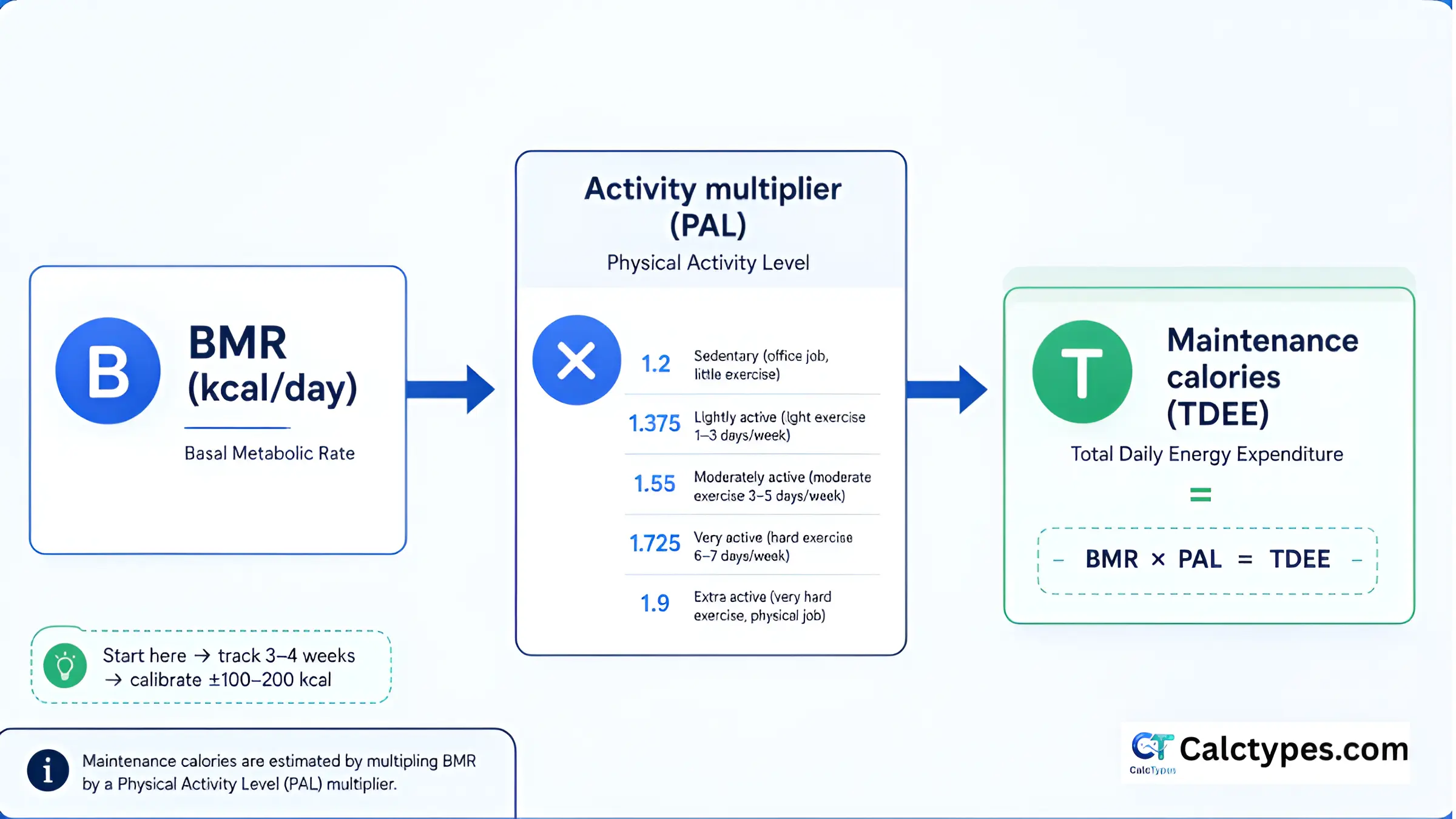
Maintenance calories (TDEE) is the total number of calories your body uses in a full day including all activity: formal exercise, walking, fidgeting, digesting food (the thermic effect of food, TEF), and all other movement. Maintenance is estimated by multiplying BMR/RMR by a Physical Activity Level (PAL) multiplier: Sedentary (×1.2) → Extra Active (×1.9). The calculator above performs this multiplication if you select an activity level.
Practical implication: For planning, the BMR/RMR distinction matters less than the activity multiplier accuracy. The multiplier introduces far more variability than the 3–10% BMR/RMR difference. Start with a conservative estimate, track your weight trend for 3–4 weeks, and calibrate your intake accordingly.
Mifflin–St Jeor vs Harris–Benedict: which formula should I use?
Both equations use the same inputs (weight, height, age, sex) and produce outputs in kcal/day, but they were derived from different populations at different points in history — and their accuracy profiles differ meaningfully.
For a side-by-side breakdown with context on when each equation tends to differ, see our BMR formula comparison.
Harris–Benedict (Original 1919 / Revised 1984): The original was developed by Harris and Benedict from a small sample of 239 subjects (mostly young, healthy, normal-weight men). It was revised by Roza and Shizgal in 1984 using a larger dataset. The revised equations tend to slightly overestimate RMR compared to direct measurement — the original overestimates even more.
Mifflin–St Jeor (1990): Developed from 498 subjects with a wider weight range including obese individuals. Multiple validation studies, including the Frankenfield systematic review (2005), confirm it outperforms Harris–Benedict for the general adult population.
Decision rule:
- For most healthy adults without body composition data → Mifflin–St Jeor is the better default.
- For legacy comparison or institutional contexts that use Harris–Benedict → use the Harris–Benedict calculator and compare.
- For individuals with a reliable body fat % → consider Katch–McArdle.
In practice, for most people the two equations produce results within 50–150 kcal/day of each other. The activity multiplier and real-world calibration matter more than which equation you start with.
How do I convert my BMR to maintenance calories (TDEE)?
Your BMR represents energy expenditure at complete rest. To estimate how many calories you actually need in a full day, multiply your BMR by a Physical Activity Level (PAL) multiplier that reflects your typical movement pattern.
Maintenance = BMR × PAL multiplier
| Activity Level | Multiplier | Who it fits |
|---|---|---|
| Sedentary | × 1.2 | Desk job, no structured exercise, low daily steps |
| Lightly Active | × 1.375 | Light exercise 1–3 days/week or active daily life without gym |
| Moderately Active | × 1.55 | Exercise 3–5 days/week at moderate intensity |
| Very Active | × 1.725 | Hard exercise 6–7 days/week |
| Extra Active | × 1.9 | Physical job + hard training, or twice-daily sessions |
Common mistake: People consistently overestimate their activity level. A person who exercises 3 days/week but sits at a desk the remaining 16 waking hours may have an actual PAL closer to ×1.375 than ×1.55. Starting with a lower multiplier and adjusting upward after observing your weight trend is safer than starting too high.
How to calibrate: Log your calorie intake and weigh yourself daily (morning, post-toilet, pre-breakfast). Compute weekly averages. After 3–4 weeks, if weight is stable, your logged intake approximates your actual maintenance. If weight is drifting, adjust by 100–200 kcal and repeat. This beats any equation because it captures your individual biology.
For a full planning tool with macro targets and deficit/surplus settings, use our TDEE calculator.
Why might my Mifflin–St Jeor result be higher or lower than expected?
If your result looks surprising, work through these systematic checks before concluding the formula is wrong.
Result is unexpectedly high:
- Weight or height entered in wrong units (e.g., lb entered where kg expected, or ft entered where cm expected). This is the most common cause of dramatically wrong results.
- Age entered as a very low number — lower age increases BMR in the formula.
- You may genuinely have a higher-than-average metabolic rate — athletes and people with significant lean mass often do.
Result is unexpectedly low:
- Same unit error in reverse — entering a value that is numerically smaller than intended (e.g., entering height as 1.75 m instead of 175 cm).
- You may have a lower metabolic rate than average. Common causes include hypothyroidism, significant caloric restriction history (metabolic adaptation), or certain medications. Predictive equations cannot detect these — only clinical assessment can.
- Comparing to an old calculator that used a different equation — Mifflin–St Jeor typically produces lower BMR estimates than Harris–Benedict for the same inputs.
The calibration approach: Rather than chasing a “correct” equation, use this result as a starting point and track your actual weight trend against your tracked calorie intake over 3–4 weeks. Your body’s response is the ground truth.
Does Mifflin–St Jeor work for overweight or obese individuals?
Yes — and this is one of Mifflin–St Jeor’s specific advantages over Harris–Benedict. The 1990 derivation sample included 234 obese subjects, meaning the regression was calibrated on a weight range that included higher BMI values. Harris–Benedict, by contrast, was derived primarily from normal-weight subjects.
However, performance degrades at the extremes. For individuals with BMI above 40, Mifflin–St Jeor may still overestimate BMR because total body weight rises faster than lean mass — and lean mass is the primary driver of resting energy expenditure. At very high weights, a larger proportion of the body weight increase is fat mass, which is metabolically less active per kilogram.
What this means in practice: Mifflin–St Jeor is a reasonable starting point for overweight and class I/II obese individuals. For class III obesity (BMI ≥ 40), or for clinical weight management, a registered dietitian using indirect calorimetry will produce a more accurate individual estimate.
Is the Mifflin–St Jeor equation accurate for older adults (60+)?
Mifflin–St Jeor includes age as a direct input (subtracting 5× age from the result), which means it does reduce the BMR estimate as age increases — correctly reflecting the biological reality that resting metabolic rate typically declines with age due to loss of lean mass, hormonal changes, and reduced organ function.
However, the age coefficient was derived from a population that included older adults but was not specifically validated in large geriatric cohorts. For adults over 70–80, accuracy tends to decline because:
- Sarcopenia (age-related muscle loss) accelerates, meaning body weight increasingly reflects fat and less metabolically active tissue.
- Organ metabolic rates can change with age in ways not captured by a simple linear coefficient.
- Chronic conditions, polypharmacy, and reduced mobility are common and affect actual energy expenditure.
Practical guidance: For healthy adults in their 60s and 70s, Mifflin–St Jeor remains a useful starting estimate. For adults over 80, or those with multiple health conditions, a clinical assessment is more appropriate. The calculator will display a reminder for ages above 80 in the Warnings section.
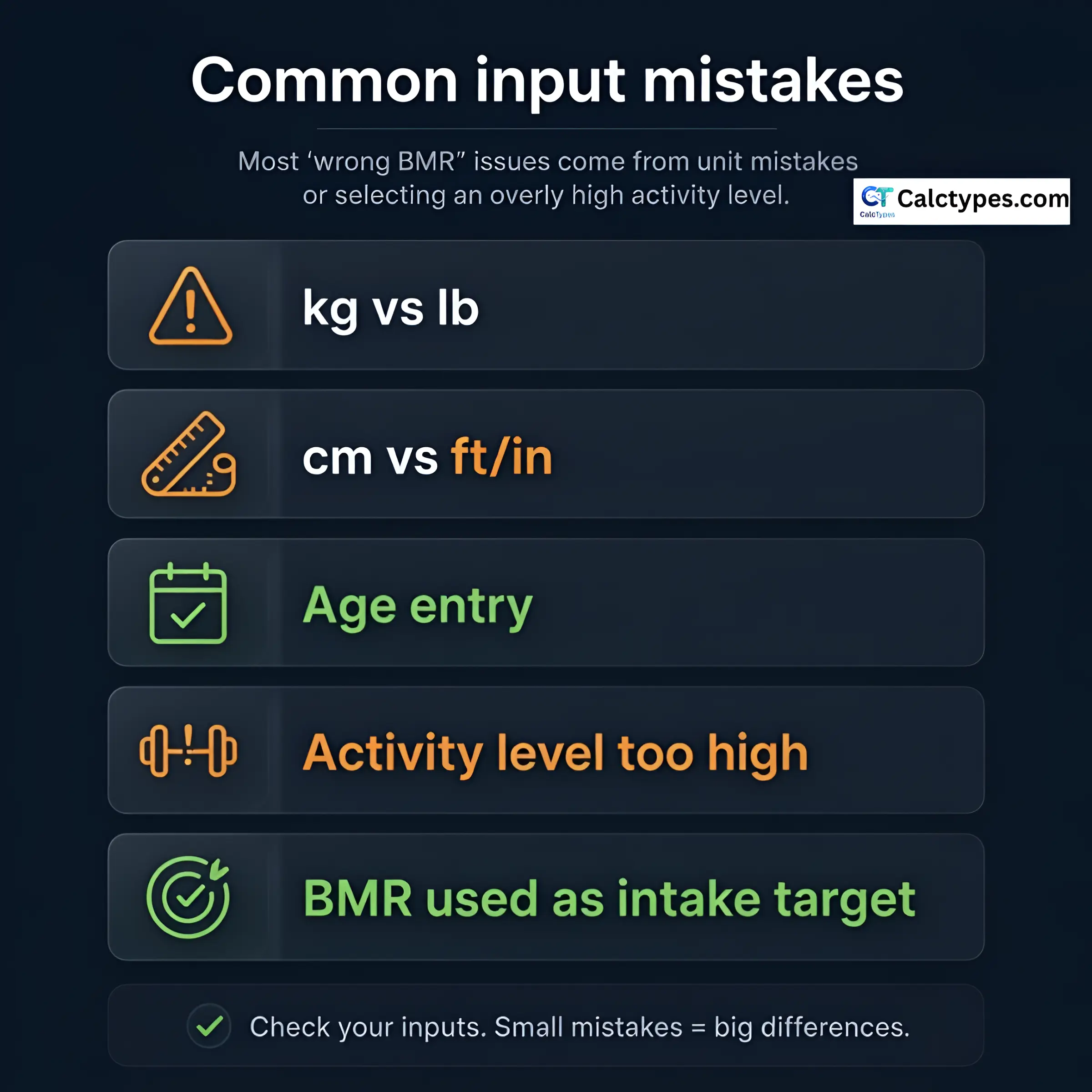
Common mistakes when using the Mifflin–St Jeor calculator
Most errors fall into predictable categories. Here is a complete guide to avoiding them.
Mistake 1: Unit confusion.
Entering weight in pounds when the calculator is set to kg, or height in feet/metres when cm is expected, produces dramatically wrong results. Always check which unit system is active before entering values. This calculator shows the active unit next to each input field and converts automatically when you switch systems.
Mistake 2: Using BMR as an intake target.
BMR is energy expenditure at complete rest. Eating at BMR level puts almost everyone in a significant caloric deficit — appropriate only in specific clinical contexts and not without professional oversight. Always apply an activity multiplier and set intake relative to your maintenance (TDEE), not your BMR.
Mistake 3: Overestimating activity level.
Selecting “Very Active” because you exercise 5 days a week, while spending the other 19 waking hours sitting, produces a higher maintenance estimate than your actual needs. If you are gaining weight on your calculated maintenance, your real PAL is likely one level lower than you selected. Adjust down and track for 3 weeks.
Mistake 4: Reacting to daily weight fluctuations.
Daily scale weight can vary by 1–3 kg due to hydration, glycogen, bowel content, and hormonal cycles — none of which reflects fat gain or loss. Make calorie adjustments only based on weekly average trends over at least 3–4 weeks.
Mistake 5: Expecting the equation to account for metabolic adaptation.
After a prolonged caloric deficit, measured RMR often drops beyond what weight loss alone would predict (adaptive thermogenesis). Predictive equations cannot model this. If your actual weight trend doesn’t match your calorie targets after a diet phase, metabolic adaptation may be a factor requiring real-world recalibration or clinical input.
Mistake 6: Not recalculating after significant weight change.
Your BMR changes as your body weight changes. After losing or gaining 5+ kg, recalculate. The Mifflin–St Jeor formula’s weight coefficient (10 kcal/kg) means every 5 kg of weight change shifts your BMR estimate by approximately 50 kcal/day.
How should I use this calculator as part of a longer-term nutrition or fitness plan?
A BMR calculator is most useful as a starting point, not an endpoint. Here is a practical five-step framework for turning your BMR estimate into actionable, self-calibrating guidance.
Step 1 — Get a baseline estimate.
Use this calculator with your current accurate weight, height, and age. Note the BMR result and your chosen activity multiplier. This is your starting maintenance estimate.
Step 2 — Set a starting calorie target.
If fat loss: set intake 250–500 kcal below your maintenance estimate (modest, sustainable deficit). If muscle gain: set 200–300 kcal above. If body recomposition: start at maintenance and track.
Step 3 — Track calories and weight simultaneously for 3–4 weeks.
Use a food tracking app to log all intake. Weigh yourself daily at the same time (morning, post-toilet, pre-breakfast). Compute weekly averages — not daily readings.
Step 4 — Calibrate against the actual trend.
If weekly average weight is stable: your logged intake ≈ your actual maintenance. If weight is drifting in the wrong direction: adjust by 100–200 kcal and repeat for 3 weeks. After two calibration cycles you will have a reasonably accurate personal maintenance figure.
Step 5 — Recalculate periodically.
Every 4–8 weeks, or after a weight change of 3–5 kg, recalculate your BMR estimate and update your targets accordingly. For a full planning tool with macro breakdowns, use our TDEE calculator.
Sources & Further Reading
These references support the equation and concepts used in this calculator.
- Mifflin MD, St Jeor ST, et al. (1990) — A new predictive equation for resting energy expenditure in healthy individuals — American Journal of Clinical Nutrition — original derivation paper.
- Frankenfield D, et al. (2005) — Comparison of predictive equations for resting metabolic rate in healthy nonobese and obese adults — Journal of the American Dietetic Association — key systematic validation review.
- Roza AM, Shizgal HM (1984) — The Harris Benedict equation reevaluated — American Journal of Clinical Nutrition — Harris–Benedict revision for comparison context.