BMI Prime Calculator (BMI ÷ 25) + Ponderal Index
BMI Prime & Ponderal Index Calculator
Calculate your BMI Prime (BMI expressed as a ratio to the healthy-weight ceiling) and Ponderal Index (a height-cubed alternative to BMI) alongside your standard BMI. For the base BMI calculation and healthy weight range, see our main BMI Calculator.
Your Measurements
Your Results
Assumptions & Limitations
📋 Calculation Breakdown
| Item | Value |
|---|---|
| Enter your measurements to see the breakdown. | |
What Is BMI Prime?
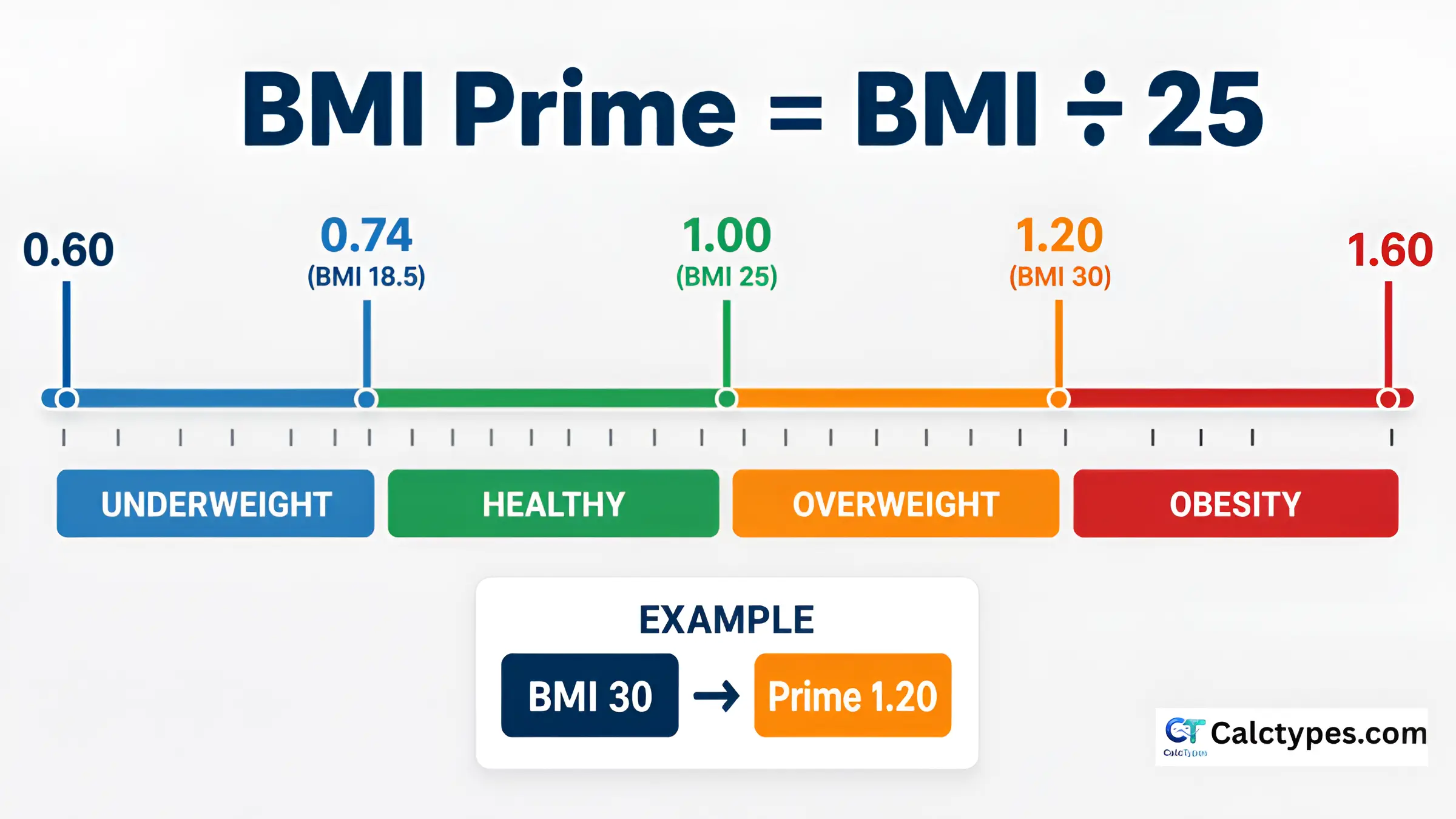
BMI Prime, introduced by Gadzik (2006), expresses your BMI as a ratio to the upper limit of the healthy BMI category (25 kg/m²): BMI Prime = BMI ÷ 25. A value below 1.0 means you’re under the overweight threshold; above 1.0 means you’ve exceeded it. Some simplified tools divide by 24.9 instead of 25 — the difference is negligible in practice.
| BMI Prime | Meaning |
|---|---|
| < 0.74 | Underweight |
| 0.74 – 1.00 | Healthy weight |
| 1.00 – 1.20 | Overweight |
| > 1.20 | Obesity |
What Is the Ponderal Index?
The Ponderal Index (also called the Corpulence or Rohrer Index) uses height cubed instead of squared: PI = weight (kg) ÷ height³ (m³). It’s used less often for adults than BMI but appears in research and pediatric contexts because it’s less distorted by extreme height. Typical adult reference range is roughly 11–15 kg/m³, though there’s no single universally adopted adult classification table.
Questions People Ask
What does a BMI Prime of 1.2 mean?
A BMI Prime of 1.2 means your BMI is 20% above the upper boundary of the healthy weight category (25 kg/m²), since 1.2 × 25 = 30 — the threshold for obesity. In practical terms, BMI Prime gives you an intuitive percentage-style read on how far above or below the healthy ceiling you are, without needing to remember the exact category cutoffs.
This can be more useful than raw BMI for tracking relative change over time. If your BMI Prime drops from 1.2 to 1.1 over several months, you know you’ve closed about half the gap back toward the healthy-range ceiling, which is often a more motivating way to visualize progress than the raw BMI number alone.
For the full category breakdown and your standard BMI figure alongside BMI Prime, use the calculator above or our main BMI Calculator.
Why divide by 25 instead of 24.9 for BMI Prime?
The original BMI Prime concept, introduced by Gadzik in a 2006 paper, defines the reference denominator as the round number 25 kg/m² — the conventional upper limit of the “normal” BMI category used in most international guidelines. Using a clean round number makes the resulting ratio easier to interpret at a glance (a BMI Prime of exactly 1.0 corresponds to a BMI of exactly 25).
Some simplified or localized tools instead use 24.9 (the practical upper bound before “overweight” technically begins under WHO’s 18.5–24.9 healthy range), which produces a nearly identical result — the difference between dividing by 25 versus 24.9 changes the final BMI Prime value by less than half a percent for most people.
This calculator uses the original 25 kg/m² denominator to align with the most widely cited academic definition of BMI Prime.
Is Ponderal Index better than BMI?
Neither metric is universally “better” — they serve slightly different purposes and have different sensitivities. Ponderal Index divides weight by height cubed rather than squared, which theoretically makes it less biased for people at the extremes of height (very tall or very short individuals), where standard BMI can sometimes over- or under-estimate relative body size.
In practice, for most adults of average height, BMI and Ponderal Index tend to agree closely on general category (healthy, overweight, etc.), so the choice rarely changes the practical takeaway. Ponderal Index sees more use in specific research contexts — particularly neonatal and pediatric growth studies — than in general adult health screening, where BMI remains the more widely recognized and clinically referenced standard.
For everyday adult use, BMI (and its close relative BMI Prime) remains the more practical, widely understood metric — but Ponderal Index is a useful secondary data point, which is why this calculator provides both.
Does BMI Prime account for muscle mass any better than BMI?
No — BMI Prime shares the exact same core limitation as standard BMI, because it’s mathematically derived directly from it (BMI Prime is simply BMI divided by a constant). If your BMI is elevated due to high muscle mass rather than excess fat, your BMI Prime will be proportionally elevated too, for the same reason.
BMI Prime is a re-scaling of BMI for easier interpretation of “how far from the healthy ceiling” you are — it is not a different underlying measurement, and it does not add any new information about body composition. If you’re concerned that muscle mass might be skewing your BMI (and therefore your BMI Prime), pair your result with a body fat percentage estimate for a more complete picture.