Waist-to-Height Ratio (WHtR) Calculator – Metric & US Units
Waist-to-Height Ratio (WHtR) Calculator
Waist-to-height ratio (WHtR) compares your waist circumference to your height. A common public-health rule of thumb is: keep your waist less than half your height (WHtR < 0.5).
- Body Composition hub (all composition tools in one place)
- BMI Calculator (weight-for-height screening)
- Body Fat Percentage Calculator (multi-method)
- Navy Body Fat Calculator (tape-based estimate)
Different tools can disagree—use them as planning screens and track trends consistently.
Your Measurements
Your Results
- Compare with BMI for a second screening view.
- If your goal is composition, estimate Body Fat % (multi-method) or try the Navy method.
- Browse related tools in the Body Composition hub.
Assumptions & Warnings
Calculation steps
- Steps update automatically based on your inputs.
Detailed breakdown
| Parameter | Value |
|---|---|
| Enter your measurements to see the breakdown. | |
Questions people ask
Expanded answers to match common WHtR calculator search intent (chart, thresholds, inches, men/women, and comparisons).
How do you calculate waist-to-height ratio (WHtR)? (formula + example)
Waist-to-height ratio (WHtR) is calculated using a simple formula: WHtR = waist circumference ÷ height, using the same unit for both measurements. If you measure waist in centimeters, height must also be in centimeters. If you measure waist in inches, height must be in inches. This is why many people specifically search for a “waist-to-height ratio calculator in inches” — the math is easy, but unit consistency is where errors happen.
Example (metric): If your waist is 80 cm and your height is 175 cm, then WHtR = 80 ÷ 175 = 0.457. Example (US): If your waist is 32 in and your height is 70 in, then WHtR = 32 ÷ 70 = 0.457. Same ratio, different units — because the units match inside each calculation.
The “half your height” rule is just a rearrangement of the same equation. If WHtR = 0.5 is your target, then your waist target is 0.5 × height. That’s why this calculator also shows a “what should my waist be for my height?” style target: it’s the height-based waist value that corresponds to WHtR = 0.50.
Waist-to-height ratio chart: what should my waist be for my height?
When people look for a waist-to-height ratio chart, they usually want a quick “ideal waist size for my height” target. The simplest chart-like rule is the widely repeated heuristic: waist ≈ half of height (WHtR ≈ 0.5). Instead of memorizing a chart, you can compute the same target directly: target waist = 0.5 × height.
Practical examples: If you’re 160 cm tall, a half-height waist target is 80 cm. If you’re 180 cm tall, it’s 90 cm. In inches, if you’re 66 in tall (5’6″), the half-height target is about 33 inches. If you’re 72 in tall (6’0″), it’s about 36 inches. These numbers are not “perfect” or “medical cutoffs”; they’re screening targets designed to be simple and memorable.
Why do charts vary online? Because different sources may: (1) use different WHtR thresholds (0.5 vs 0.55 vs 0.6), (2) create separate bands by sex/age/population, or (3) mix in clinical waist circumference cutoffs. The cleanest way to use WHtR is to treat it as a trend metric—measure consistently, then track whether your ratio moves down over time with improved waist measurement and lifestyle changes.
What is a good (healthy) waist-to-height ratio for men and women?
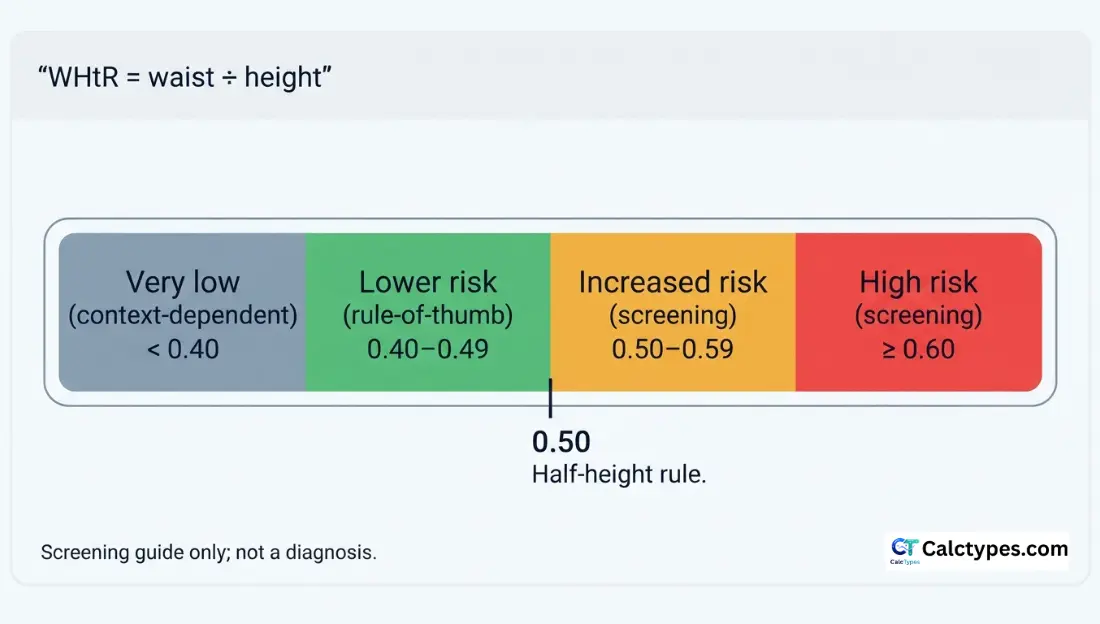
Many searches split this into “WHtR for men” and “WHtR for women,” but the reason WHtR is popular is that it often uses a single easy-to-communicate threshold across adults: WHtR < 0.5 as a general “lower risk” screening band. That said, real human bodies vary. Sex, ethnicity, age, athletic build, pregnancy status, and medical context can all affect interpretation.
A practical way to use the number: treat 0.5 as a conversation starter rather than a verdict. If your WHtR is 0.46, you’re below the rule-of-thumb. If it’s 0.54, you’re above it and may want to check measurement technique, track trends, and consider professional guidance if other risk factors are present (blood pressure, labs, family history). For many people, the biggest value is that WHtR responds to changes in central waist size—so it’s often more “behaviorally trackable” than weight alone.
If you want a fuller picture, pair WHtR with BMI (weight-for-height screening) and a composition estimate like Body Fat %. BMI and WHtR can disagree, and that disagreement is often informative: a “normal BMI but high WHtR” pattern is exactly the kind of scenario WHtR is intended to flag as possible central adiposity.
Is a waist-to-height ratio of 0.55 or 0.60 bad (or dangerous)?
This is one of the most common high-intent queries: “is 0.55 WHtR bad?” or “is 0.6 WHtR dangerous?” A useful way to think about it is: WHtR rises as waist increases relative to height, so higher values tend to correlate (in screening research) with higher likelihood of central fat accumulation and cardiometabolic risk factors. That does not mean it is a diagnosis, and it does not tell you the cause (diet, inactivity, stress, medications, endocrine issues, etc.).
At 0.55, many people treat it as a “pay attention” band: confirm waist measurement technique (level tape, relaxed exhale), and look at the trend over multiple weeks instead of one reading. At 0.60, the ratio is meaningfully above the half-height heuristic and is more likely to coincide with other risk markers in screening contexts—especially if blood pressure, glucose/A1c, triglycerides, or HDL are unfavorable.
A concrete example: At 175 cm tall, WHtR 0.55 corresponds to a waist of ~96 cm; WHtR 0.60 corresponds to ~105 cm. That’s a substantial difference in central circumference. If your number is high, the most productive next step is usually not obsessing over the decimal—it’s combining waist trend tracking with lifestyle changes and, if needed, a clinical check-in. Use this calculator as a planning screen, not a pass/fail test.
Is waist-to-height ratio better than BMI or waist-to-hip ratio?
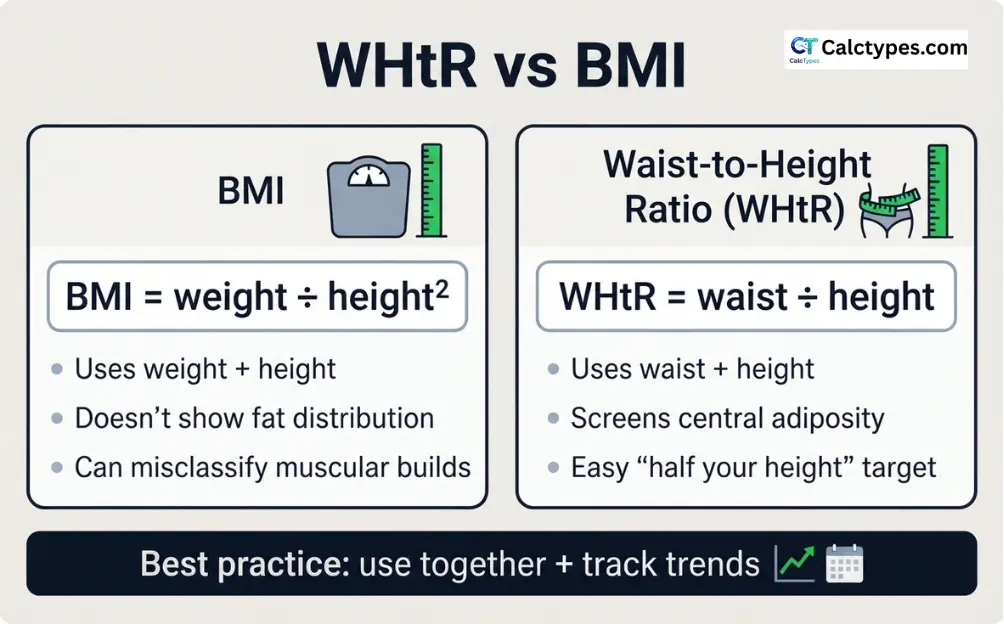
People often search “WHtR vs BMI” or “waist-to-height ratio vs waist-to-hip ratio” because they want to know which single number is “best.” In practice, each metric answers a different question. BMI is weight relative to height; it’s fast but can’t tell muscle from fat or where fat is stored. WHtR directly reflects waist size relative to height, making it more sensitive to central fat distribution. The waist-to-hip ratio (WHR) compares waist to hip circumference, which can highlight body shape patterns, but it introduces a second measurement (hips) and therefore another source of measurement error.
A useful “real-world” approach: use WHtR when your main question is central waist size relative to your frame, use BMI when you want a broad weight-for-height screen, and use body composition tools when you need more detail. For example, two people with the same BMI can have different WHtR due to different waist distribution; that’s one reason many people like WHtR as an add-on screen.
For composition-based estimates, compare with Body Fat % or the Navy method.
How do I measure waist correctly for WHtR?
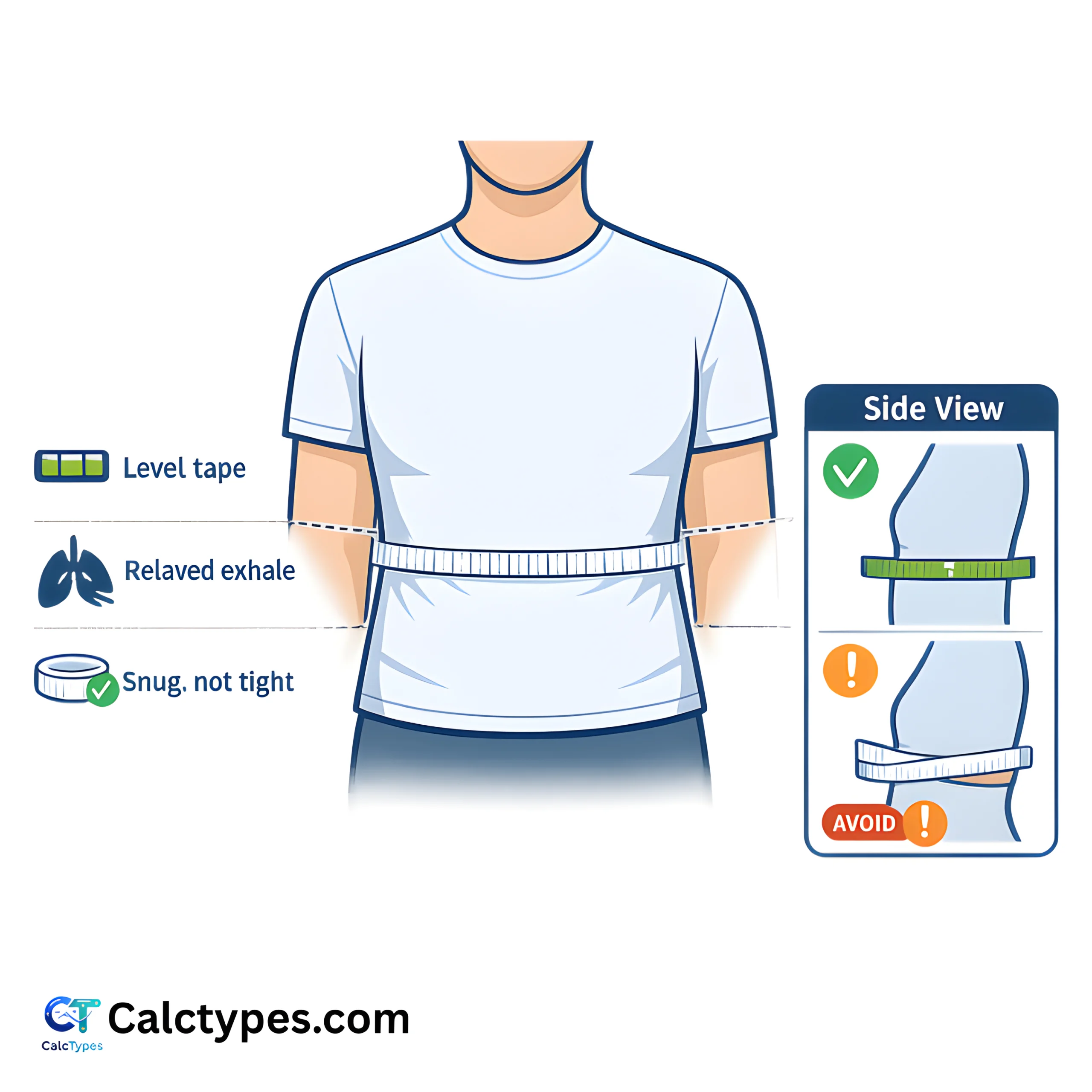
Waist measurement technique is the #1 driver of WHtR accuracy. Use a flexible tape (not elastic), stand relaxed, and measure on bare skin or thin clothing. The tape should be level all the way around and snug without compressing the skin. Take the reading after a normal exhale—not after sucking in and not after a deep inhale.
Where exactly do you measure? Many protocols use the narrowest point of the torso, or the midpoint between the lowest rib and the top of the hip bone if the narrowest point isn’t clear. Consistency matters more than perfection: pick a standard site and repeat it the same way every time. If you measure 2 cm higher one week and 2 cm lower the next, you can “create” fake progress (or fake regression) in the number.
If you also use the Navy Body Fat Calculator, keep the exact same measurement protocol described in Navy method: how to measure so your tools agree as closely as possible.
How can I lower my waist-to-height ratio (realistic approach)?
Because WHtR is driven primarily by waist circumference, lowering WHtR generally means reducing central waist size over time—usually through a combination of nutrition, activity, sleep, and stress management. The ratio won’t move dramatically day-to-day (and shouldn’t), so it’s best used as a weekly or biweekly trend metric.
A realistic framework: (1) create a sustainable calorie deficit if fat loss is appropriate for you, (2) prioritize protein and high-fiber foods that improve satiety, (3) include resistance training to preserve lean mass, and (4) add regular walking or other low-impact cardio to increase weekly energy expenditure. Sleep and stress matter because they influence appetite regulation and consistency—two things that determine whether the plan actually continues long enough to change waist size.
Also: improve measurement quality. Many people “lower WHtR” instantly just by measuring correctly (level tape, relaxed exhale). That’s not cheating—it’s removing error. Then track the true signal over time. If your WHtR remains elevated and you have other risk factors, a clinician can help interpret the number in context (labs, blood pressure, medications, underlying conditions).
Methodology
We calculate:
- WHtR = waist ÷ height (using consistent units)
- Half-height waist target = 0.5 × height
For composition-based estimates, consider Body Fat % or the Navy method. For tool navigation, use the Body Composition hub.
Sources & further reading
Limitations & Disclaimer
Planning estimate only. WHtR is a screening metric, not a diagnosis. It does not account for pregnancy, growth in children/teens, certain medical conditions, or individual differences in body composition. It should not be used for diagnosis, treatment decisions, or any compliance/clearance requirement.
Related calculators