Lean Body Mass Calculator (LBM) — Calculate Lean Mass From Body Fat %
Lean Body Mass (LBM) Calculator
Calculate lean body mass (LBM) from weight and body fat %. This is useful for body composition tracking and for LBM-based calorie equations like Katch–McArdle.
Content review
Calculator
Your Details
Your Results
Enter weight and body fat % to calculate lean body mass.
Assumptions & warnings
What this calculator assumes
- Body fat % is reasonably estimated using a consistent method.
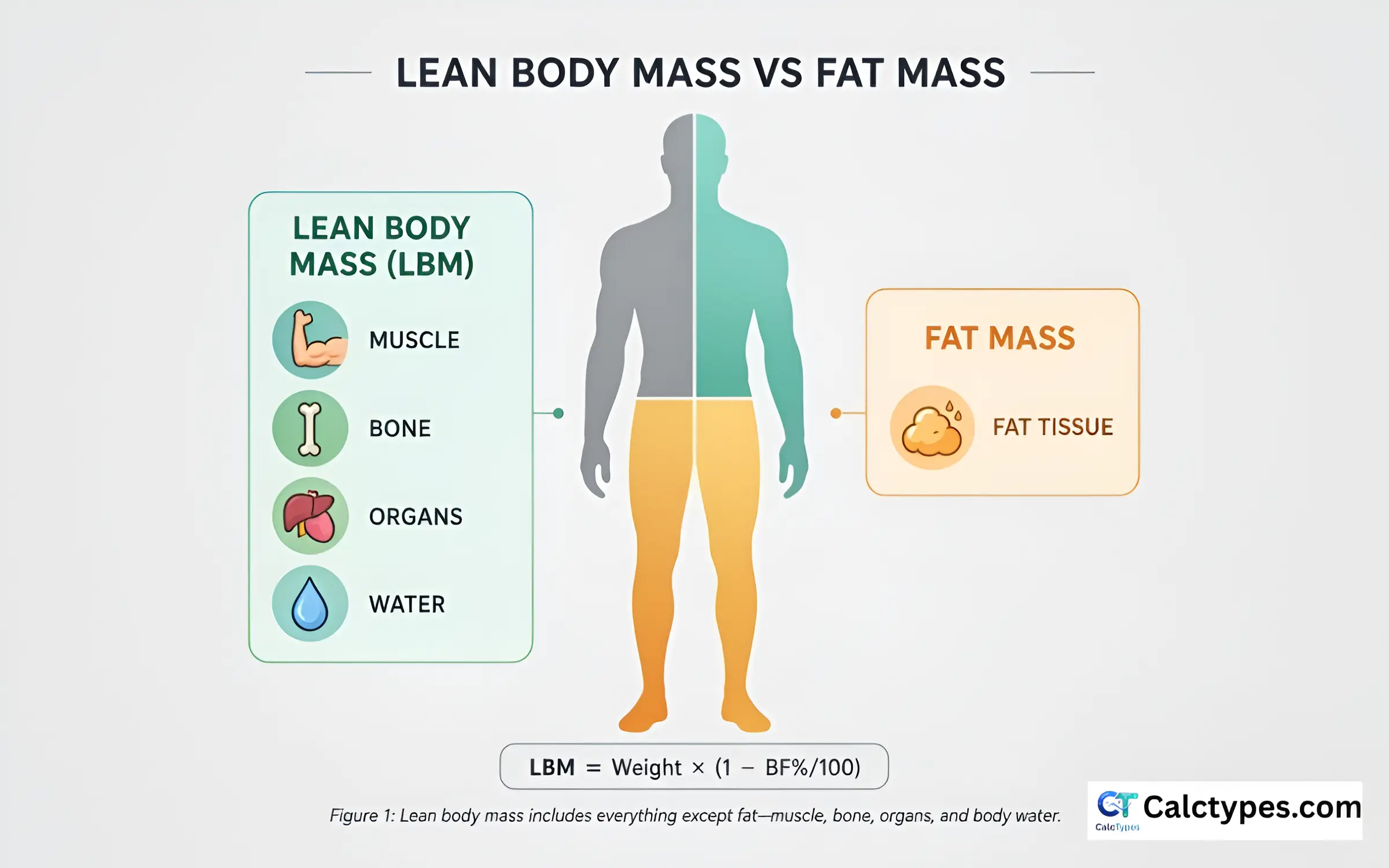
- LBM is calculated as: weight × (1 − bodyFat%/100).
Warnings (based on your inputs)
- Enter your details to see warnings.
Actions
Share / download / print
Report an issue
Found a bug or unclear result?
Send us the details and (if possible) the share link you generated.
On this page
Lean mass vs fat mass (chart)
Visual comparison
This chart updates when you enter values. It’s a visualization of the same math shown in the steps.
Visual guide
Calculation steps
Detailed breakdown
| Parameter | Value |
|---|---|
| Enter your details to see the breakdown. | |
Embed this calculator
Simple embed
If you embed on another site, replace PAGE_URL with the correct URL of this calculator page.
<iframe src="PAGE_URL" width="100%" height="900" style="border:0;border-radius:14px" loading="lazy"></iframe>
How to use
Step-by-step
- Choose Metric (kg) or US (lb).
- Enter your weight.
- Enter body fat % from a consistent measurement method.
- Review LBM and fat mass results, then use the steps/breakdown for verification.
Understanding lean body mass
LBM is not the same as “muscle mass”
Lean body mass is everything in your body that is not fat mass. That includes muscle, bone, organs, connective tissue, and body water. This is why LBM can change with hydration and measurement method—especially when body fat % is estimated from consumer BIA scales.
Accuracy & interpretation
How to interpret your number safely
Treat this as a planning and tracking estimate. If your body fat % input is off, your LBM result is off by the same direction. For practical use, the most reliable approach is to keep your measurement method consistent and watch the trend over time.
Limitations (important)
What can make the result misleading
- Body fat % uncertainty: LBM is only as good as your BF% estimate.
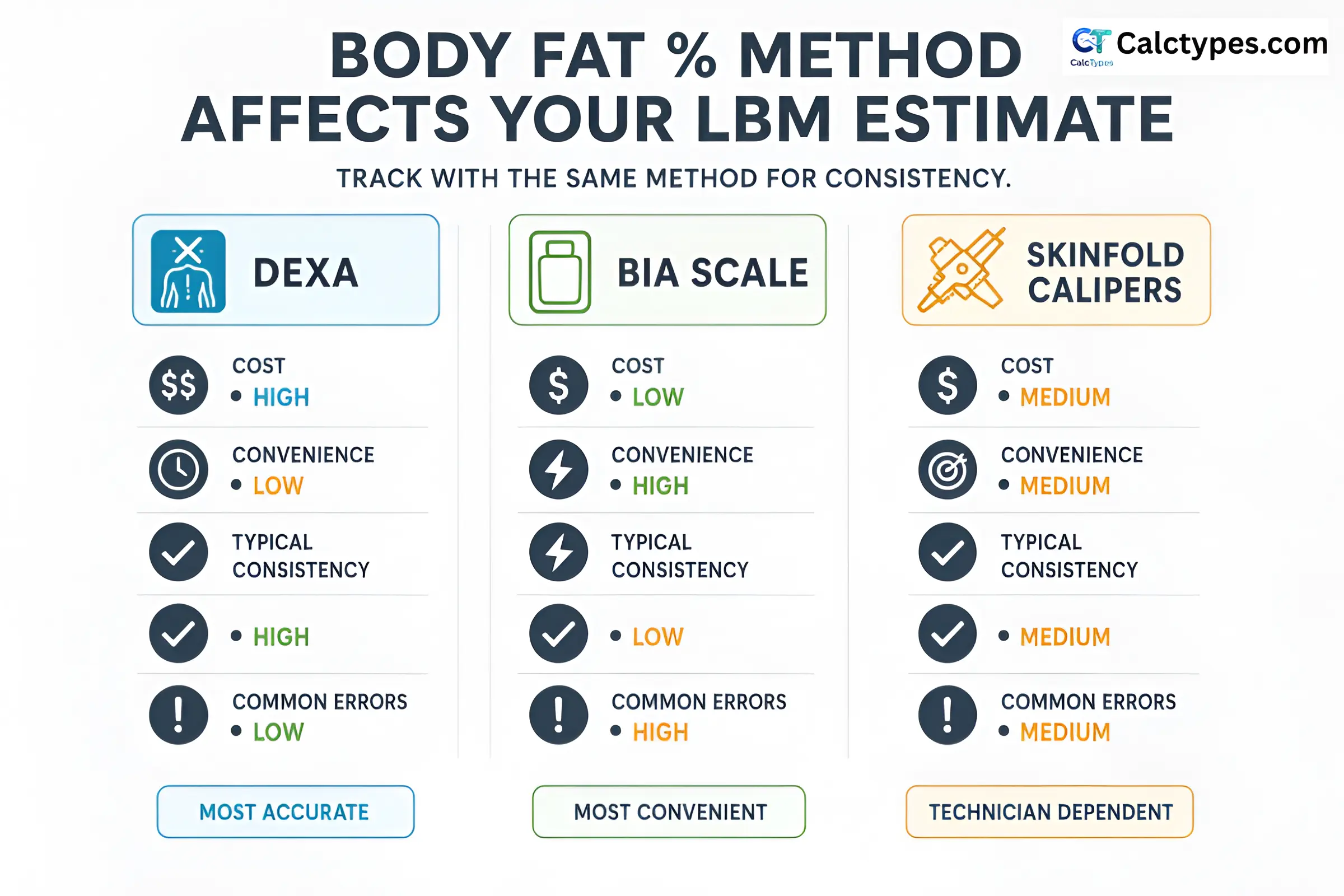
- Method differences: DEXA, calipers, and BIA can produce different BF% values.
- Not medical advice: not for diagnosis/treatment decisions.
Full policy: CalcTypes Disclaimer.
Methodology (how LBM is calculated)
Formula used
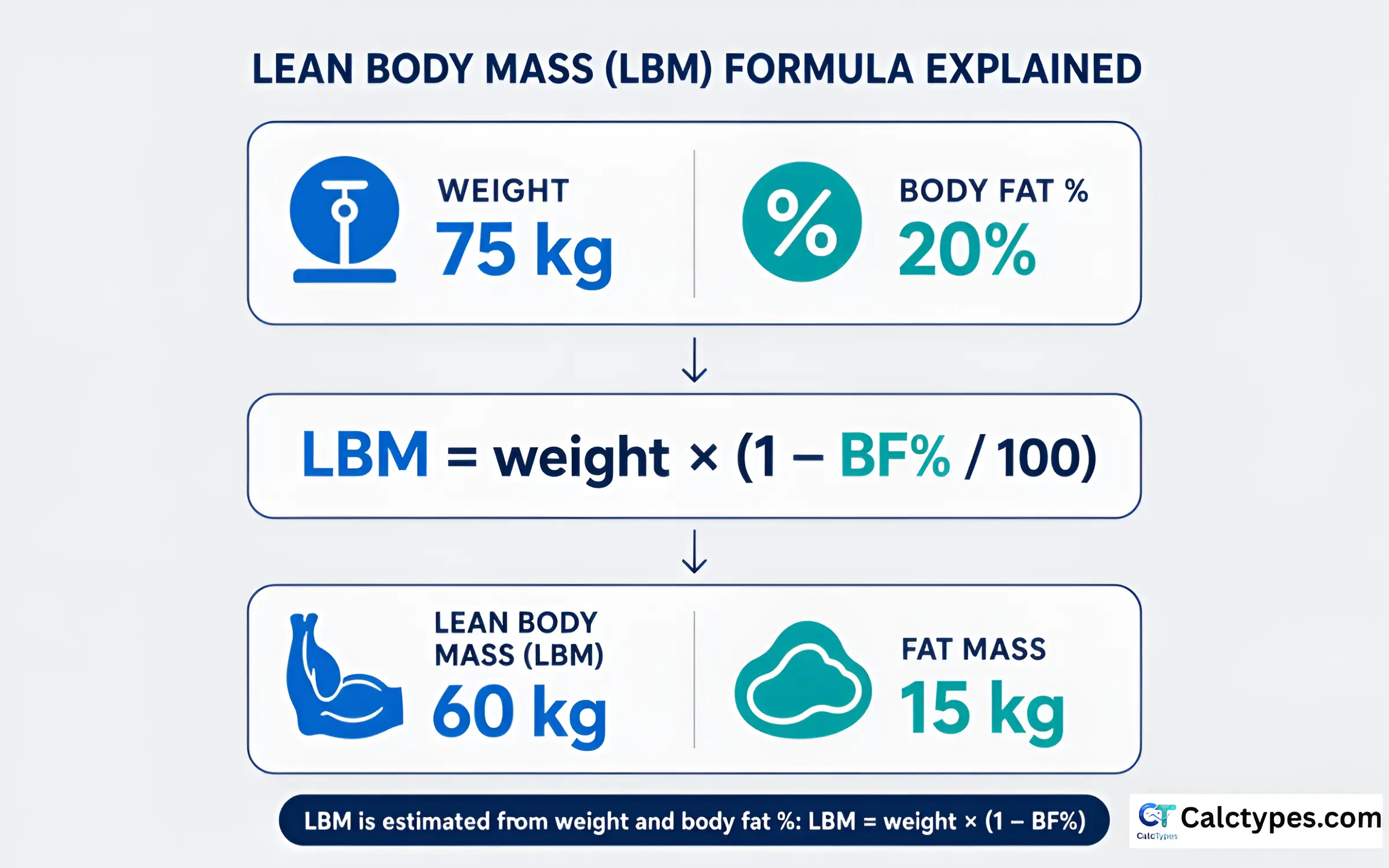
LBM = weight × (1 − bodyFat%/100)
Fat mass = weight − LBM
Questions people ask
What is lean body mass (LBM)?
Lean body mass (LBM) is your body weight minus the weight of your body fat. It includes muscle, bone, organs, connective tissue, and body water. People often confuse LBM with “muscle mass,” but muscle is only one component of lean mass. This matters because an LBM number can look “high” or “low” for reasons that have nothing to do with muscle—such as hydration changes, glycogen changes, and the method used to estimate body fat percentage.
A practical way to use LBM is as a trend. If you measure body fat % with the same method each time (for example, the same BIA scale under similar conditions), changes in LBM can help you understand whether weight changes are more likely coming from fat mass or from lean components. For calorie estimation formulas that use LBM, remember that any error in body fat % flows directly into the LBM result, so precision is limited.
How do I calculate lean body mass from body fat %?
The core relationship is: LBM = weight × (1 − bodyFat%/100). For example, if you weigh 70 kg and your body fat % is 20%, your LBM is 70 × (1 − 0.20) = 56 kg. Your fat mass would be 70 − 56 = 14 kg.
The reasoning is straightforward: body fat % is the share of your total weight that is fat. If 20% is fat, then 80% is non-fat (lean) mass. Multiplying your body weight by that “non-fat fraction” yields an estimate of lean body mass. This is why it’s essential to use a body fat % value that is at least reasonably consistent and within a realistic range for you—otherwise the calculator can still produce a number, but it won’t be a meaningful estimate.
Is LBM the same as fat-free mass (FFM)?
In many consumer contexts, LBM and fat-free mass (FFM) are used interchangeably, because both refer to “everything that isn’t fat.” Some technical definitions distinguish them slightly (for example, whether essential lipids are considered), but for an educational calculator like this—based on body fat %—treating them as equivalent is usually fine.
The practical takeaway: if you see “FFM” on a scale report and “LBM” in a calculator, they are often describing the same concept. What matters more than the label is the measurement method and its consistency over time.
Why is LBM important for Katch–McArdle?
The Katch–McArdle approach estimates basal metabolic rate (BMR) using lean body mass, on the idea that lean tissues generally have higher metabolic activity than fat tissue. That means your BMR estimate can change meaningfully if your LBM estimate changes.
However, because your LBM here depends on body fat %, any body fat % error becomes a BMR error if you plug the LBM into an LBM-based equation. If you use Katch–McArdle, the safest approach is to keep your measurement method consistent and focus on trend-based adjustments. You can run the full equation in our Katch–McArdle calculator.
What’s a common mistake when using an LBM calculator?
The most common mistake is treating the result as “precise” when body fat % is estimated with a method that has day-to-day noise. If you enter a body fat % value that swings by a few points depending on hydration, sleep, or time of day, your LBM result will swing too—even if your true body composition did not change.
A second common mistake is mixing methods (DEXA one month, BIA next month, calipers later) and comparing the numbers as if they are perfectly compatible. They often are not. If you want useful tracking, pick one method and standardize your conditions (time, hydration, pre-meal state).
Can LBM change quickly?
True lean tissue (like muscle) generally does not change dramatically overnight. But measured “lean mass” can appear to change quickly because LBM includes body water and glycogen. After high-carb meals, training changes, illness, or dehydration, your scale/measurement method may report changes that look like lean mass changes.
That’s why it’s smarter to evaluate LBM trends across weeks/months rather than day-to-day. If you want a stable signal, measure under consistent conditions and interpret changes in context: training, diet, hydration, and measurement method.
Is this calculator suitable for children or teens?
This calculator provides an educational estimate and is not designed for pediatric assessment. Children and teens are still growing and have different body composition patterns, and body fat % estimation methods can be especially variable in younger populations.
If you are under 18 (or calculating for someone under 18), it’s safer to use clinician-guided interpretation and avoid using LBM numbers to drive restrictive dieting or aggressive training plans. If there are concerns about growth, weight change, or health, consult a qualified healthcare professional.
How should I use LBM for goals like fat loss or muscle gain?
LBM can be helpful as a tracking lens: if your body weight is changing, LBM helps you estimate how much of the change might be fat vs non-fat components—provided your body fat % estimate is consistent. For fat loss goals, you generally want fat mass to trend downward while maintaining lean mass as much as possible. For muscle gain goals, you may want lean mass to trend upward over time.
The safest approach is to combine LBM trends with performance, measurements (waist/hip), photos (if comfortable), and how you feel. Don’t use a single LBM reading as a “grade.” Use it as one data point in a bigger picture.
Sources
Disclaimer
This calculator and content are for educational purposes only and are not medical advice. Results are estimates and can be misleading when body fat % inputs are inaccurate or inconsistent.
Do not use this tool for diagnosis, treatment decisions, or medical clearance. For medical concerns, consult a qualified healthcare professional. Read the full disclaimer: Full Disclaimer.