Molarity Calculator
Molarity Calculator: Mass, Moles, Volume & Dilution
Calculate molarity from moles or grams, work backwards to mass or solution volume, and prepare dilutions from stock solutions. See formulas, unit conversions and complete steps for each result.
Quick answer: Molarity (M) is the moles of dissolved solute divided by the final solution volume in litres. For example, 0.25 mol of solute in 0.50 L of final solution gives 0.50 M. The calculator can also use solute mass and its molar mass.
Enter your values
Formula: M = n / V(L); n = mass(g) / molar mass(g/mol); C₁V₁ = C₂V₂
Final solution volume matters: dissolving 5 g in 100 mL of water is not necessarily the same as making the solution up to exactly 100 mL. Enter the volume of the finished solution.
Your calculation result
↑ Review entered valuesChoose a calculation mode, enter values and select Calculate.
Educational calculation aid. Results use approximate conventional atomic weights unless a molecular weight is supplied. Check measurement uncertainty, composition and units for laboratory work.
How to Calculate Molarity Step by Step
A molarity calculator measures molar concentration: how many moles of a solute are present in each litre of the final solution. The standard symbol for molarity is uppercase M, with units mol/L. First find the solute amount in moles, then divide it by the final volume expressed in litres.
Step 1 — Find the amount of solute in moles
If you already know the number of moles, use it directly. If your problem gives grams, calculate moles from the mass and molar mass. For NaCl, the approximate molar mass is 58.44 g/mol, so 5.844 g represents approximately 0.1000 mol. The calculator accepts the chemical formula and computes the formula mass, or you can enter a known molecular weight directly.
Step 2 — Convert the final volume to litres
Divide millilitres by 1,000 to obtain litres. For example, 250 mL is 0.250 L. Microlitres and millimoles can also be entered using the unit selectors. Always use the volume of the completed solution, rather than treating the initial solvent volume as the finished volume.
Step 3 — Divide moles by final solution volume
For 0.1000 mol of NaCl in 1.000 L of final solution, molarity is 0.1000 M. If that same amount occupied 0.500 L, concentration would be 0.2000 M. At a fixed solute amount, a smaller final volume means a higher molarity.
What does a 1 M solution mean?
A 1 M solution contains one mole of the dissolved substance per litre of final solution.
It does not necessarily contain one mole per litre of water added. The amount of material in a mole depends on its molar mass, so a 1 M sodium chloride solution and a 1 M glucose solution require different masses of solute.
How to Calculate Molarity from Grams and Millilitres
To calculate molarity from grams, use the formula M = mass / (molar mass × volume in litres). The mass must be in grams, molar mass in grams per mole, and the final solution volume in litres. Unit selection is part of the calculation, not a separate approximation.
Worked example: Suppose 2.922 g of sodium chloride is dissolved and the final solution is adjusted to 500 mL. Sodium chloride has a molar mass of approximately 58.44 g/mol. The number of moles is 2.922 ÷ 58.44 ≈ 0.0500 mol. Divide by 0.500 L to obtain approximately 0.100 M.
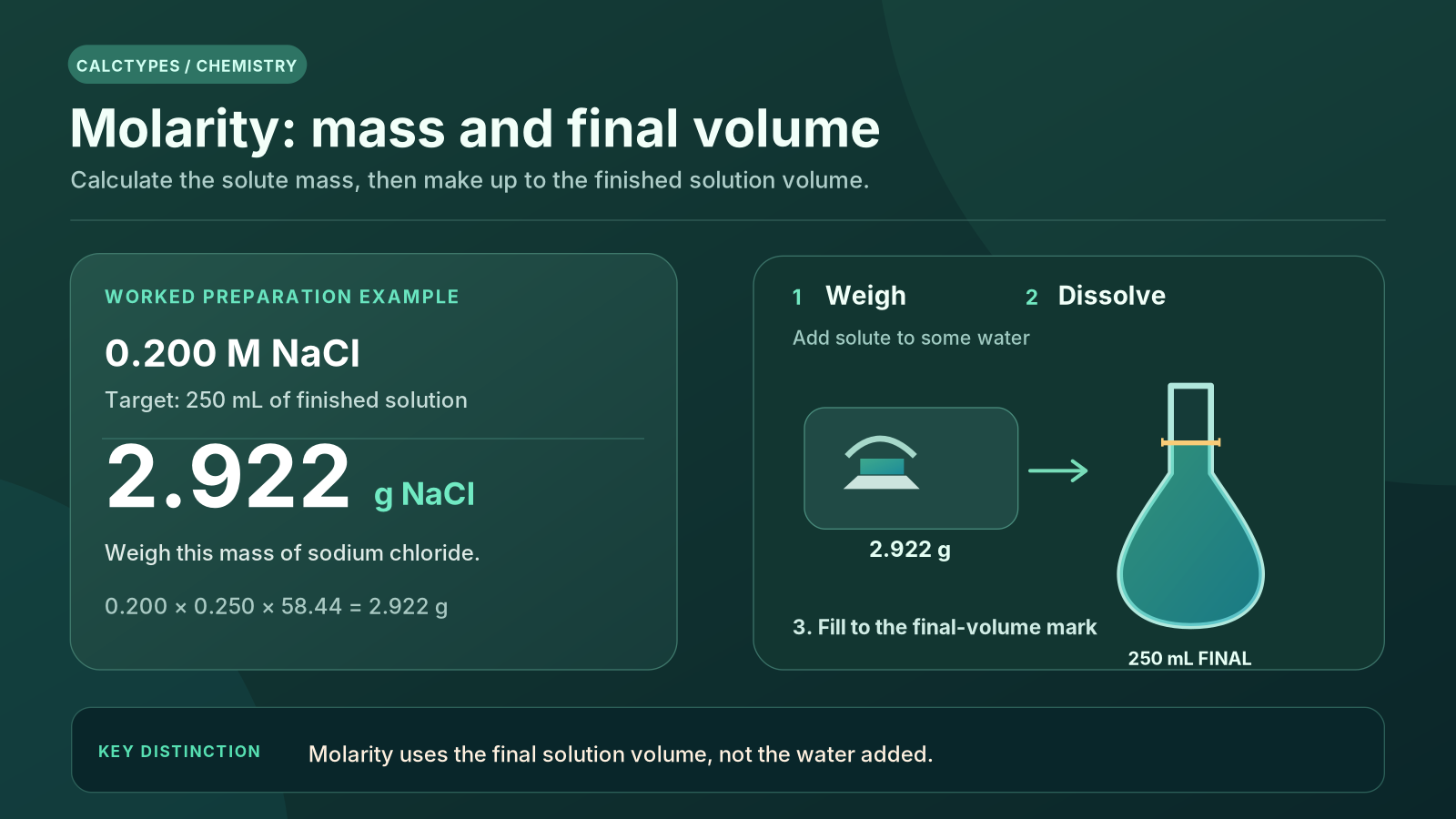
To find the mass needed for a required concentration, reverse the equation: mass = M × V × molar mass. For 250 mL of a 0.20 M NaCl solution, the theoretical solute mass is approximately 2.922 g.
How to convert mg/mL to molarity
Because 1 mg/mL is numerically equal to 1 g/L, divide mg/mL by the molecular weight in g/mol. For example, 9 mg/mL of NaCl corresponds to about 0.154 M. This shortcut assumes the stated mg/mL value is the mass concentration of the same solute whose molar mass you enter.
Working with protein molecular weights
For a protein, enter the molecule’s appropriate molecular weight manually, usually in g/mol (numerically equal to Da). Verify that the weight applies to the actual form of the protein, such as a fusion tag or multimer; a simple elemental formula is not always practical. The chemical formula box should be left blank when using manual molecular weight.
Molarity Dilution Calculator: How Much Stock Solution Is Needed?
Use C₁V₁ = C₂V₂: the stock volume needed is V₁ = C₂V₂ ÷ C₁.
When you dilute a stock solution without chemical reaction, the number of moles of solute is conserved. That leads to C₁V₁ = C₂V₂, where C₁ is the stock concentration, V₁ the volume of stock to take, C₂ the target concentration, and V₂ the intended final solution volume.
Example: To make 250 mL of 0.10 M solution from 1.0 M stock, measure 25.0 mL stock, then add solvent until the total solution volume is 250 mL. The nominal difference is 225 mL, but the procedure is to make up to the final mark because liquid volumes may not be perfectly additive.
Can dilution increase molarity?
No. Adding solvent decreases concentration. The dilution mode rejects a final concentration higher than the stock concentration. Concentrating a solution by removing solvent requires a different calculation and may change the composition or chemistry.
Are mM and µM supported?
Yes. Use the selectors for M, mM, µM and nM; the calculator converts them to the same base unit before calculating. For example, 100 mM is 0.100 M and 500 µM is 0.000500 M. This is especially useful for stock solutions and biochemical work.
Common Molarity Mistakes and Calculation Limits
The most common mistake is to confuse the amount of solvent added with the volume of the solution after dissolving the solute. Another mistake is to enter millilitres as if they were litres, causing a thousand-fold error. In mass-based calculations, be careful to use molecular weight for the exact chemical form, including waters of hydration when applicable.
For instance, CuSO4 and CuSO4·5H2O have different molar masses. If you weigh the pentahydrate, enter its full hydrate formula. This calculator supports ordinary element symbols, nested brackets and hydrate dot notation such as CuSO4·5H2O. It does not model solution non-ideality, acid-base equilibria or changing chemical species.
Use a sensible number of significant figures based on your experimental measurements. Displayed digits are for convenient checking, not a guarantee of laboratory accuracy. For formal lab preparation or critical work, follow applicable procedures, chemical safety information and validated measurement methods.
Molarity Calculator Worked Examples: Try Every Calculation
The examples below explain the problem, the units, the calculation and the final answer. Select Check this worked example in the calculator to fill in the exact values automatically, switch to the correct mode and calculate the result. You can then change any input to explore a different problem.
Example 1: Molarity from moles and millilitres
Problem: A student dissolves 0.25 mol of solute and makes the final solution volume 500 mL. What is the concentration?
Method: Convert 500 mL to 0.500 L. Then divide 0.25 mol by 0.500 L.
Answer: 0.50 M (0.50 mol/L). The molarity is based on the completed solution volume, not the quantity of water poured in first.
Example 2: Molarity from grams: 2.922 g NaCl in 500 mL
Problem: A problem supplies 2.922 g sodium chloride and a final solution volume of 500 mL. Find molarity using the NaCl formula.
Method: NaCl molar mass ≈ 58.44 g/mol; moles ≈ 2.922 / 58.44 = 0.0500 mol. The final volume is 0.500 L.
Answer: About 0.100 M. The calculator looks up the formula weight, performs both conversions and shows the complete result.
Example 3: How many grams for 250 mL of 0.20 M NaCl?
About 2.92 g of NaCl (0.250 L × 0.20 mol/L × 58.44 g/mol).
Problem: You want 250 mL of a 0.20 M NaCl solution. What mass of solute is required?
Method: Moles required = 0.20 mol/L × 0.250 L = 0.050 mol. Multiply by approximately 58.44 g/mol.
Answer: About 2.922 g NaCl. Dissolve it and make the final solution up to 250 mL, rather than adding it to exactly 250 mL of water.
Example 4: How many moles are in 100 mL of 250 mM?
0.025 mol (0.100 L × 0.250 mol/L).
Problem: A sample has a stated concentration of 250 mM and a volume of 100 mL. Find the amount of dissolved solute.
Method: 250 mM = 0.250 mol/L. 100 mL = 0.100 L. Moles = 0.250 × 0.100.
Answer: 0.025 mol (25 mmol). The calculator accepts mM and mL directly, preventing common thousand-fold unit errors.
Example 5: How much final volume gives 0.30 M?
0.50 L, because volume = moles ÷ molarity = 0.150 ÷ 0.30.
Problem: You have 0.150 mol of dissolved solute and need a solution at 0.30 M. Find the final volume.
Method: Rearrange M = n / V to V = n / M. Divide 0.150 mol by 0.30 mol/L.
Answer: 0.500 L, or 500 mL. This is the target volume of the finished solution.
Example 6: Dilution: 1.0 M stock to 0.10 M, final 250 mL
Problem: Prepare 250 mL of 0.10 M solution from a 1.0 M stock. How much stock is needed?
Method: Use C₁V₁ = C₂V₂. V₁ = (0.10 × 250 mL) / 1.0 = 25 mL.
Answer: 25 mL of stock. Add diluent to a final total volume of 250 mL; do not assume exactly 225 mL of solvent must be added.
Example 7: Convert 9 mg/mL NaCl to molarity
Problem: A material is labelled 9 mg/mL NaCl. Convert mass concentration into molar concentration.
Method: Because 9 mg/mL = 9 g/L, divide 9 g/L by NaCl molar mass (about 58.44 g/mol).
Answer: About 0.154 M, equivalent to about 154 mM. This conversion requires the correct solute molecular weight.
Example 8: Hydrated salt: copper sulfate pentahydrate
Problem: You weigh 24.968 g of CuSO₄·5H₂O and bring the final solution to 500 mL. Do not use anhydrous CuSO₄ molar mass.
Method: The hydrate formula includes five waters of crystallisation. Its molar mass is approximately 249.68 g/mol, so the solute amount is approximately 0.100 mol.
Answer: Approximately 0.200 M. The formula parser uses the entered hydrate, not the anhydrous compound.
Questions People Ask About the Molarity Calculator
Explore the detailed explanations below. Each answer includes an example that you can load straight into the calculator above.
What is the formula for molarity?
Molarity = moles of solute ÷ litres of solution (M = n/V).
Molarity, symbol M, is an amount concentration. It tells you how many moles of a specified solute are contained in one litre of the finished solution. The defining equation is M = n/V, where n is moles of solute and V is final solution volume in litres. A value of 1.0 M means one mole of solute per litre of solution, not one mole per litre of solvent initially added.
To use the relationship correctly, identify what the question already gives you. If the amount is in grams, obtain moles by dividing by the molar mass. If the volume is in mL, divide by 1,000. For example, 0.25 mol in a final volume of 500 mL produces 0.50 M.
How do you calculate molarity from grams?
Convert grams to moles (grams ÷ molar mass), then divide by the solution volume in litres.
This is a two-stage calculation. First turn grams into moles using n = mass ÷ molar mass. Next divide those moles by the final solution volume in litres. For an ordinary compound, the molar mass can be determined from its chemical formula. For a protein or a chemically unusual formulation, use the verified molecular weight of the material you actually have.
For example, 2.922 g NaCl in 500 mL of final solution gives about 0.0500 mol divided by 0.500 L, which is 0.100 M. The answer would be different if the final volume differed from 500 mL. Remember to enter hydrated compounds with their full formula when they are the material being weighed.
How do you calculate molarity from millilitres?
Convert millilitres to litres by dividing by 1,000, then divide the moles by that volume.
Millilitres are a convenient measurement unit in laboratories, but the molarity definition uses litres. Convert volume by multiplying the millilitre amount by 0.001, then use M = n/V. In the calculator you can choose mL directly; the conversion is performed internally before the result is calculated.
For a concrete example, 5 mmol of solute in 50 mL of finished solution is 0.005 mol / 0.050 L = 0.100 M. Do not divide by 50 as if it were 50 litres: that would introduce a factor-of-1,000 error. This distinction applies whether the solute was measured in moles, millimoles or grams.
How many grams do I need to prepare a solution at a target molarity?
Multiply the target molarity by the volume in litres to get moles, then multiply by the molar mass to get grams.
Work backward from the desired concentration. Multiply target molarity (mol/L) by final solution volume (L) to obtain the required number of moles. Then multiply by the solute molar mass (g/mol) to obtain the mass in grams. The relationship is mass = M × V × molar mass. It gives the theoretical amount of solute, assuming the stated substance is the one being prepared.
To prepare 250 mL of 0.20 M NaCl, you need 0.20 × 0.250 = 0.050 mol, corresponding to about 2.922 g NaCl. Dissolve and bring the solution up to the required final volume. The calculator also supports unit changes such as mM, µM, mL and µL.
How do you dilute a stock solution using molarity?
For a dilution without reaction or loss of solute, use C₁V₁ = C₂V₂.
C₁ is the stock concentration, V₁ is the amount of stock to transfer, C₂ is the desired concentration, and V₂ is the desired final volume. Rearranging gives V₁ = C₂V₂/C₁. Before you calculate, put both concentrations in compatible units and both volumes in compatible units.
For example, preparing 250 mL of 0.10 M solution from a 1.0 M stock requires 25 mL stock. Place the stock in suitable equipment, then add solvent until the total volume reaches 250 mL. The difference between V₂ and V₁ is not always the exact physically measured solvent volume because mixing volumes can be non-additive.
How do you convert mg/mL to molarity?
1 mg/mL equals 1 g/L, so divide the mg/mL value by the molar mass (g/mol) to get mol/L.
An mg/mL value is a mass concentration, whereas molarity is an amount concentration. To convert, first observe that 1 mg/mL equals 1 g/L numerically. Divide that g/L concentration by the compound molar mass in g/mol. The unit becomes mol/L. You cannot accurately convert mg/mL to M without a molar mass.
For example, 9 mg/mL NaCl corresponds to 9 g/L ÷ approximately 58.44 g/mol = 0.154 M. For a protein, choose the molar mass for the correct oligomeric state or molecular construct; otherwise the molarity will be misleading. This calculator lets you enter a formula or a known molecular weight.
What is the difference between molarity and molality?
Both measure concentration, but they use different denominators. Molarity is moles of solute per litre of final solution.
Molality, symbol lowercase m, is moles of solute per kilogram of solvent. The solvent is only part of the finished solution, and the final solution volume is not generally the same as the solvent volume.
Because solution volume can change with temperature, a given sample’s molarity may change as it expands or contracts; its molality is based on masses and is not directly affected in the same way. A numerical conversion between M and m generally needs the solution density and solute molar mass. Use our separate Molality Calculator for mass-based examples.
Can the molarity calculator handle hydrates and proteins?
Yes, within clearly defined limits.
A hydrate contains water of crystallisation as part of its chemical formula, so its molar mass is not the same as the corresponding anhydrous salt. When the substance being weighed is CuSO₄·5H₂O, enter that complete hydrate formula; entering only CuSO₄ would overestimate moles for the same weighed mass.
For a protein, the elemental formula may be inconvenient or may not represent the actual purified construct. Instead, enter a reliable molecular weight in g/mol and leave the formula field empty. A 2 mg/mL protein preparation with a molecular weight of 66,000 g/mol corresponds to about 30.3 µM, assuming that molecular weight describes the relevant species.
Chemistry Data and Further Reading
For primary reference material on chemical nomenclature and atomic weights, consult the IUPAC Periodic Table and CIAAW Standard Atomic Weights. These references support checking formulas and atomic masses; they do not replace your experimental procedure.
Assumptions and Limitations
Assumptions
- Standard atomic weights (IUPAC/CIAAW conventional values) are used.
- Formulas and equations are entered correctly, with element symbols capitalised properly.
- Volume is the final volume of the solution, not the volume of water added.
Limitations
- Textbooks may round atomic weights or significant figures differently.
- Calculations do not show whether a reaction happens or is safe.
- For real laboratory work, follow your procedures and safety data sheets.
- Solution volume can change slightly on mixing and with temperature.
Disclaimer
Please read before relying on this page. The Molarity Calculator works from the amounts you enter and assumes ideal solution volume. Real solutions can change volume on mixing, and purity matters. Use it for study and planning, and follow your laboratory’s procedures and safety data sheets when preparing solutions.
Laboratory safety. Calculations do not show whether a reaction or preparation is safe.
Your responsibility. Results are estimates for general information and education only, and nothing here is professional advice. You use this page at your own risk; to the fullest extent permitted by law, CalcTypes, its authors and reviewers accept no liability for loss, injury or damage arising from reliance on it. Spotted an error? Use “Report an issue” or our contact page. Full terms: Disclaimer · Terms of use.