Molality Calculator
Molality Calculator: Solute Moles, Solvent Mass & Conversions
Calculate molality from moles or grams of solute and the mass of solvent. Also solve for solute mass, use mass percentage, or convert between molality and molarity when solution density is known.
Quick answer: Molality (m) is the number of moles of solute divided by the mass of the solvent in kilograms. For example, 0.20 mol of solute dissolved in 0.50 kg of solvent yields 0.40 mol/kg. Unlike molarity, molality does not use final solution volume.
Enter your values
Formula: m = n / mass of solvent(kg); n = solute mass(g) / molar mass(g/mol)
The denominator is the mass of solvent alone. If only total solution mass is available, subtract the mass of solute first. Conversion to or from molarity needs the solution density and molar mass.
Your calculation result
↑ Review entered valuesChoose a calculation mode, enter values and select Calculate.
Educational calculation aid. Results use approximate conventional atomic weights unless a molecular weight is supplied. Check measurement uncertainty, composition and units for laboratory work.
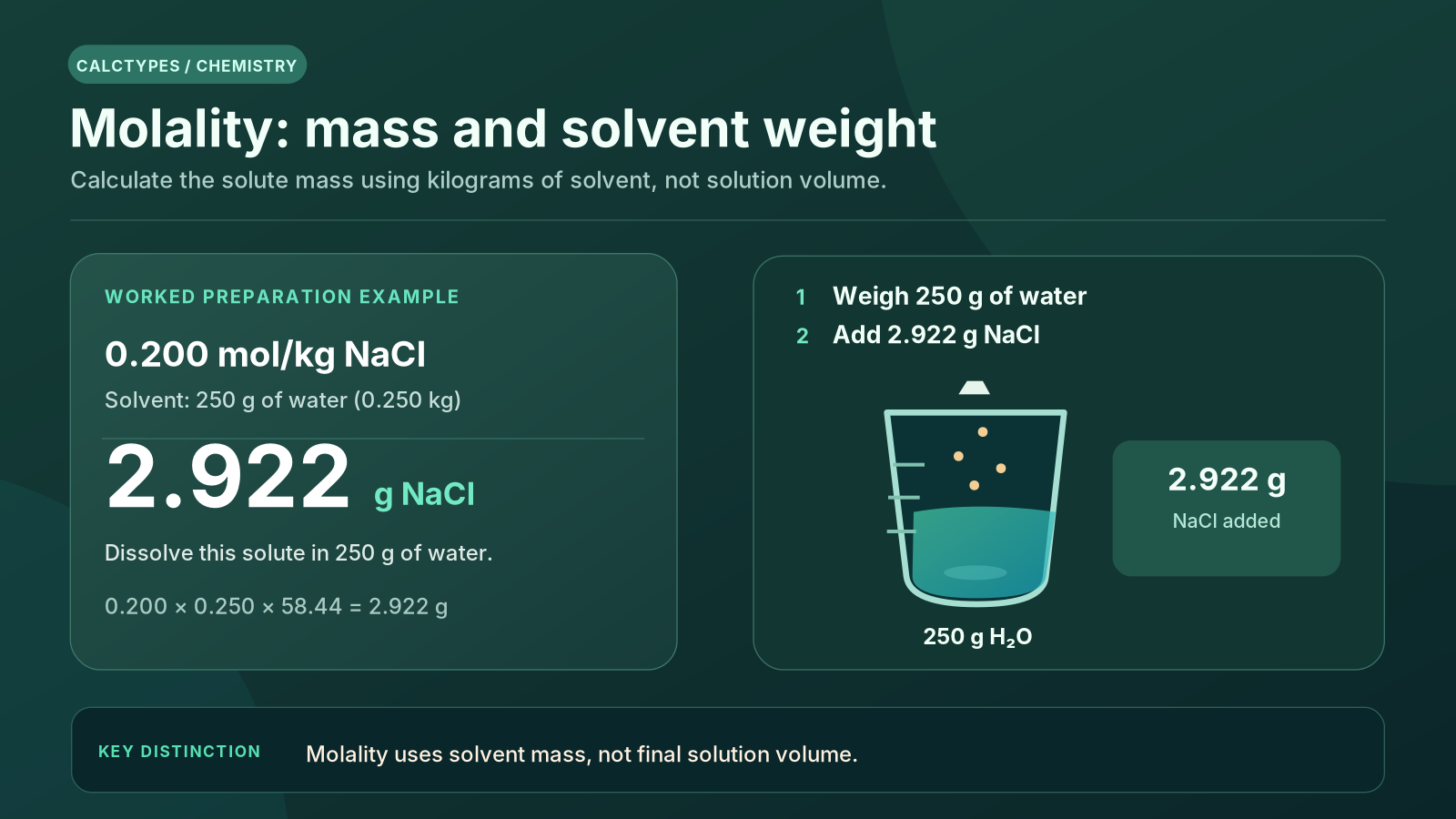
How to Calculate Molality from Solute Moles and Solvent Mass
Molality measures the amount of dissolved solute relative to the mass of the solvent. Its symbol is lowercase m, and its usual units are mol/kg. Calculate the solute amount in moles, weigh or determine the solvent mass, convert that mass to kilograms, then divide.
Worked example using moles
Suppose a solution contains 0.20 mol of solute dissolved in 500 g of solvent. Convert 500 g to 0.500 kg; then divide 0.20 mol by 0.500 kg. The molality is 0.40 mol/kg. Notice that the volume of the resulting solution is not required for this calculation.
Why is solvent mass different from solution mass?
The solvent is the material that does the dissolving, such as water. The solution includes both the solvent and the dissolved solute.
If you have 10 g of solute in 100 g of final solution, the solvent mass is 90 g, not 100 g. Using the whole 100 g as the denominator would underestimate molality.
Is molality affected by temperature?
Molality is defined using mass, which does not change merely because the solution expands or contracts with temperature.
Molarity instead uses solution volume, which may vary with temperature. This is one reason molality is useful for temperature-dependent thermodynamic and colligative-property calculations.
How to Calculate Molality from Grams and Molar Mass
Many textbook problems give the mass of a solute rather than its amount in moles. First divide its mass in grams by its molar mass in grams per mole. Then divide the result by the kilograms of solvent. You can use the chemical formula field to calculate an ordinary compound’s molar mass automatically.
Example: Dissolve 5.844 g NaCl in 100 g water. The approximate molar mass of NaCl is 58.44 g/mol. The amount is about 0.1000 mol, and water mass is 0.100 kg; therefore molality is about 1.000 mol/kg.
Find solute mass for a required molality
Reverse the formula: solute moles = molality × solvent mass in kg. Multiply those moles by the solute molar mass to get grams. For 0.50 m NaCl in 200 g solvent, solute moles equal 0.10 mol and the required mass is approximately 5.844 g.
What if I know only the total solution mass?
Use the Calculate from total solution mass mode.
Enter both the solute mass and total solution mass. The calculator subtracts the solute mass to determine the solvent mass and rejects inputs in which the solute mass would leave no solvent.
Molality Calculator from Mass Percentage (w/w)
A mass percentage expresses how much solute is present in a given mass of solution. For example, 10% w/w means 10 g of solute in every 100 g of solution, with the remainder (90 g in this example) being solvent. The mass percentage is not a volume percentage.
For a 10% by-mass NaCl solution, take 100 g of total solution as a convenient example. The solute is 10 g, approximately 0.1711 mol of NaCl; the solvent is 90 g (0.090 kg). The molality is about 1.901 mol/kg. The calculator accepts any suitable total solution mass and reports the working.
Using percent w/w is useful when your problem statement does not give solvent mass directly. If you have volume percent or mass/volume percent instead, this mode is not the correct conversion without additional information.
How to Convert Molarity to Molality (and Molality to Molarity)
Molarity and molality cannot usually be converted using only the concentration value. You also need the density of the solution and the molar mass of the solute. Density connects volume to total solution mass, while molar mass connects solute moles to solute mass. The density should be for the actual solution at the temperature of interest.
Example: Convert molarity to molality
Consider a 1.0 M NaCl solution with a specified density of 1.05 g/mL. One litre has a total mass of 1,050 g and contains about 58.44 g NaCl. That leaves about 991.56 g of solvent, or 0.99156 kg. Divide 1.0 mol by 0.99156 kg to obtain approximately 1.009 mol/kg.
This density is a hypothetical example supplied for demonstration, not a recommended or measured density for every 1.0 M NaCl solution. Do not assume that all aqueous solutions have density 1.00 g/mL.
Which is better for colligative properties?
Molality often appears in idealised freezing-point depression and boiling-point elevation calculations, because it uses solvent mass and is not directly affected by volume expansion.
Whether a real calculation requires an activity coefficient or other correction depends on the chemistry and concentration.
Molarity vs. Molality: Difference, Units and Examples
| Feature | Molarity (M) | Molality (m) |
|---|---|---|
| Definition | Moles per litre of final solution | Moles per kilogram of solvent |
| Denominator | Solution volume | Solvent mass |
| Unit | mol/L | mol/kg |
| Temperature sensitivity | May change when volume changes | Not directly affected by thermal expansion |
| Common use | Solution preparation, reactions, dilution | Colligative properties, solvent-based concentrations |
For some very dilute aqueous solutions, molarity and molality can have similar numerical values. They are still different quantities; substituting one for the other without considering density and composition is not generally reliable.
Common Molality Errors, Hydrates and Measurement Limits
Check three common issues: (1) entering the mass of the entire solution instead of solvent alone; (2) using grams as though they were kilograms; and (3) calculating moles using a molar mass for the wrong hydrated or salt form. For example, CuSO4 and CuSO4·5H2O do not have identical molar masses, and weighing the hydrate requires its own formula mass.
The calculator performs standard amount and mass relationships; it does not predict solubility, chemical dissociation, changing composition, or real-solution activity effects. Report experimental results with appropriate significant figures. If you are preparing an actual laboratory solution, consult suitable handling guidance and a validated procedure.
Molality Calculator Worked Examples: Try Every Calculation
The examples below explain the problem, the units, the calculation and the final answer. Select Check this worked example in the calculator to fill in the exact values automatically, switch to the correct mode and calculate the result. You can then change any input to explore a different problem.
Example 1: Molality from moles: 0.20 mol in 500 g solvent
Problem: A solution is made from 0.20 mol of a dissolved solute and 500 g of solvent. Calculate molality.
Method: Convert 500 g of solvent to 0.500 kg and divide 0.20 mol by 0.500 kg.
Answer: 0.40 mol/kg (0.40 m). The total solution volume is not relevant.
Example 2: Molality from grams: 5.844 g NaCl in 100 g water
Problem: Dissolve 5.844 g NaCl in 100 g of water. Calculate the molality of the mixture.
Method: 5.844 g / 58.44 g/mol ≈ 0.1000 mol NaCl. Solvent mass = 0.100 kg, so divide 0.1000 by 0.100.
Answer: Approximately 1.000 mol/kg. Notice that 100 g is the water (solvent) mass, not the total mass after adding salt.
Example 3: Find the NaCl mass for 0.50 m in 200 g solvent
Problem: Prepare a solution with 0.50 mol/kg NaCl using 200 g of solvent. Find the salt mass.
Method: 0.50 mol/kg × 0.200 kg = 0.100 mol NaCl. Convert to grams using 58.44 g/mol.
Answer: About 5.844 g NaCl. This is a mass-based target, not a target final solution volume.
Example 4: Find solvent mass for 0.30 mol at 0.60 m
Problem: You have 0.30 mol solute and require a 0.60 m solution. What solvent mass is needed?
Method: Rearrange m = n / kg solvent to kg solvent = n / m = 0.30 / 0.60.
Answer: 0.500 kg (500 g) solvent. Do not confuse this with 500 g of total solution.
Example 5: Molality when only total solution mass is known
Problem: A 100 g solution consists of 10 g NaCl and the remainder solvent. Calculate molality.
Method: Solvent mass = 100 − 10 = 90 g = 0.090 kg. NaCl amount ≈ 10/58.44 = 0.1711 mol.
Answer: About 1.901 mol/kg. Dividing by 100 g rather than 90 g would give an incorrect answer.
Example 6: Molality from 10% w/w NaCl solution
Problem: You have a solution with 10% NaCl by mass. Use a convenient 100 g solution basis.
Method: Of 100 g of solution, 10 g is NaCl and 90 g is solvent. Convert 10 g NaCl to moles and 90 g solvent to kg.
Answer: About 1.901 mol/kg. A weight percentage is not the same as a volume percentage.
Example 7: Convert 1.0 M NaCl to molality with density
Problem: A hypothetical 1.0 M NaCl solution has an assumed density of 1.05 g/mL. Convert to molality.
Method: Consider 1 L solution: total mass 1,050 g; NaCl mass ≈ 58.44 g; solvent mass ≈ 991.56 g = 0.99156 kg.
Answer: About 1.0085 mol/kg. This density is given for illustration and must not be assumed for every real solution.
Example 8: Convert 0.50 m NaCl to molarity using density
Problem: A hypothetical 0.50 m NaCl solution has a specified density of 1.02 g/mL. Find molarity.
Method: On a 1 kg solvent basis there are 0.50 mol NaCl (≈29.22 g). Total solution mass is about 1,029.22 g; its volume is this mass divided by 1.02 g/mL.
Answer: About 0.4955 M. Density and solute molar mass are both necessary for this conversion.
Example 9: Hydrate formula changes molality
Problem: Suppose you weigh 2.4968 g CuSO₄·5H₂O and add it to 100 g solvent. Use the full hydrate formula for formula-weight conversion.
Method: The hydrate molar mass is about 249.68 g/mol. That mass is close to 0.0100 mol, divided by 0.100 kg solvent.
Answer: About 0.100 mol/kg based on moles of the weighed hydrate formula units. For solution-speciation questions, additional chemical context may be required.
Questions People Ask About the Molality Calculator
Explore the detailed explanations below. Each answer includes an example that you can load straight into the calculator above.
What is the formula for molality?
Molality = moles of solute ÷ kilograms of solvent (m = n/kg).
Molality, symbol lowercase m, expresses the amount of solute relative to the mass of solvent. Its defining expression is m = n/kg solvent, where n is moles of dissolved solute. The usual unit is mol/kg. A 1 m solution contains one mole of specified solute per kilogram of solvent, not per kilogram of total solution.
For example, 0.20 mol of solute with 500 g (0.500 kg) of solvent gives 0.20/0.500 = 0.40 mol/kg. This calculation does not require you to know the volume of the finished solution. The calculator accepts solvent mass in grams or kilograms, then converts to the correct denominator.
How do you calculate molality from grams?
Convert solute grams to moles (grams ÷ molar mass), then divide by the solvent mass in kilograms.
Begin by converting the solute mass to moles: n = solute grams ÷ molar mass (g/mol). Then convert solvent mass to kilograms and divide n by that solvent mass. Be careful about chemical formula and hydration, because the amount in moles depends on the exact material used.
For example, 5.844 g NaCl contains about 0.1000 mol using an approximate molar mass of 58.44 g/mol. If the solvent is 100 g water, its mass is 0.100 kg and the molality is approximately 1.000 mol/kg. If you were given the total solution mass instead, you would first need to subtract the solute mass.
Does molality use kilograms of solution or solvent?
It uses solvent only.
This distinction matters because a solution contains both the solute and the material dissolving it. Using the mass of the whole mixture as the denominator gives a smaller, incorrect molality. A problem that states “100 g of solution containing 10 g NaCl” describes 90 g of solvent, not 100 g solvent.
To solve that example, 10 g NaCl is about 0.1711 mol and 90 g solvent is 0.090 kg, so molality is about 1.901 mol/kg. If the exercise instead states “10 g NaCl dissolved in 100 g water,” the solvent denominator is 0.100 kg. Read the problem wording carefully.
How can I calculate the solute mass needed for a target molality?
This is the reverse of the ordinary molality formula. Multiply the target molality (mol/kg) by the solvent mass (kg) to obtain moles of solute.
Then multiply by the solute molar mass in g/mol to obtain the mass of solute in grams. You do not need to know the final solution volume for this calculation.
For example, to prepare a 0.50 mol/kg NaCl solution with 200 g of solvent, calculate 0.50 × 0.200 = 0.100 mol NaCl. Multiplying by approximately 58.44 g/mol gives about 5.844 g. This is a molal recipe based on solvent mass and should not be confused with 0.50 M preparation.
How do you calculate molality from mass percentage?
Assume 100 g of solution: the percentage gives grams of solute and the rest is solvent; convert the solute to moles and divide by the solvent mass in kg.
A mass percentage (% w/w) states the solute mass as a percentage of the total solution mass. For a one-solute solution containing 10% NaCl by mass, any convenient 100 g sample contains 10 g NaCl and 90 g solvent. Convert the solute mass to moles, then divide by the solvent mass in kilograms.
For NaCl, the answer is approximately (10/58.44)/(90/1,000) = 1.901 mol/kg. A weight percentage must not be confused with volume percentage or mass/volume percentage. The calculator requests the total solution mass explicitly and derives solvent mass so the denominator remains correct.
Can molarity be converted to molality without density?
In general, no. Molarity describes moles per solution volume, and molality describes moles per solvent mass.
Converting between them requires enough information to determine the mass of solvent corresponding to a known volume of solution. The solution density supplies total solution mass, while the solute molar mass supplies solute mass.
For a hypothetical 1.0 M NaCl solution of density 1.05 g/mL, a litre weighs 1,050 g, of which about 58.44 g is NaCl. The remaining 991.56 g is solvent. Therefore 1.0 mol divided by 0.99156 kg is about 1.0085 mol/kg. The assumed density is an example, not a universal property of 1 M NaCl.
Is molality temperature dependent?
No. Molality uses masses, so it does not change with temperature, unlike molarity.
Molality is defined using masses, so simple expansion or contraction caused by a temperature change does not alter its numerical value as long as the composition remains unchanged. Molarity uses volume, and a solution’s volume can change with temperature; its molarity can therefore change even if solute moles stay constant.
This distinction is useful in discussions of colligative properties and some thermodynamic calculations. However, real systems can undergo evaporation, precipitation, reaction or other composition changes as temperature changes; those processes can alter molality. The calculator performs concentration arithmetic and does not model these chemical or physical changes.
How do you convert molality to molarity?
Use M = 1000 × ρ × m ÷ (1000 + m × W), where ρ is solution density in g/mL and W is the solute’s molar mass.
To convert molality m to molarity M, supply the solution density ρ (g/mL) and the solute molar mass W (g/mol). The relationship is M = 1000ρm / (1000 + mW) when the units match. This comes from choosing a 1 kg solvent basis, adding the mass of solute to get total mass, then dividing by density to obtain solution volume.
For example, a hypothetical 0.50 m NaCl solution with density 1.02 g/mL has about 0.50 mol NaCl per kg solvent. Its total mass on that basis is about 1,029.22 g. Dividing by 1.02 g/mL gives the volume, and the resulting molarity is about 0.4955 M.
Chemistry Data and Further Reading
For primary reference material on chemical nomenclature and atomic weights, consult the IUPAC Periodic Table and CIAAW Standard Atomic Weights. These references support checking formulas and atomic masses; they do not replace your experimental procedure.
Assumptions and Limitations
Assumptions
- Standard atomic weights (IUPAC/CIAAW conventional values) are used.
- Formulas and equations are entered correctly, with element symbols capitalised properly.
- Molality uses the mass of solvent only (kg), not the whole solution.
Limitations
- Textbooks may round atomic weights or significant figures differently.
- Calculations do not show whether a reaction happens or is safe.
- For real laboratory work, follow your procedures and safety data sheets.
Disclaimer
Please read before relying on this page. The Molality Calculator uses the masses you enter. Purity, hydration water and rounding affect real values. It is a study tool; follow laboratory procedures and safety data sheets for real preparations.
Your responsibility. Results are estimates for general information and education only, and nothing here is professional advice. You use this page at your own risk; to the fullest extent permitted by law, CalcTypes, its authors and reviewers accept no liability for loss, injury or damage arising from reliance on it. Spotted an error? Use “Report an issue” or our contact page. Full terms: Disclaimer · Terms of use.