Child & Teen TDEE Calculator (Ages 2–18) — Maintenance Calories + Formula
Use this Child TDEE calculator to estimate maintenance calories (a child’s daily energy needs) for ages 2–18. It uses pediatric Estimated Energy Requirement (EER) equations from the Institute of Medicine (IOM) based on age, sex, height, weight, and activity level.
People also search this tool as: teen TDEE calculator, TDEE calculator for kids, calorie calculator for kids, calorie calculator for teens, maintenance calorie calculator under 18, pediatric calorie calculator, and TDEE calculator formula for teenagers.
- Maintenance calories (kcal/day) + a typical range
- Calories by activity level chart + table
- Calculation steps (transparent math)
- Share/export tools (link, PDF/print, image)
- Methodology: exact pediatric/teen formula + PA activity multipliers
Helpful companions: Child & Teen BMI Calculator, Teen BMI results explained, Water Intake Calculator. Adults 18+ should use our TDEE Calculator.
- This is a planning estimate, not a prescription.
- Kids/teens should not pursue aggressive calorie deficits or bulking without professional guidance.
- If there are concerns about growth, energy, eating behaviors, or rapid weight change, consult a pediatrician or registered dietitian.
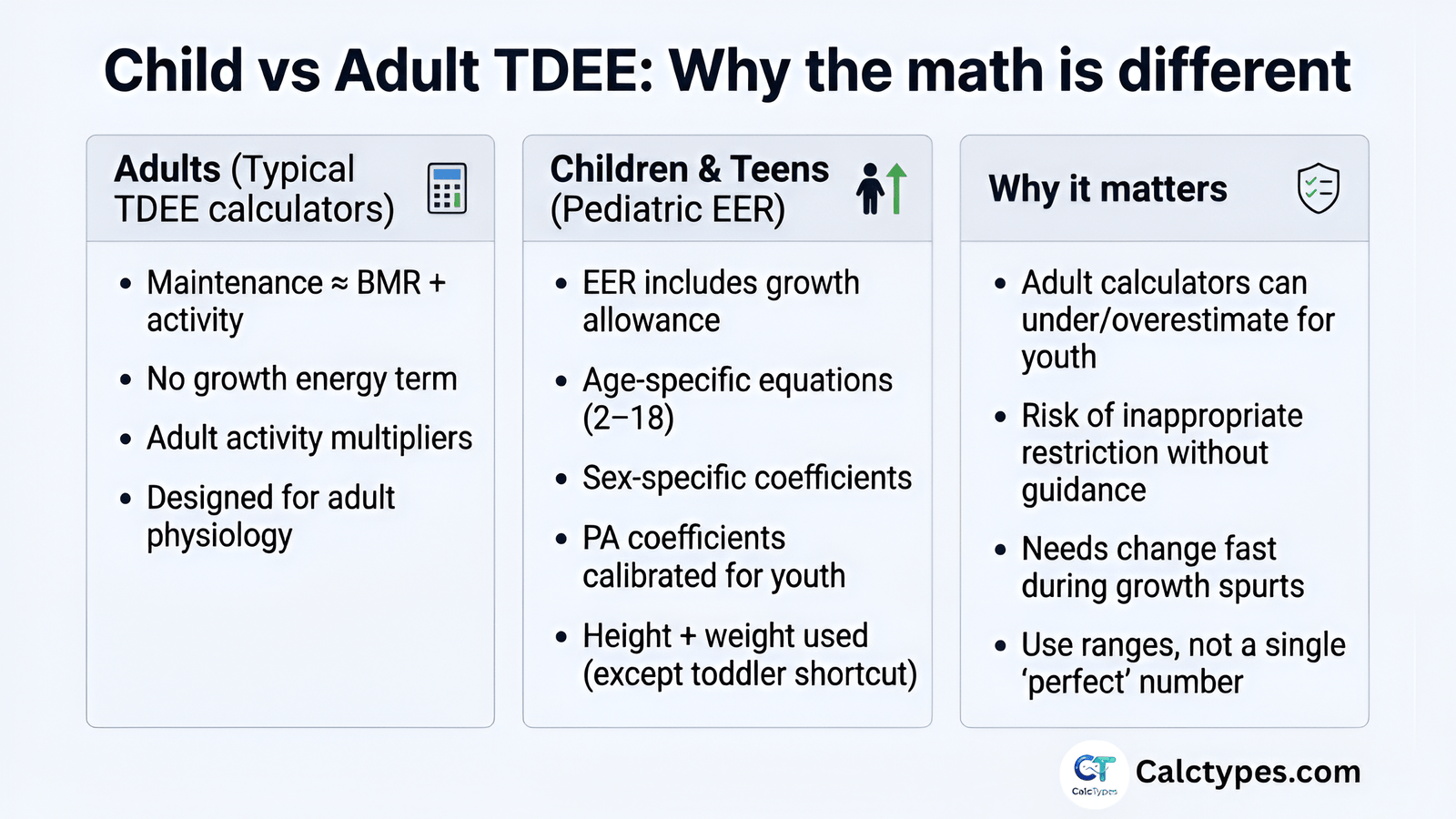
A child/teen “TDEE” is the estimated calories per day to maintain weight while supporting normal growth. For ages 2–18, this page uses pediatric EER equations (not adult TDEE multipliers).
Enter details
Disclaimer: This calculator estimates daily calorie needs for generally healthy children and teens ages 2–18. It does not replace medical advice. Children with underweight, obesity, eating disorders, chronic illness, pregnancy, or sports-performance goals should be assessed by a pediatrician or registered dietitian. If you are considering intentional weight change for a child or teen, seek professional guidance first.
How this Child & Teen TDEE (EER) calculator works
This page estimates “child/teen TDEE” using pediatric Estimated Energy Requirement (EER) equations. People often say “TDEE” to mean “maintenance calories,” but for ages 2–18, pediatric guidance commonly uses EER because it’s designed for growing bodies.
- Convert units to metric values used by the equations.
- Select the correct age band: toddler (2.0–2.11), child (3–8), or teen/adolescent (9–18).
- Use sex-specific coefficients (male vs female).
- Apply activity (PA coefficient for ages 3–18) and a small growth allowance.
- Show a range because real needs vary day to day.
Methodology (Teen & child TDEE formula / pediatric EER equations)
This calculator uses Institute of Medicine (IOM) pediatric Estimated Energy Requirement (EER) equations for ages 2–18.
PA coefficients (activity multipliers)
| Sex | Sedentary | Low Active | Active | Very Active |
|---|---|---|---|---|
| Boys | 1.00 | 1.13 | 1.26 | 1.42 |
| Girls | 1.00 | 1.16 | 1.31 | 1.56 |
Equations used
Toddler (2.0–2.11 years):
EER = (89 × weight_kg − 100) + 20

Ages 3–8:
Male:   EER = 88.5 − 61.9×age + PA×(26.7×weight_kg + 903×height_m) + 20
Female: EER = 135.3 − 30.8×age + PA×(10.0×weight_kg + 934×height_m) + 20

Ages 9–18 (teens/adolescents):
Male:   EER = 88.5 − 61.9×age + PA×(26.7×weight_kg + 903×height_m) + 25
Female: EER = 135.3 − 30.8×age + PA×(10.0×weight_kg + 934×height_m) + 25
Worked example (adolescent male)
Example (adolescent male): 15 years 0 months, Male, 55 kg, 168 cm (1.68 m), Low Active (PA=1.13)

Growth allowance (age 9–18): +25

EER = 88.5 − 61.9×15 + 1.13×(26.7×55 + 903×1.68) + 25
    = 2558.6 kcal/day (rounded to nearest 5 in the calculator)
Limitations of this Child & Teen TDEE calculator
This calculator uses evidence-based pediatric EER equations, but it is still an estimate. Real calorie needs vary because children are growing and because real life is not “average.”
1) Individual variation (two kids can differ even with the same inputs)
Genetics, muscle mass, sleep, stress, puberty timing, and day-to-day movement (“non-exercise activity” like fidgeting, walking around, climbing stairs) can create meaningful differences between children with identical age/sex/height/weight/activity selections.
2) Medical conditions and medications are not accounted for
Chronic illness, digestive disorders, endocrine conditions (thyroid, diabetes), and certain medications can change appetite, absorption, or metabolism. If any of these apply, a clinician’s assessment is more appropriate than a general formula.
3) Not designed for special clinical situations
- Eating disorders or disordered eating
- Pregnant/breastfeeding adolescents
- Severe illness recovery, malnutrition, or medically supervised weight management
- Elite youth athletes with very high training loads
4) Input accuracy matters a lot
Height and weight errors (or choosing an activity level that doesn’t match the child’s typical week) can shift the estimate substantially. Use current measurements and a realistic activity selection.
5) Snapshot, not a treatment plan
This tool doesn’t interpret a growth chart trend, puberty stage, lab markers, or dietary quality. If growth or eating patterns are concerning, seek professional guidance.
Visual guide: Why child/teen formulas differ from adult TDEE
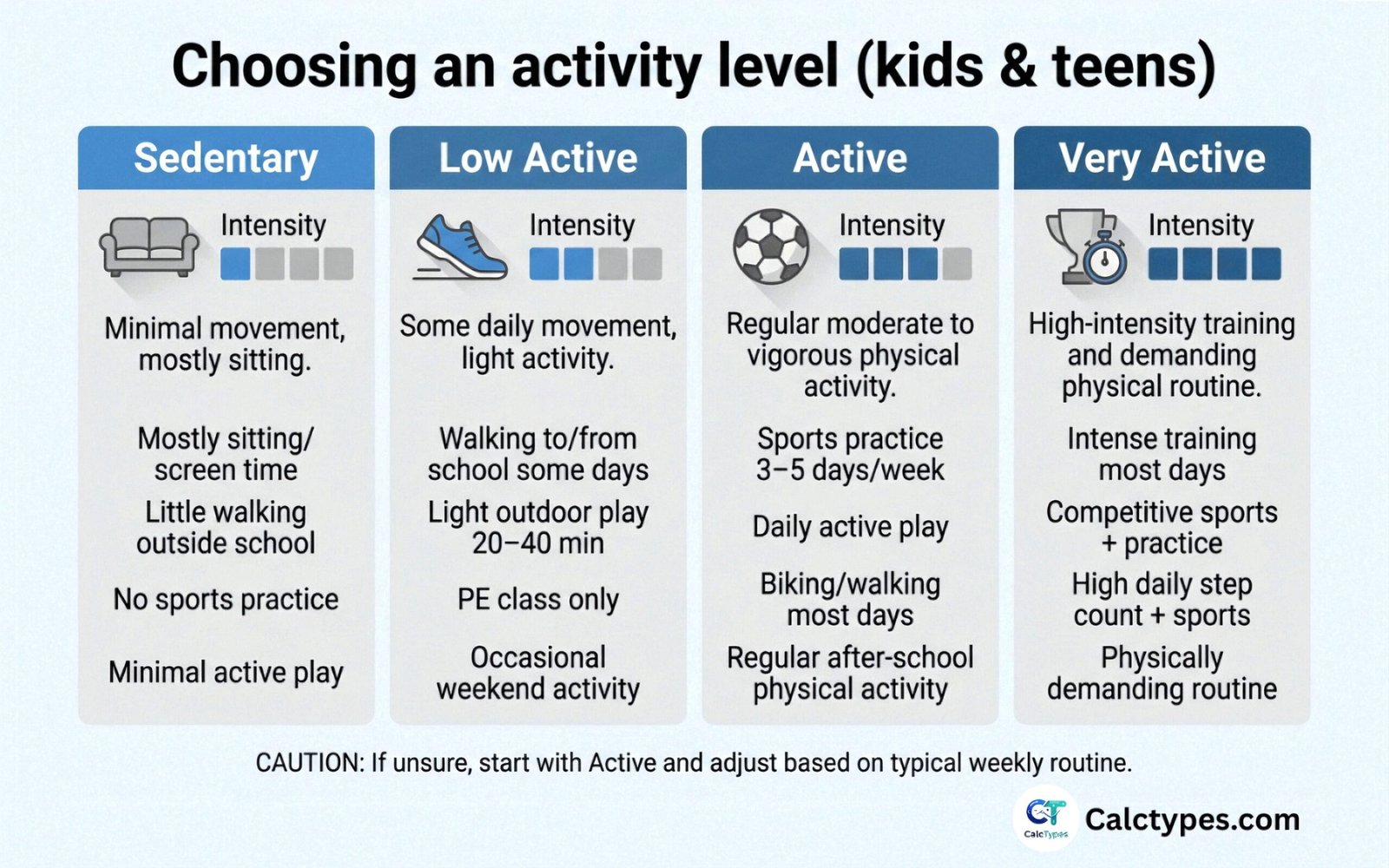
Visual guide: Activity level examples (sedentary → very active)
Questions People Ask (Child & Teen TDEE / Calorie Needs)
This section stays open. Each question expands when clicked. Educational guidance only (not medical advice).
Q1: How does the Child TDEE Calculator estimate daily calories?
This calculator estimates maintenance calories for ages 2–18 using pediatric Estimated Energy Requirement (EER) equations published by the Institute of Medicine (IOM). Many people use “TDEE” to mean “maintenance calories,” but for kids and teens, EER is the better-designed framework because it’s built for growing bodies.
What “maintenance calories” means for minors
For a child or teen, “maintenance” is not only “maintain today’s scale weight.” It also means supporting normal: growth (height), development (bone, muscle), school concentration, mood stability, and (for athletes) recovery.
What the calculator actually uses
- Age (years + months) → selects the correct age-band equation.
- Sex → applies sex-specific coefficients and PA multipliers.
- Weight → directly changes energy requirement.
- Height (ages 3–18) → included inside the equation.
- Activity level (ages 3–18) → uses PA coefficients inside the equation.
Why you see a range
A child’s true daily needs swing with sleep, training days, growth spurts, illness recovery, and ordinary measurement noise. That’s why the calculator displays a “typical range” instead of pretending one number is perfect.
Q2: How does this calculator estimate calories for kids and teens?
The calculator follows a structured “pediatric logic” rather than an adult “BMR × multiplier” approach. It first identifies the child’s age band, then applies the correct IOM EER equation.
Step-by-step workflow
- Convert units to kg and meters (internally).
- Compute exact age (years + months).
- Select equation:
- 2.0–2.11: toddler shortcut (weight-based)
- 3–8: child equation (+20 growth allowance)
- 9–18: adolescent equation (+25 growth allowance)
- Apply PA coefficient for ages 3–18 based on activity category.
- Round and display a practical result + a realistic range.
Why it’s not “exact” (and why that’s normal)
Calorie needs are not a fixed constant. Kids also have “hidden movement” (fidgeting, pacing, standing, playing) that’s hard to capture perfectly. This is why tracking the trend (over weeks/months) matters more than obsessing over a single day.
Q3: Is this a TDEE calculator for teens (teen TDEE calculator)?
Yes. For ages 9–18, the calculator uses the adolescent EER equation (with a teen growth allowance). That’s why this works as a legitimate teen TDEE/maintenance calculator.
Why teen calorie needs can feel unpredictable
- Growth spurts: energy demand can rise even if activity stays the same.
- Puberty timing: two teens same age can be at different developmental stages.
- Sports seasons: training volume changes dramatically.
Practical way to use the number
If a teen is constantly tired, unusually hungry, not recovering from sport, or losing weight unintentionally, their true needs may be near the upper end of the displayed range (or beyond, for high-volume athletes).
Q4: Does this teen TDEE calculator work for female teens?
Yes. Selecting Female switches to female coefficients and female PA values in the IOM equations. This is essential because the reference data and average growth patterns differ by sex.
Why female teens sometimes notice swings
- Puberty changes body composition and appetite signals.
- Menstrual cycle can affect hunger, water retention, and scale weight (not fat gain).
- Training load changes (sports seasons) can significantly shift needs.
Common input mistakes (that make the result look wrong)
- Entering pounds while in metric mode (kg field).
- Entering height in cm but meaning inches.
- Choosing “Very Active” when activity is only occasional.
Q5: Why shouldn’t I use an adult TDEE or BMR calculator for my child?
Adult TDEE calculators are usually built like this: estimate adult BMR (resting needs) with an adult formula, then multiply by an activity factor. That system is not designed around pediatric growth and pediatric coefficients.
Key differences: adult vs pediatric
- Growth allowance: pediatric equations include a small extra term to reflect growth energy needs.
- Pediatric coefficients: energy relationships to height/weight differ in kids vs adults.
- Development: puberty timing and growth velocity affect needs.
What “wrong tool” can lead to
Using adult formulas on minors can underestimate needs during growth spurts, or overestimate if activity is misclassified. Either way, it can create unnecessary stress and poor planning.
Q6: What activity level should I choose?
Choose the level that matches a typical week over the month (school weeks matter most). If you pick an extreme that doesn’t match reality, the calorie estimate will drift.
Quick guide (examples)
| Level | What it usually looks like |
|---|---|
| Sedentary | Mostly sitting, minimal walking, no regular sports/exercise. |
| Low Active | Some daily movement (walking, casual play) but little structured training. |
| Active | Regular moderate activity most days (PE + sports practice a few days/week). |
| Very Active | Intense training most days (competitive sports, long practices, high daily movement). |
If you’re stuck between two levels
Start with Active, then adjust based on real outcomes over 2–4 weeks: stable growth trend, good energy, good sleep, good recovery = you’re close.
Q7: Why doesn’t activity level change the result for toddlers?
For ages 2.0–2.11, the calculator uses a toddler shortcut equation that depends on weight only. That means height and activity aren’t inputs to that formula, so changing them does not change the output.
Why a simpler toddler equation exists
Toddler activity can look chaotic and hard to categorize, and height measurement can be less reliable at that age. A weight-based approach is a practical shortcut for planning estimates.
How to use toddler results safely
- Use it for meal planning structure, not strict calorie targets.
- Watch growth chart trends and appetite patterns.
- Consult a pediatrician if there’s poor growth, persistent fatigue, or very rapid change.
Q8: Is this calculator free, and can I share results?
Yes. You can share a prefilled link that reopens the calculator with the same inputs, and you can export results via print/PDF or a downloadable image.
Privacy note (important for kids)
A share link typically contains the entered values in the URL. Share only with trusted people and avoid posting publicly.
Best use case
- Parent-to-parent coordination
- Coach + parent discussion for fueling (without guessing)
- Clinician visit preparation
Q9: Is this an NHS tool or an official country-specific tool?
No. This is an independent educational calculator. It uses publicly published IOM equations and provides sources. It is not an official NHS/CDC/WHO tool.
How you can verify reliability
- Check the Methodology section for the exact equations and PA coefficients.
- Compare with published IOM/Dietary Reference Intake documentation.
- Use results as a planning estimate, not as medical instruction.
Q10: Do kids in India need different equations?
The equation uses personal inputs (age, sex, height, weight, activity), not country. So the same formula can be applied broadly. However, regional clinical practices and nutrition guidance can differ.
What might differ by country/region
- Local dietary patterns and common deficiencies
- Local growth references used in clinics
- Public-health guidelines and screening thresholds
If the child has a medical condition or complex nutrition needs, local professional guidance should lead.
Q11: Can I use this child calorie calculator for weight loss?
Use extreme caution. For minors, self-directed calorie restriction can risk nutrient gaps, impaired growth, fatigue, injuries (for athletes), and disordered eating patterns.
Safer framing (education-only)
- Focus on routine quality: regular meals, fewer sugary drinks, adequate protein/fiber.
- Support sleep: poor sleep increases hunger signals and reduces activity energy.
- Increase enjoyable movement: walking, play, sport, active family time.
- Track growth trend over months, not daily weight changes.
Q12: Can I use this child TDEE calculator to gain weight?
Yes, as a baseline. But for minors, weight gain should prioritize nutrient adequacy and healthy growth, not just adding calories.
Better “weight gain” checklist
- Protein at meals
- Calcium + vitamin D for bone development
- Iron (especially for menstruating teens)
- Regular meals + planned snacks (often more effective than forcing huge meals)
Q13: Is 1500 calories enough for a 14-year-old boy?
It depends on height, weight, activity, and growth stage—but for many 14-year-old boys, especially active ones, 1500 kcal/day is often too low to be maintenance.
Why “age-only” questions don’t work
- A smaller sedentary teen and a taller athletic teen can have very different needs.
- Growth spurts can temporarily increase appetite and needs.
- Sports training can add large energy demands.
Practical next step
Use this calculator with accurate inputs. If it estimates (for example) 2400 kcal/day maintenance and someone is eating 1500, that’s not “maintenance”—it’s a large deficit for a growing teen.
Q14: Is 1200 calories okay for a 15-year-old?
In many cases, 1200 kcal/day is too low for a 15-year-old. It may not support growth, school performance, sports recovery, or adequate micronutrients.
Signs a teen may be under-fueled
- Persistent fatigue, dizziness, irritability
- Difficulty concentrating
- Frequent injuries or poor workout recovery
- In girls: menstrual irregularities (one possible sign among many)
Q15: How do I calculate calorie needs without a calculator?
You can calculate pediatric EER manually, but you must use the correct age band, correct units, and the correct PA coefficient. Most “manual” errors come from unit mistakes.
Manual checklist
- Select the correct equation (toddler vs 3–8 vs 9–18, male vs female).
- Convert weight to kg; convert height to meters.
- Select PA coefficient (sedentary/low/active/very active by sex).
- Compute and add growth allowance (+20 or +25 depending on age band).
Common mistakes
- Using cm instead of meters in the height term
- Using lb as if it were kg
- Using adult activity multipliers instead of pediatric PA coefficients
Q16: How do I calculate TDEE for teenagers?
For teenagers, use adolescent EER equations (pediatric method) rather than adult multipliers. Then treat the result as an estimate range that should be updated as growth and sports change.
Best practice
- Use accurate, recent height/weight.
- Pick realistic activity based on typical weeks.
- Re-check every few months (teens change fast).
- Use trends: energy, hunger, performance, and growth pattern.
Q17: How to calculate kg by age?
You generally can’t calculate a child’s weight from age alone. Healthy weights vary widely based on height, puberty timing, genetics, and body composition.
What to do instead
- Measure weight and height accurately.
- Use growth charts and track the trend over time.
- Discuss concerns with a pediatrician if there’s a sudden percentile shift or symptoms.
Sources
- U.S. Department of Health and Human Services. Physical Activity Guidelines for Americans (2nd ed.). health.gov
- Centers for Disease Control and Prevention. Tips for Maintaining Healthy Weight. cdc.gov
- MedlinePlus. Child Nutrition. medlineplus.gov
- Johns Hopkins Medicine. School-Aged Child Nutrition. hopkinsmedicine.org
Embed this calculator
Copy and paste this HTML into your site. Attribution link included.
<iframe
  src="https://calctypes.com/child-tdee-calculator/"
  style="width:100%;max-width:980px;height:980px;border:0;"
  loading="lazy"></iframe>
<p><a href="https://calctypes.com/child-tdee-calculator/">Child TDEE Calculator by CalcTypes</a></p>