BMI vs Body Fat Percentage: Which Matters More?
BMI vs Body Fat Percentage: Which Should You Trust?
Both BMI and body fat percentage try to answer “is my weight healthy?” — but they measure fundamentally different things. This guide breaks down exactly what each metric captures, where each one fails, and how to use both together for a fuller picture of your body composition.
Quick takeaway
BMI is fast, free, and needs no equipment — but it can’t tell muscle from fat. Body fat percentage directly measures what proportion of your weight is fat — but it needs measurement tools (calipers, scales, tape, or DEXA) and has its own margin of error depending on method. Best practice: use BMI as a quick first screen, then check body fat % if your BMI result seems inconsistent with how you look or feel. Try both: BMI Calculator and Body Fat Calculator.
BMI vs Body Fat Percentage: Side-by-Side
| Factor | BMI | Body Fat Percentage |
|---|---|---|
| What it measures | Weight relative to height² | Proportion of total weight that is fat |
| Equipment needed | Scale + tape measure | Calipers, BIA scale, tape formula, or DEXA |
| Distinguishes muscle from fat? | No | Yes |
| Accounts for fat distribution? | No | Partially (some methods) |
| Speed / cost | Instant, free | Fast (tape/BIA) to slow & costly (DEXA) |
| Best used for | Fast population-level screening | Individual body composition tracking |
How Body Fat Percentage Is Measured
- Skinfold calipers: Pinch measurements at several body sites, plugged into a formula. Low-cost but technique-dependent.
- Bioelectrical impedance (BIA): Common in smart scales; sends a small electrical current through the body. Convenient but sensitive to hydration levels.
- Tape-measurement formulas (e.g., US Navy method): Uses waist, neck, and (for women) hip circumference. Reasonably accessible and moderately accurate.
- DEXA scan: Considered a gold-standard method in research settings, using low-dose X-ray to distinguish fat, muscle, and bone. Accurate but requires a clinical facility.
Try the tape-measurement or BMI-based estimation methods instantly with our Body Fat Calculator.
The “Skinny Fat” Problem: When BMI Misleads
“Normal weight obesity,” informally called skinny fat, describes someone with a BMI in the healthy 18.5–24.9 range but a body fat percentage and lean mass profile associated with higher metabolic risk. This happens because BMI cannot see body composition — it only sees total weight relative to height.
Research on normal-weight obesity has found that individuals in this category can have cardiometabolic risk markers (blood pressure, cholesterol, insulin sensitivity) that resemble those of individuals classified as obese by BMI, despite a “healthy” BMI number — a clear illustration of why body fat percentage adds meaningful information BMI alone cannot provide.
Which Metric Should You Actually Use?
For most people, the practical answer is: use both, in sequence. Start with BMI as a fast, free, zero-equipment screen. If your BMI result seems inconsistent with your visible muscle mass, activity level, or how you feel physically — or if you simply want a more complete picture — follow up with a body fat percentage estimate.
Athletes and heavily muscled individuals should weight body fat percentage more heavily than BMI, since BMI is known to overestimate risk in this group. Sedentary individuals with a “normal” BMI but little muscle tone may benefit most from checking body fat percentage specifically to rule out normal-weight obesity.
Questions People Ask
Which is more important, BMI or body fat percentage?
Neither is universally “more important” — they answer different questions, and the more useful one depends on your specific situation. BMI answers “is my overall weight in a typical range for my height?” while body fat percentage answers “what proportion of my body is actually fat tissue?” These can diverge significantly for the same person depending on muscle mass.
For general population screening — like large-scale public health studies tracking obesity trends over time — BMI remains more practical because it requires no special equipment and can be self-reported reasonably reliably. For individual health assessment, particularly for athletes, older adults, or anyone whose BMI seems inconsistent with how they look and feel, body fat percentage generally provides more actionable, personally relevant information.
The most balanced approach is checking both. Start with our BMI Calculator, then follow up with our Body Fat Calculator for a fuller picture.
Can two people have the same BMI but very different body fat percentages?
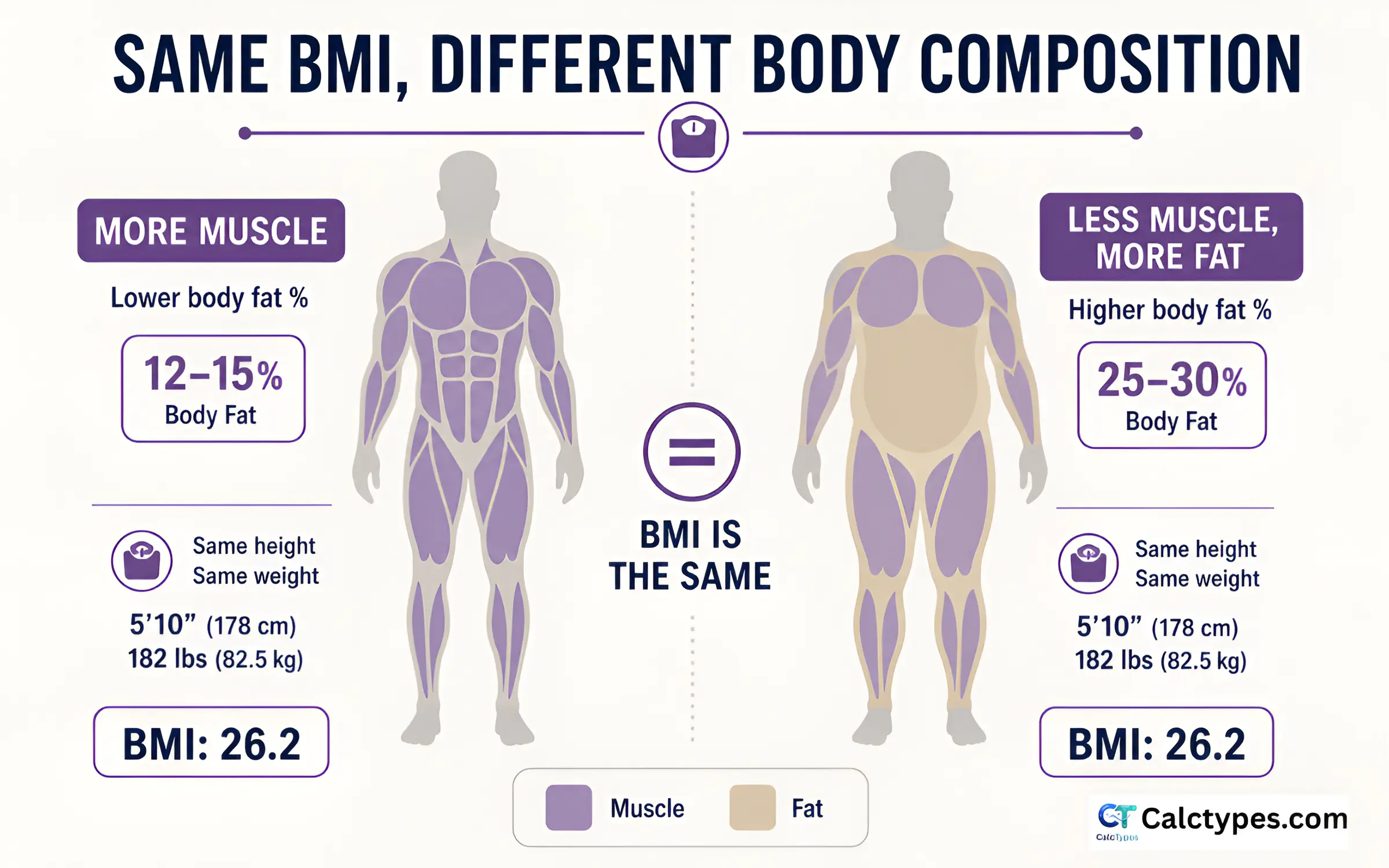
Yes, and this is one of the clearest demonstrations of BMI’s core limitation. Consider two men, both 1.80 m tall and both weighing 85 kg — identical BMI of 26.2, placing both in the “overweight” category. One is a competitive bodybuilder with 12% body fat and substantial muscle mass; the other is sedentary with minimal muscle tone and 28% body fat. Despite an identical BMI, their actual health risk profiles, fitness levels, and body compositions are dramatically different.
This scenario happens because muscle tissue is denser than fat tissue — it takes up less volume per kilogram — so someone with more muscle mass will weigh more at any given height and visual leanness than someone with less muscle and more fat. BMI, being purely a weight-to-height-squared ratio, cannot distinguish between these two very different bodies.
What is normal-weight obesity (“skinny fat”)?
Normal-weight obesity describes a person whose BMI falls within the standard healthy range (18.5–24.9) but who has a relatively high body fat percentage and low muscle mass for their body size — often the result of a sedentary lifestyle, poor nutrition quality, or age-related muscle loss (sarcopenia), rather than overeating in the traditional sense.
Research on this population has found cardiometabolic risk markers — including blood pressure, triglycerides, and insulin resistance — that can approach levels seen in individuals classified as obese by BMI, despite the “healthy” BMI number. This occurs because it’s specifically excess fat mass (particularly visceral fat) and insufficient lean mass driving metabolic risk, not body weight itself.
If you suspect you might fall into this category — a normal BMI but low muscle tone, sedentary lifestyle, or family history of metabolic conditions — checking your body fat percentage with our Body Fat Calculator and considering resistance training can be more informative than BMI alone.
How accurate is a home body fat scale compared to BMI?
Home bioelectrical impedance (BIA) scales estimate body fat percentage by sending a very small, imperceptible electrical current through your body and measuring resistance — fat tissue conducts electricity differently than lean tissue and water. While convenient, BIA scales can have a measurement error of several percentage points depending on your hydration level, recent food or exercise, and even room temperature, since these factors affect electrical conductivity.
Despite this variability, BIA scales are still generally more informative about body composition than BMI alone, because they at least attempt to distinguish fat from lean mass — BMI makes no such attempt whatsoever. For the most consistent tracking, use your BIA scale at the same time of day, under similar hydration conditions, and focus on the trend over weeks rather than any single reading.
If you don’t have a BIA scale, our Body Fat Calculator offers a tape-measurement-based estimate as a free alternative.
Should athletes ignore their BMI entirely?
Not entirely — but athletes should weight BMI results with significant skepticism and prioritize body fat percentage and performance metrics instead. Because BMI cannot account for the higher-than-average muscle mass typical in many athletes, it frequently misclassifies muscular, lean individuals as “overweight” or even “obese” despite very low body fat and excellent cardiovascular fitness.
Rather than discarding BMI entirely, athletes can use it as one small, low-weight data point while relying primarily on body fat percentage (via calipers, BIA, or DEXA), performance benchmarks, and how clothing fits as more meaningful indicators of body composition changes over a training cycle.
If you’re a strength athlete tracking changes across a training block, pairing your body fat percentage with a waist-to-hip ratio check gives a more complete picture than BMI alone.