No Added Sugar vs Unsweetened vs Sugar-Free
No Added Sugar vs Unsweetened vs Sugar-Free
Understand what these claims mean, what to check on labels, and how to quantify sugar in grams, teaspoons, and %DV.
No added sugar vs unsweetened vs sugar-free is one of the most confusing label comparisons—because the phrases look similar, but they can describe very different products. This guide helps you interpret the claim and verify it using the Nutrition Facts panel.
Once you find the label number, quantify it with the added sugar label calculator, % Daily Value to grams calculator, and grams to teaspoons calculator.
On this page
What Each Claim Means (Plain English)
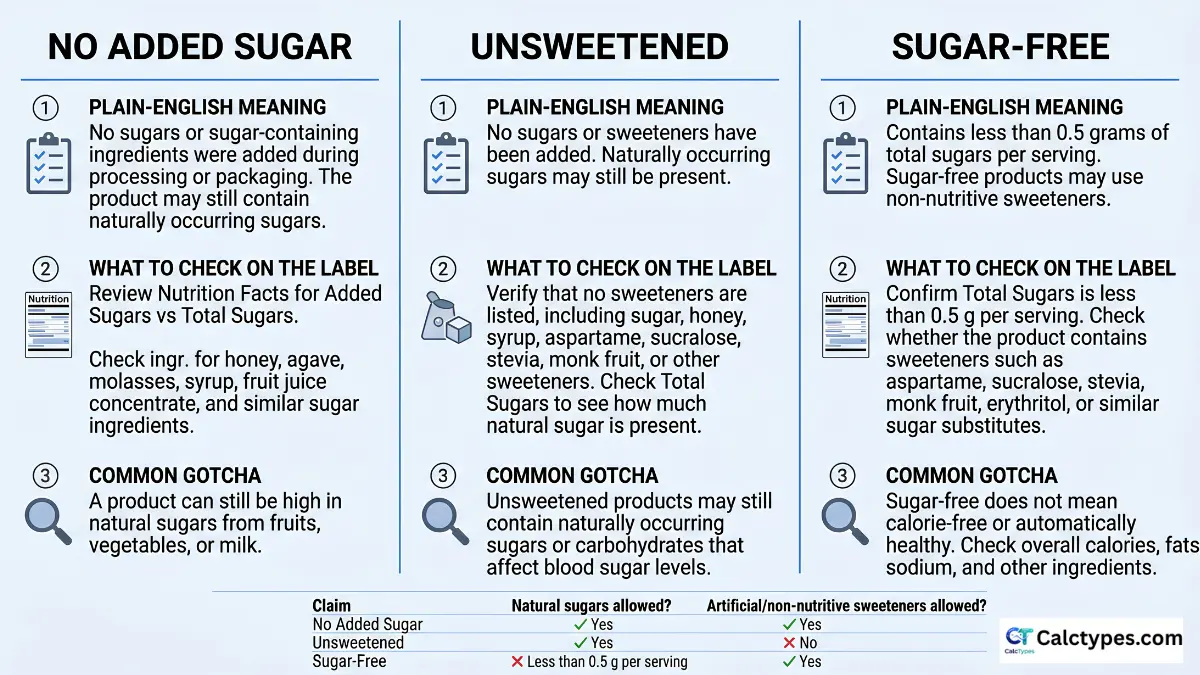
1) “No added sugar”
Generally means the manufacturer didn’t add sugar sweeteners during processing. However, the product may still contain naturally occurring sugars (fruit, milk) and can still be “sweet.”
2) “Unsweetened”
Generally implies no sweetener was added. But “unsweetened” does not automatically mean “low sugar,” because natural sugars can remain. The label is still the deciding factor.
3) “Sugar-free”
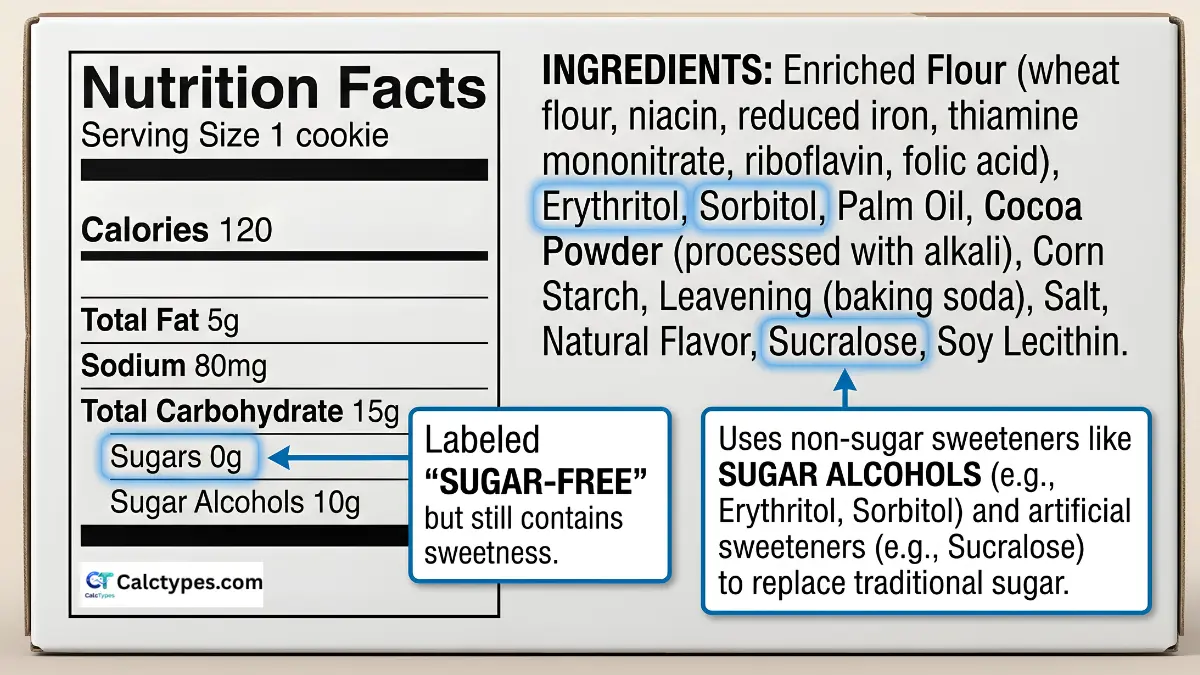
Typically means very low sugar per serving (exact thresholds vary by regulation). Sugar-free products may still taste sweet because they often use sugar substitutes or sugar alcohols.
Quick Comparison Table
| Claim | What it suggests | Best label check | Common gotcha |
|---|---|---|---|
| No added sugar | No added sweetener during processing | Total Sugars + ingredients | Can still be high in natural sugars (juice/purée) |
| Unsweetened | No sweetener added | Ingredients + Added Sugars (if listed) | Natural sugars can still be present |
| Sugar-free | Very low sugar per serving | Ingredients (sweeteners/sugar alcohols) | Not always low-calorie; may use substitutes |
How to Verify the Claim (Fast Workflow)
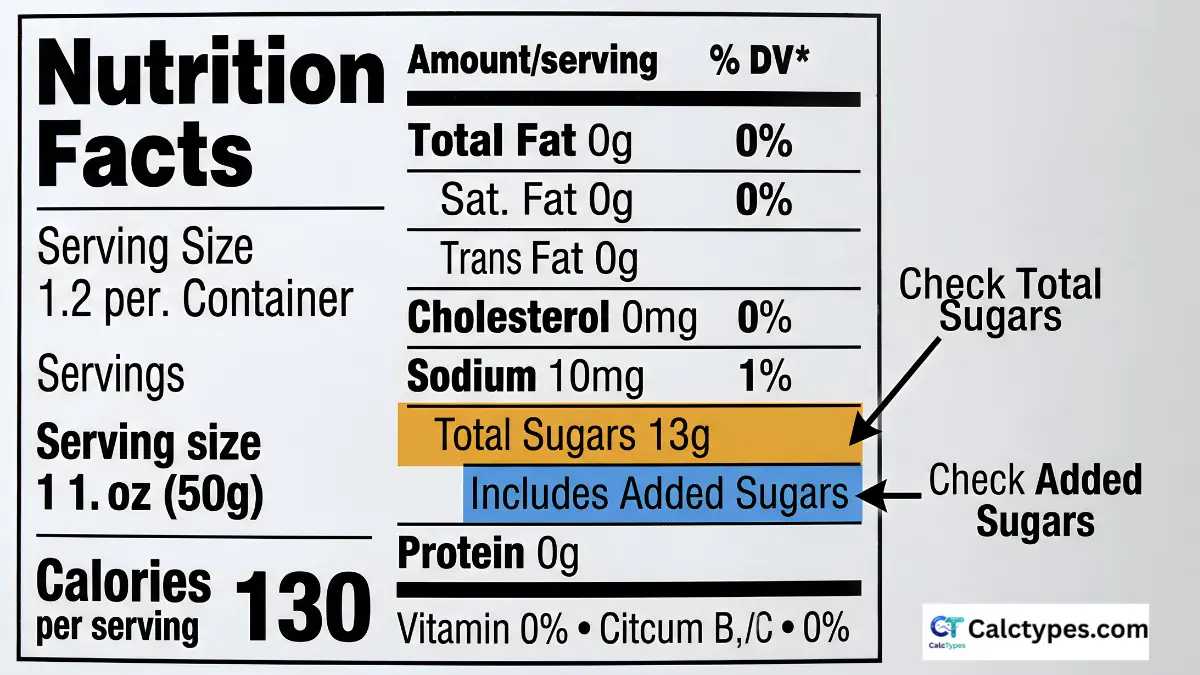
- Check Added Sugars (g) when present (US labels). If it’s > 0, it’s not truly “no added sugar.”
- Check Total Sugars (g) to see how sweet it is overall.
- Scan ingredients for syrups, concentrates, sweeteners, and sugar alcohols.
- Quantify what you found using calculators: %DV → grams, grams → teaspoons, grams → calories.
Hidden sweeteners show up in many food categories—this list is useful: hidden added sugar foods.
Examples That Commonly Confuse People
| Product example | Common claim | Why it’s confusing | What to do |
|---|---|---|---|
| No added sugar apple juice | No added sugar | Still high total sugar because juice is concentrated fruit sugar | Check Total Sugars and serving size |
| Unsweetened almond milk | Unsweetened | May still have small natural sugars; brands vary | Compare per serving and ingredients |
| Sugar-free candy | Sugar-free | May use sugar alcohols and still have calories | Check sugar alcohols/sweeteners + calories |
Questions People Ask
Does “no added sugar” mean no sugar?
No. It means no sweetener was added during processing. The product can still contain naturally occurring sugars (fruit, milk), so Total Sugars may still be high.
Does “no added sugar” mean low sugar?
Not necessarily. Some “no added sugar” products can still have a lot of natural sugar (for example, juice). Use Total Sugars and serving size to judge.
Is “unsweetened” the same as “no added sugar”?
They overlap but aren’t identical. Definitions vary; the safest method is verifying using Added Sugars/Total Sugars and the ingredient list.
Does “sugar-free” mean no carbohydrates?
No. It usually means very low sugar per serving, not zero carbs. Some products contain starches or sugar alcohols.
Can sugar-free foods still have calories?
Yes. Sugar-free can still contain fat, starches, or sugar alcohols that contribute calories. Check the calories line.
Are sugar alcohols counted as sugar on labels?
Usually not as “Added Sugars.” They may appear as sugar alcohols (e.g., erythritol, sorbitol). They still matter for sweetness and sometimes calories.
Is fruit juice concentrate an added sugar?
When used as a sweetener ingredient, it’s treated like an added sugar source. Always verify with the “Added Sugars” line when available.
How do I convert Added Sugars %DV into grams?
Use %DV to grams calculator. On US labels, 100% DV corresponds to 50g added sugar.
How do I visualize sugar grams as teaspoons?
Use grams to teaspoons. Standard label conversion is 4g ≈ 1 teaspoon.
Where can I read a deeper explanation of these claims?
This deep-dive is helpful: no added sugar vs unsweetened vs sugar-free.
Key takeaways
- No added sugar does not mean low sugar—check Total Sugars.
- Unsweetened can still contain natural sugars (milk/fruit).
- Sugar-free may use sweeteners or sugar alcohols—read ingredients.
- Quantify labels with added sugar label calculator and %DV to grams.
Important Disclaimer (Read Before Using)
This guide is educational only and does not provide medical advice, diagnosis, or treatment. Claim definitions and thresholds vary by country and product category. Always verify using the Nutrition Facts panel and ingredient list. Read the full policy here: Full Disclaimer.
Sources
- U.S. FDA — Added sugars on Nutrition Facts label. Link