Hidden Added Sugar Checklist
Hidden Added Sugar Checklist
Spot added sugar faster on labels and ingredients—then quantify it in grams, teaspoons, calories, and daily limits.
“Hidden sugar” doesn’t mean sugar is secret—it means it’s easy to miss. Added sugar can show up in foods that don’t taste very sweet, and it can appear under many ingredient names (syrups, concentrates, dextrose, malt extracts, etc.).
Use this checklist in two steps: (1) scan the Added Sugars line on the Nutrition Facts label, and (2) scan the ingredients list for common sugar aliases. If you want a visual label walkthrough, see how to read the added sugar label.
After you find a number, quantify it fast: %DV → grams, grams → teaspoons, and grams → calories. To track a full day, use added sugar intake calculator.
Store-Ready Checklist (Fast Scan)
That number is the quickest “truth” signal. If it’s high, you don’t need to decode ingredients.
Use % Daily Value to grams to get a clear gram number.
Use grams to teaspoons (4g ≈ 1 tsp).
Use daily added sugar limit to know what “a lot” means for you.
Manufacturers often split added sugar across several ingredients (syrup + dextrose + concentrate).
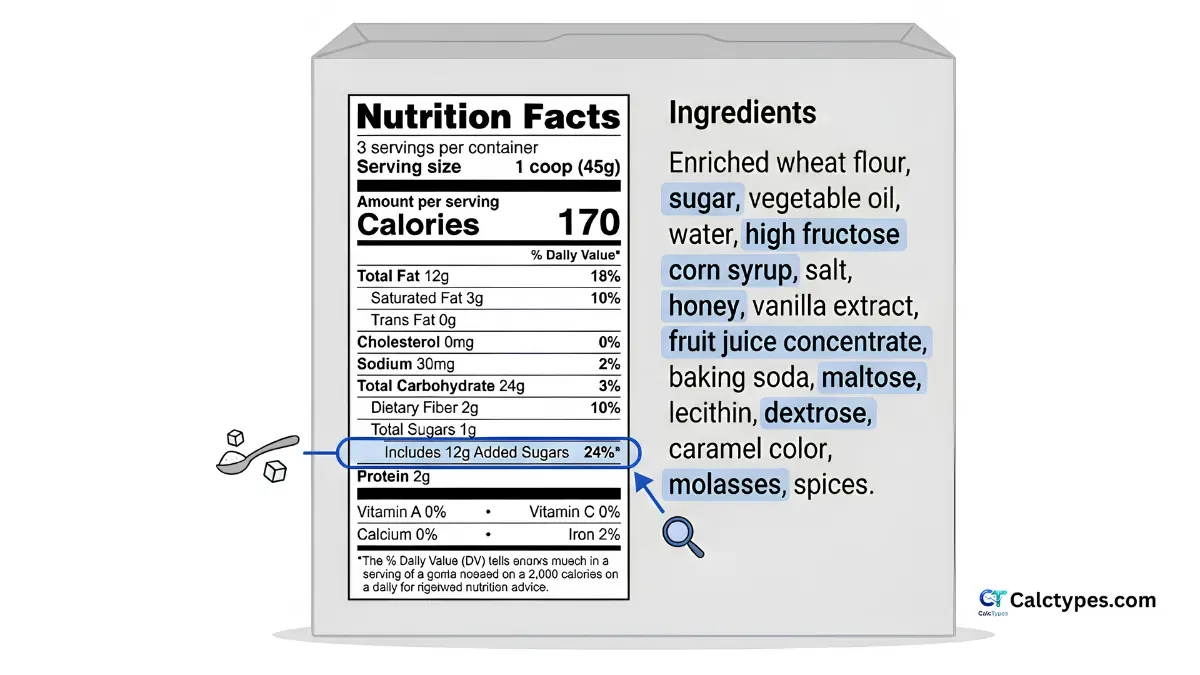
Common Hidden Added Sugar Names (Ingredient Checklist)
Ingredient names vary by brand and country, but these often signal added sugar or sweeteners. Use them as a scan list. For more category examples, this reference is helpful: hidden added sugar foods.
| Label name | Type | Common where |
|---|---|---|
| High-fructose corn syrup (HFCS) | Syrup | Sodas, sweet drinks |
| Glucose syrup / corn syrup | Syrup | Bars, cereals, sauces |
| Rice syrup / brown rice syrup | Syrup | “Natural” snack bars |
| Dextrose / glucose | Sugar | Baked goods, cereals |
| Maltose / malt extract | Sugar/extract | Cereals, drinks, snacks |
| Honey / maple syrup / agave | Added sugar | “Natural” sweetened foods |
| Fruit juice concentrate | Sweetener | Yogurt, snacks, drinks |
| Molasses | Added sugar | Cookies, sauces |
| Evaporated cane juice | Added sugar | “Clean label” foods |
Where Added Sugar Commonly Hides (Food Categories)
These are the categories most likely to contain “unexpected” added sugar even when they don’t taste very sweet:
- Salad dressings, ketchup, barbecue sauce, pasta sauce
- Flavoured yogurt, flavoured milk, sweetened oat/almond drinks
- Granola, cereal, protein bars, “energy” snacks
- Sports drinks, iced teas, bottled coffees
- Bread, buns, wraps (small amounts can add up across the day)
If you want to quantify a specific product quickly, use the added sugar label calculator (best for label-based checks).
Questions People Ask
How do I know if sugar is “hidden” on a label?
Start with the “Added Sugars” grams. Then scan ingredients for multiple sweetener names (syrup + dextrose + concentrate). If several appear, sugar is likely a major contributor.
How many different names for sugar are there?
There are many. The practical approach is not memorizing every name—it’s recognizing the common families (syrups, concentrates, dextrose/maltose, “natural” sweeteners).
Is fruit juice concentrate considered added sugar?
When used as a sweetener during processing, it counts as added sugar and contributes to the Added Sugars line. Always verify using the nutrition label.
Is honey “added sugar”?
Yes, when honey is added to a processed food. “Natural” doesn’t mean “not added.”
How do I convert Added Sugars %DV into grams?
Use % Daily Value to grams and enter the %DV shown next to “Added Sugars.”
How do I convert grams into teaspoons?
Use grams to teaspoons. Standard label conversion is 4g ≈ 1 teaspoon.
Should I track total sugars or added sugars?
Track added sugars for daily-limit guidance. See added sugar vs total sugar for the difference.
Why do savory foods include sugar?
Often for flavor balancing, browning, or texture. Even small amounts per serving can add up if you eat several servings across the day.
How do I know if I’m over my daily limit?
Use the daily added sugar limit page to get your guideline target, then track intake with the added sugar intake calculator.
What’s the fastest way to quantify a product during shopping?
Use the “Added Sugars” grams and convert to teaspoons (optional). If only %DV is listed, convert %DV → grams first.
For a visual label walkthrough with examples, see: how to read sugar on labels.
Key takeaways
- Use “Added Sugars (g)” as your primary indicator.
- Ingredient lists can split sugar across multiple names—scan for syrup + dextrose + concentrate patterns.
- Convert %DV → grams → teaspoons to make label numbers intuitive.
- Track your day with the intake calculator if you want the real picture.
Important Disclaimer (Read Before Using)
This checklist is educational and does not provide medical advice, diagnosis, or treatment guidance. Ingredient naming and labeling rules vary by country and product category, and the same ingredient can appear under different names. Always verify with the Nutrition Facts label (especially “Added Sugars”) and consult a qualified professional for personalized advice. Read the full policy here: Full Disclaimer.