Daily Added Sugar Limit Calculator
Daily Added Sugar Limit Calculator
Find your recommended daily added sugar limit by age and sex — in grams and teaspoons — based on AHA and WHO guidelines.
How much added sugar is actually too much? The answer depends on who you ask — and who you are. This daily added sugar limit calculator shows your recommended limit in grams and teaspoons, based on your age and sex, using guidelines from the American Heart Association (AHA) and World Health Organization (WHO).
These limits apply specifically to added sugars — not naturally occurring sugars in whole fruit or plain dairy. If you want to understand the difference, our guide on added sugar vs total sugar explains it clearly.
Once you know your limit, you can check any food label with our % Daily Value to grams calculator or see how much of your limit a product uses with the added sugar label calculator.
Find Your Daily Limit
Used to calculate your WHO-based limit. Default 2,000 kcal is the standard reference diet.
Quick profiles:
Your Daily Limit
Check any food label against your limit using the added sugar label calculator or % DV to grams calculator.
On this page
Daily Added Sugar Limits at a Glance
Different organisations set different limits. The AHA focuses on cardiovascular health and sets strict limits by sex. The WHO uses a percentage-of-energy approach. Neither limit is a personal medical prescription — they are population-level guidelines to help reduce chronic disease risk.
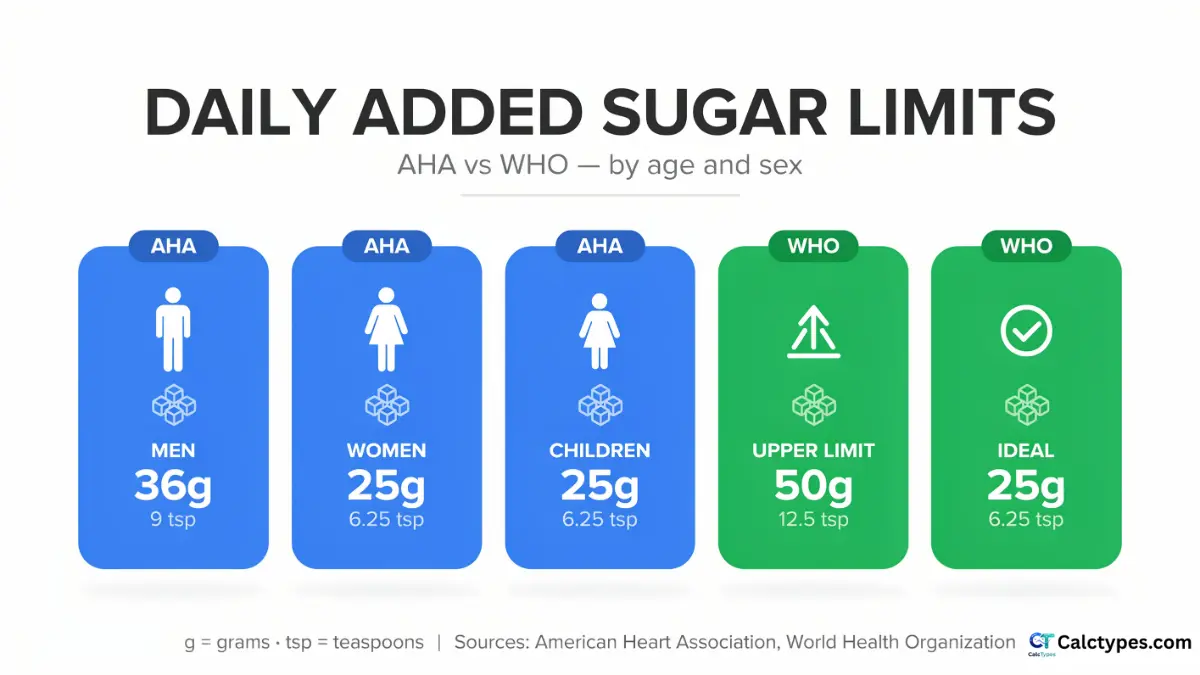
The AHA limits are stricter than the WHO upper limit — particularly for women and children — because they focus specifically on cardiovascular risk reduction. Understanding how your body processes sugar beyond these limits is helpful context; this overview of how long sugar stays in your body explains what happens physiologically after consumption.
New in 2026: US Dietary Guidelines 2025–2030 on added sugar
In January 2026 the US Departments of Agriculture and Health and Human Services published the Dietary Guidelines for Americans 2025–2030. They take a stricter line on added sugar than earlier editions:
- No amount of added sugar or non-nutritive sweetener is described as part of a healthy diet.
- A single meal should contain no more than 10 g of added sugar.
- Children should avoid added sugar until age 10 (earlier guidance said under age 2).
The previous limit of less than 10% of calories (about 50 g on a 2,000 kcal diet) has effectively been replaced. Three meals at the 10 g ceiling add up to about 30 g a day — close to the AHA’s 25 g and 36 g limits and the WHO’s 5% “ideal” target. US Nutrition Facts labels still calculate % Daily Value from 50 g for now, so a label’s %DV is not the same as the new guideline.
Source: Harvard T.H. Chan School of Public Health — The Nutrition Source; DietaryGuidelines.gov.
Daily Added Sugar Limit Reference Table
All values are for added sugars only — not naturally occurring sugars in whole fruit or plain dairy.
| Profile | AHA limit (g) | AHA limit (tsp) | WHO upper (g) | WHO ideal (g) | Source |
|---|---|---|---|---|---|
| Adult men (19+) | 36g | 9 tsp | 50g* | 25g* | AHA / WHO |
| Adult women (19+) | 25g | 6.25 tsp | 50g* | 25g* | AHA / WHO |
| Children (2–18) | 25g | 6.25 tsp | Proportional** | Proportional** | AHA / WHO |
| Children under 2 | 0g (avoid) | 0 tsp | Avoid | Avoid | AHA |
| Pregnancy / breastfeeding | 25g | 6.25 tsp | Varies | Varies | AHA |
* Based on 2,000 kcal reference diet. ** WHO applies % of energy, so children’s limits are proportionally lower with calorie intake.
These are population-level reference values — not personal medical recommendations.
Worked Examples
Click “Load” to fill the calculator automatically.
Example 1 — Adult man, 2,000 kcal diet
AHA limit: 36g / 9 tsp added sugar per day. WHO upper: 50g. WHO ideal: 25g. One can of regular cola (39g) already exceeds his AHA daily limit.
Example 2 — Adult woman, 1,800 kcal diet
AHA limit: 25g / 6.25 tsp per day. WHO upper: 45g (10% of 1,800 kcal = 180 kcal ÷ 4 = 45g). A flavoured latte with 28g of added sugar already exceeds her AHA limit.
Example 3 — Child aged 8, 1,600 kcal diet
AHA limit: 25g / 6.25 tsp per day. WHO upper: 40g (10% of 1,600 kcal = 160 kcal ÷ 4 = 40g). A child’s limit is the same as an adult woman’s in AHA terms — but their smaller body means the impact is proportionally larger.
Example 4 — Child under 2
The AHA recommends zero added sugar for children under 2. This aligns with WHO guidance. Naturally occurring sugars in breast milk, formula, and whole fruit are fine.
Questions People Ask
How much added sugar per day is recommended?
The AHA recommends no more than 36g (9 tsp) for men and 25g (6.25 tsp) for women and children per day. The WHO recommends keeping free sugars below 10% of total energy — about 50g on a 2,000 kcal diet — with an ideal target of 5% (25g).
Is the daily sugar limit for total sugar or added sugar?
These limits apply to added sugars only — sugars added during food processing or preparation. Naturally occurring sugars in whole fruit, vegetables, and plain dairy do not count toward these limits. See our guide on added sugar vs total sugar for the full explanation.
Why is the AHA limit lower than the WHO limit?
The AHA focuses specifically on cardiovascular risk reduction and sets tighter limits based on research linking added sugar to heart disease, obesity, and metabolic syndrome. The WHO limit (50g) is a broader public health reference designed to be achievable across diverse populations and dietary patterns worldwide.
How many teaspoons of sugar is the daily limit?
AHA: 9 teaspoons for men, 6.25 teaspoons for women and children. WHO upper limit: 12.5 teaspoons. WHO ideal: 6.25 teaspoons. Use our sugar grams to teaspoons calculator to convert any gram amount.
Should children under 2 have any added sugar?
No. The AHA recommends zero added sugar for children under 2 years old. This includes sugar-sweetened beverages, processed snacks with added sugar, and sweet condiments. Naturally occurring sugars in breast milk, formula, and whole fruit are not included in this restriction.
Does my calorie intake affect my sugar limit?
Yes — for the WHO-based limit. The WHO sets free sugar intake at 10% (upper) and 5% (ideal) of total energy. So if you eat 1,600 kcal per day, your WHO upper limit is 160 kcal ÷ 4 = 40g, not 50g. The calculator adjusts for this automatically when you enter your calorie intake.
What happens if I regularly exceed the daily added sugar limit?
Consistently high added sugar intake is associated with increased risk of obesity, type 2 diabetes, cardiovascular disease, dental cavities, and non-alcoholic fatty liver disease in research literature. These are population-level associations — individual risk depends on overall diet, genetics, and lifestyle. If you’re reducing sugar, understanding the timeline helps — this sugar detox timeline outlines what to expect when you cut back.
Key Takeaways
- AHA men’s limit: 36g (9 tsp) added sugar per day.
- AHA women’s and children’s limit: 25g (6.25 tsp) added sugar per day.
- Children under 2: zero added sugar recommended.
- WHO upper limit: 50g (10% of energy) on a 2,000 kcal diet.
- WHO ideal target: 25g (5% of energy) for additional health benefits.
- These limits apply to added sugars only — not sugars naturally present in whole foods.
- Use the % DV to grams calculator to check labels against your limit.
How This Calculator Works (Methodology)
AHA limits are fixed by sex/age group as published in the AHA scientific statement (Johnson et al., 2009, updated guidance). WHO limits are calculated as: Upper = (calories × 0.10) ÷ 4 and Ideal = (calories × 0.05) ÷ 4 (where 4 kcal/g is the energy density of sugar). The comparison bar uses the highest limit (WHO upper) as the 100% reference.
All values are population-level reference figures. Individual requirements vary.
Sources
- American Heart Association — Added Sugars. Link
- Johnson RK et al. (2009). Dietary sugars intake and cardiovascular health. Circulation, 120(11), 1011–1020. DOI
- World Health Organization — Sugars intake for adults and children (2015). Link
- American Academy of Pediatrics — How to Reduce Added Sugar in Your Child’s Diet. Link