Body Fat Calculator: US Navy Tape & BMI Methods
Estimate Your Body Fat Percentage
Use this body fat calculator to estimate adult body fat percentage with the US Navy tape method or a BMI-based estimate. Choose a method, enter measurements in Metric or US/Imperial units, and view estimated fat mass and lean mass. These are estimates, so use the same method and measurement technique when tracking changes over time.
For related health metrics, try our BMI Calculator and TDEE Calculator. If you only want the tape method, use the dedicated US Navy Body Fat Calculator, or browse our Health Calculators hub.
Enter Your Details
How to Measure Correctly (Tape Method)
The small figure beside each input gives a quick cue while typing. Use these larger diagrams when you want to confirm exact placement.
- Neck: Measure just below the larynx (Adam’s apple).
- Waist: Men at navel level; Women at the narrowest point.
- Hip (Women): Measure at the widest point of the hips/buttocks.
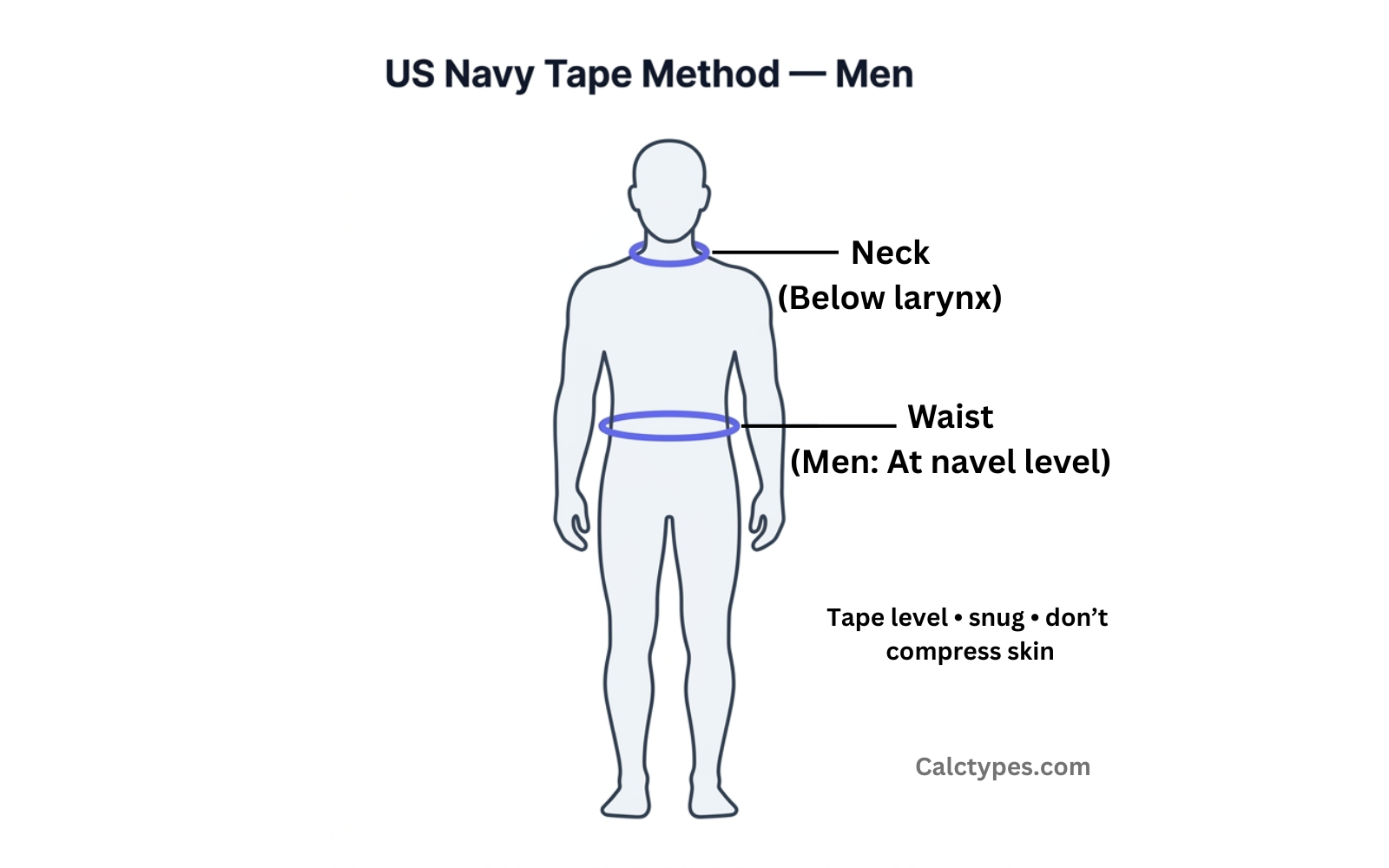
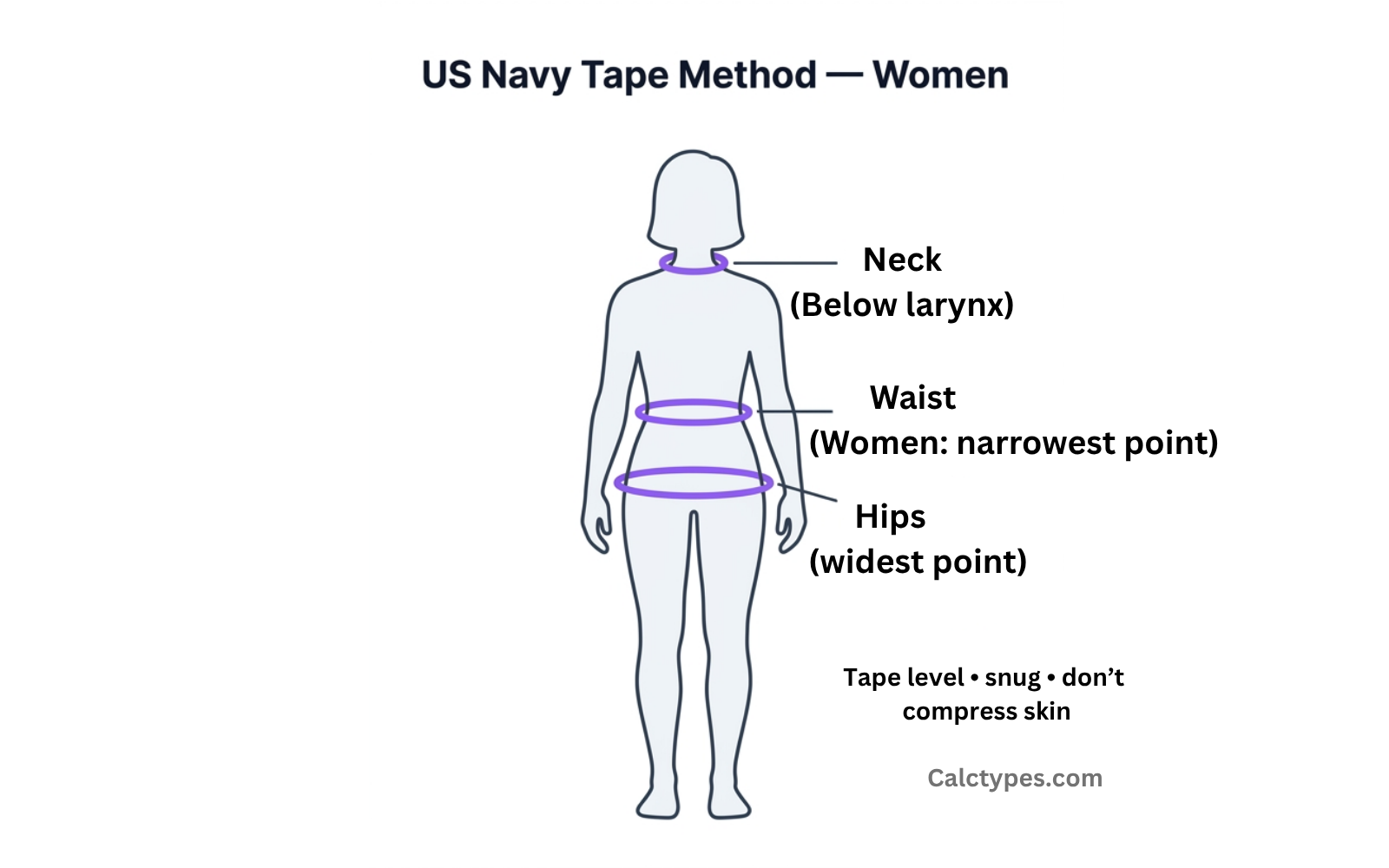
Keep the tape snug but not compressing the skin. For consistency, measure at the same time of day.
Expert Review & Body Composition Context
This calculator and its supporting guidance were reviewed from two complementary perspectives: medical/health framing and physical-education/body-composition use. The reviewers assessed the areas listed below rather than treating the calculator as a clinical diagnostic test or an official military Body Composition Assessment.
Calculator check completed October 4, 2026: Both reviewers entered sample values and checked the resulting calculations. The outputs they tested were found consistent with the methods presented on this page.
Dr. Hena A. Ansari
MBBS • MD (Pathology) • Professor
Department of Pathology, Jawaharlal Nehru Medical College, Aligarh Muslim University (AMU), Aligarh, India
Review focus: medical framing, estimate-only guidance, health/safety wording, limitations, and when a calculator result should not replace individualized professional assessment.

Dr. Merajuddin Faridi
Ph.D. • M.P.Ed. • B.P.Ed. • Assistant Professor
Department of Physical Education, Aligarh Muslim University (AMU), Aligarh, India
Review focus: practical measurement guidance, body-composition and fitness interpretation, trend-tracking context, and clarity for users entering and interpreting measurements.
How to Use This Body Fat Calculator
If you accidentally type an inch value while Metric is selected—for example, a 34-inch waist entered as 34 cm—the calculator will ask you to confirm the unit instead of returning a misleading result.
What is the US Navy Tape Method?
The classic US Navy circumference method estimates body fat percentage from body circumferences and height. For men it uses neck and waist. For women it uses neck, waist, and hips, plus height. While it is not a direct clinical measurement of body fat, it is practical for repeat measurements when the same landmarks, tape tension, and measuring conditions are used each time.
How We Calculate (US Navy Tape Method Formula)
The calculator uses the direct US Navy circumference equations below. They use log10 (log base 10) and expect inches. Metric measurements are converted to inches internally before the equation is applied.
Men
Body fat % = 86.010 × log10(waist − neck)
             − 70.041 × log10(height)
             + 36.76

Women
Body fat % = 163.205 × log10(waist + hip − neck)
             − 97.684 × log10(height)
             − 78.387
The calculator also offers a BMI-based adult estimate: Body fat % = 1.20 × BMI + 0.23 × age − 10.8 × sex − 5.4, where sex = 1 for male and 0 for female.
This is an educational estimate. An official military Body Composition Assessment can apply service-specific measurement, rounding, table, and administrative rules, so use current service guidance for an official determination.
Questions People Ask
Open any question for a detailed explanation.
How does the Body Fat Calculator work?
The calculator gives you two ways to estimate body fat percentage. The US Navy tape method uses body circumferences together with height. For men, it uses neck and waist measurements; for women, it also includes the hips. The BMI-based method estimates body fat from BMI, age, and sex, so it can be used when you do not have a measuring tape available.
After estimating body fat percentage, the calculator uses your body weight to estimate fat mass and lean mass. These results are useful for general tracking, but they should not be treated as a direct clinical measurement. For the most meaningful comparison over time, use the same method, measure under similar conditions, and focus on the trend rather than a very small change from one reading to the next.
Which method should I choose: US Navy (Tape) or BMI-Based?
Choose the US Navy tape method when you can take reliable circumference measurements. Because it uses your neck and waist—and hips for women—it reflects some differences in body shape that BMI alone cannot capture. It is especially useful when you want a repeatable home method for following body-composition changes over time.
Choose the BMI-based estimate when you do not have a tape measure or want a quick estimate using age, sex, height, and weight. BMI is simple and useful as a screening measure, but it does not directly distinguish fat from muscle. That means a muscular person and a person with less muscle can sometimes have a similar BMI even though their body composition is different. If you are tracking progress, avoid switching back and forth between methods because each method can produce a different estimate.
Where exactly should I measure my waist, neck, and hips?
For the neck, place the tape just below the larynx or Adam’s apple and keep it level rather than allowing it to slope sharply. For men, measure the waist at approximately navel level. For women, measure the waist at the narrowest part of the torso. Women using the Navy method should also measure the hips at the widest part of the hips and buttocks.
The tape should be snug against the body without compressing the skin. Stand naturally, avoid pulling the stomach inward, and take the measurement under similar conditions each time. Small changes in tape position, tape tension, posture, or breathing can change the result. If practical, take two or three measurements and use a consistent reading or average rather than relying on a single hurried measurement.
Is this a US Navy body fat calculator (tape method)?
Yes. When “US Navy (Tape)” is selected, the calculator applies circumference-based equations commonly referred to as the US Navy body fat or tape method. The required measurements differ by sex: men use height, neck, and waist; women use height, neck, waist, and hips.
The result is an estimate rather than a direct measurement of body fat. The method is popular because it requires only a measuring tape and can be repeated easily. If you are using the calculation to prepare for an official military body-composition assessment, remember that an official service may specify its own current measurement procedure, rounding rules, authorized measurement sites, or administrative standards. Always compare your self-check with the latest official instructions that apply to your assessment.
What does “Navy body fat percentage” mean?
“Navy body fat percentage” means an estimated percentage of total body weight that is fat, calculated from the Navy circumference method. For example, a result of 20% does not mean that the calculator directly measured every kilogram or pound of body fat. It means the entered measurements produced an estimate of approximately 20% body fat according to the selected equation.
The value is most useful when it is interpreted as an estimate and tracked consistently. If you measure yourself using the same tape placement, similar time of day, and similar conditions, the pattern across several measurements can be more informative than a single isolated result. Different body-fat methods—such as DEXA, bioelectrical impedance, skinfolds, or other circumference formulas—can give different numbers, so results from different methods should not be treated as perfectly interchangeable.
How accurate is the US Navy tape method?
The US Navy tape method is a prediction method, not a direct laboratory measurement. Its accuracy for an individual depends on how closely that person’s body shape matches the population used to develop the equation and on how carefully the measurements are taken. Incorrect tape placement, inconsistent tension, posture, breathing, or short-term changes in waist size can all shift the result.
For that reason, it is better to think of the result as a practical estimate rather than an exact body-fat reading. Its main advantage is repeatability: you can take the same measurements at home without special equipment. If you need a more precise assessment for medical, research, or professional purposes, a qualified professional may recommend a more direct body-composition method. For routine personal tracking, consistency of technique is usually more important than trying to interpret a one-point change as a major difference.
What is the BMI-based body fat estimate and when should I use it?
The BMI-based option first calculates BMI from your height and weight and then uses an age- and sex-based prediction equation to estimate body fat percentage. It is useful when you want a quick estimate and do not have reliable circumference measurements available.
Because the estimate begins with BMI, it has some of the same limitations as BMI itself. BMI measures weight relative to height and does not directly separate fat mass from muscle, bone, or other lean tissue. The estimate can therefore be less representative for people whose body composition differs substantially from the population average, including some highly muscular individuals. Use it as a broad estimate, and if you later switch to the Navy tape method, treat that as a different measurement method rather than assuming the two results should match exactly.
What’s the difference between BMI and body fat percentage?
BMI is a ratio of body weight to height. It is widely used because it is quick to calculate and useful for screening weight categories, but it does not directly tell you how much of your weight is fat and how much is lean tissue. Two people with the same BMI can have different proportions of muscle and fat.
Body fat percentage is intended to estimate the proportion of total body weight that is fat tissue. That makes it more directly related to body composition, although the quality of the estimate still depends on the method used. The Navy tape method estimates body fat from circumferences, while this calculator’s BMI-based option estimates it from BMI, age, and sex. Use BMI and body-fat percentage as complementary indicators rather than assuming that one number alone describes overall health.
Why do women need a hip measurement for the Navy method?
The female Navy circumference equation includes the hip measurement in addition to waist, neck, and height. This is part of the mathematical model used by the method and helps the equation account for body-shape and fat-distribution patterns that differ between the male and female formulas.
For a reliable result, the hip measurement should be taken at the widest part of the hips and buttocks with the tape level around the body. Avoid pulling the tape so tightly that it compresses the skin. Because the hip value is part of the equation, measuring at a different location from one session to another can create an apparent change in body fat even when body composition has not changed very much. Consistent measurement technique is therefore especially important when comparing results over time.
Can I use this calculator in metric and US/imperial units?
Yes. In Metric mode you can enter measurements in centimeters and weight in kilograms. In US/Imperial mode you can enter height in feet and inches, body circumferences in inches, and weight in pounds.
For the Navy equation used here, US/Imperial circumference and height values are used in inches, while Metric measurements are converted internally to inches before the direct inch-based equation is applied. Changing the unit system should not materially change the result when the same physical measurements are entered correctly. If you are comparing readings over time, it is still a good idea to use the same unit system each time because it reduces the chance of transcription or conversion mistakes. Always double-check that the value you entered matches the unit displayed next to the field.
How does age affect body fat percentage?
Age is used in the BMI-based prediction because the relationship between BMI and estimated body fat changes across age groups. Two adults with the same BMI can therefore receive somewhat different BMI-based body-fat estimates if their ages are different. The US Navy tape method in this calculator does not use age directly in its circumference equation.
Age can also be relevant when interpreting body composition more generally because muscle mass, activity patterns, hormonal status, and fat distribution can change across adulthood. This does not mean that age alone determines a healthy result. Use the calculator as an estimate and consider other information such as fitness, waist measurement, strength, medical history, and professional advice when health decisions depend on the result.
What is a healthy body fat percentage?
There is no single body-fat percentage that is ideal for every adult. Reference ranges vary with sex, age, athletic status, measurement method, and the purpose for which the number is being used. The category table on this calculator is intended as general context rather than a medical diagnosis or a personalized target.
Very low body fat is not automatically healthier, and a higher estimate does not by itself describe a person’s complete health status. If you are using body-fat percentage to guide training or weight-management decisions, look at the trend together with other information such as energy levels, strength, waist measurement, nutrition, and relevant health markers. If you have a medical condition, are pregnant, have a history of disordered eating, or are considering a major change in diet or exercise, personalized advice from a qualified health professional is more appropriate than relying on a calculator category alone.
Can teenagers use this calculator?
This calculator is designed for adults aged 18 and older. Children and teenagers are still growing, so body size and body composition need to be interpreted differently from adult measurements. In younger people, BMI is normally interpreted using age- and sex-specific growth references rather than the fixed adult BMI categories used for adults.
For that reason, a teenager should not use an adult body-fat calculator result as a diagnosis or as a target for dieting. If body composition, growth, weight, or nutrition is a concern for someone under 18, the appropriate approach is to use pediatric growth references and discuss the result with a qualified healthcare professional. CalcTypes’ child or teen tools should be used only where they are specifically designed for the relevant age group.
How can I lower my body fat percentage?
A sustainable reduction in body fat generally comes from reducing body fat while preserving as much lean mass as practical. For many adults, that means combining an appropriate calorie intake with regular physical activity and resistance training. Adequate protein, sleep, recovery, and a pace of change that can be maintained are also important. Very aggressive dieting can make it harder to maintain training performance and lean mass.
The calculator can help you estimate and track body-composition changes, but it cannot prescribe a personal diet or training program. If you want to estimate daily energy needs, you can use the CalcTypes TDEE Calculator as a starting point and then adjust based on real-world progress. People with medical conditions, pregnancy, a history of eating disorders, or other individual health concerns should seek guidance from a qualified healthcare professional or registered dietitian before making a substantial weight-loss or exercise change.
Medical disclaimer: This tool provides an estimate of body fat percentage using published equations. It is for informational use by adults (18+) and is not medical advice, diagnosis, or treatment. Measurement technique, hydration, posture, and individual body shape can materially affect results. For personalized guidance—especially if you have a health condition—consult a qualified healthcare professional.
Understanding Body Fat Percentage
Body fat percentage represents the proportion of your total body weight that is fat tissue. Unlike BMI, which only considers height and weight, body fat percentage provides insight into your estimated body composition.
The US Navy method uses circumference measurements to estimate body fat because body shape and fat distribution influence the relationship between measurements and body composition. It is not a direct clinical measurement, but it can be practical for consistent progress tracking when you use the same measurement technique each time.
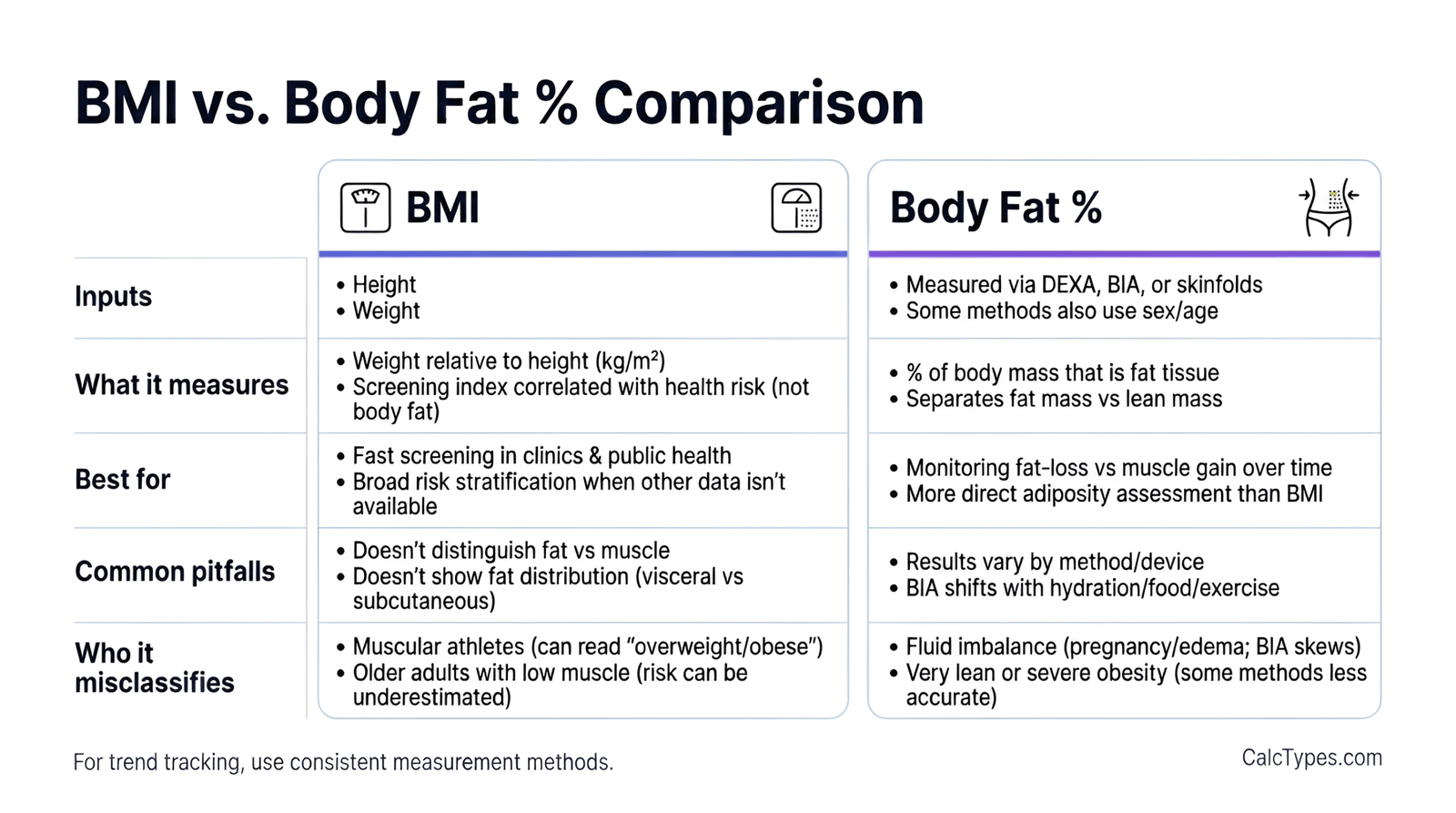
BMI vs Body Fat % (Which Method Should You Use?)
BMI uses only height and weight. Body fat % estimates how much of your body is fat tissue. If you can measure with a tape, the US Navy method can reflect circumference changes that BMI alone does not capture.
Accuracy & Limitations
For the most consistent results:
- Measure at the same time of day when practical
- Keep the tape parallel to the floor
- Apply consistent, snug pressure without compressing the skin
- Take multiple measurements and use a consistent reading or average
- Have someone else measure you if that improves consistency
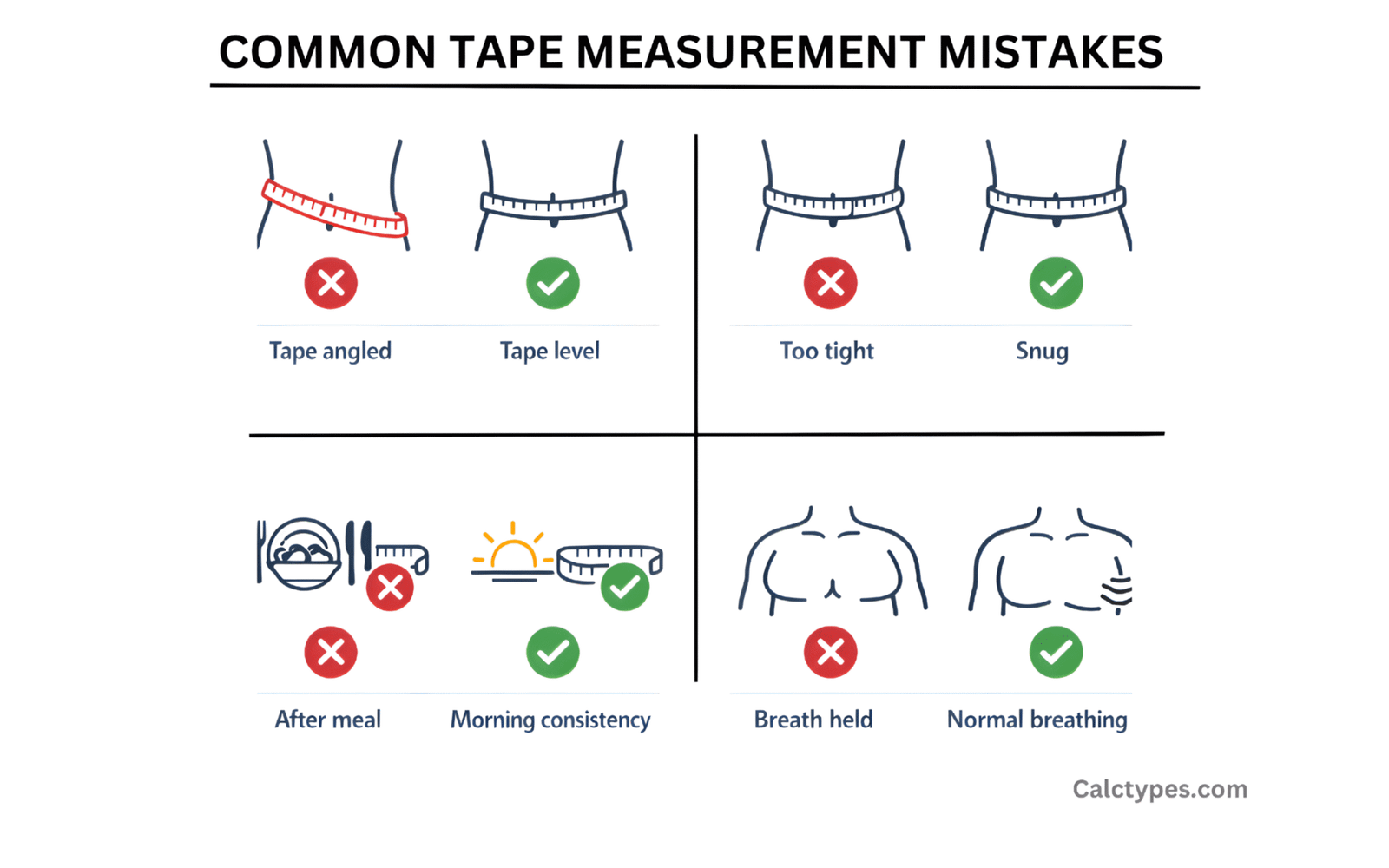
Limitations: The US Navy tape method is an estimate. Results can vary based on exactly where you place the tape, how tightly you measure, and natural short-term changes in waist or hip size. More direct clinical body-composition methods may be appropriate when greater precision is needed.
For meaningful progress tracking, measure the same way each time and focus on trends over time rather than small changes between individual readings.
Healthy Body Fat Ranges
Body fat reference ranges vary by sex, age, athletic status, measurement method, and the purpose for which the number is being used. The category table on this calculator is general context rather than a diagnosis or a personalized target.
Very low body fat is not automatically healthier, and a higher estimate does not by itself describe a person’s complete health status. If you are considering a substantial change in diet, exercise, or body weight, use the calculator as one data point and seek individualized guidance when appropriate.
For another general health-planning metric, you can also use our Water Intake Calculator.
Methodology (How This Calculator Works)
This calculator estimates body fat percentage using either (1) the classic US Navy circumference (“tape”) equations or (2) a BMI-based adult population estimate. Results are estimates rather than a clinical diagnosis or an official military assessment.
US Navy (Tape) Method
- Uses neck + waist (men) and neck + waist + hips (women), plus height.
- Calculates with the direct inch-based circumference equations; Metric entries are converted to inches internally.
- Best for: practical progress tracking when measurements are taken consistently.
- Limitations: sensitive to tape placement, tape tension, posture, and short-term circumference changes.
- Official military assessments may apply specific rounding, measurement, table, and administrative rules; use current service guidance for an official result.
BMI-Based Estimate
- Uses BMI + age + sex to approximate body fat %.
- Best for: a quick estimate when no tape measure is available.
- Limitations: BMI does not directly separate fat mass from muscle and other lean tissue.
If you need a more precise body-composition assessment for medical or professional purposes, discuss appropriate measurement options with a qualified professional. For personal tracking, use the same method consistently.
Sources & References
- Hodgdon JA, Beckett MB (1984). Prediction of Percent Body Fat for U.S. Navy Men from Body Circumferences and Height, Report 84-11. PDF (DTIC)
- Hodgdon JA, Beckett MB (1984). Prediction of Percent Body Fat for U.S. Navy Women from Body Circumferences and Height, Report 84-29. PDF (DTIC)
- U.S. Department of Defense. DoD Instruction 1308.03 (DoD Physical Fitness and Body Composition Program). PDF (esd.whs.mil)
- U.S. Navy, MyNavy HR. Physical Readiness Program — current Body Composition Assessment guidance. Current guides
- Deurenberg P, Weststrate JA, Seidell JC (1991). Body mass index as a measure of body fatness: age- and sex-specific prediction formulas. PubMed
Embed This Calculator
Copy/paste this code to add the calculator to your site. Please keep the attribution link.