Islamic Inheritance Calculator (Faraid)
Faraid Calculator
Estimate supported Sunni inheritance shares for common family scenarios. Includes Basic Mode and a limited Extended Mode for clean sibling cases. Advanced Hanafi coverage is under scholarly review and will be released after verification.
This calculator is part of our Islamic calculators hub. You may also find our zakat calculator and Zakat al-Fitr calculator useful.
Inheritance Inputs
Basic Mode: spouse, parents, sons, daughters (most common cases).
Extended Mode: limited clean sibling cases (generally no father and no descendants).
Advanced Mode (Hanafi): being verified with scholars before release (grandparents, Hanafi ‘asabah chain, radd).
Results
Assumptions & Warnings
📊 Inheritance Distribution
📋 View heir-by-heir breakdown
| Heir | Fraction | Percentage | Amount | Notes |
|---|---|---|---|---|
| Enter values to see the inheritance breakdown. | ||||
🔍 How was this calculated? (Step-by-step)
🎯 Next steps (based on your results)
Enter inheritance details above to see personalized next steps.
How to Use This Calculator
Enter the estate amount (after debts and wasiyyah) and the heirs you want to include. The calculator will show a breakdown table, chart, and step-by-step explanation. If the case is outside the supported scope, it will show a scholar advisory.
- Step 1: Choose your country (currency + legal note).
- Step 2: Select Basic or Extended Mode.
- Step 3: Enter the estate value after debts and wasiyyah.
- Step 4: Enter spouse/parents/children (and siblings if Extended Mode).
- Step 5: Download or share the result for review.
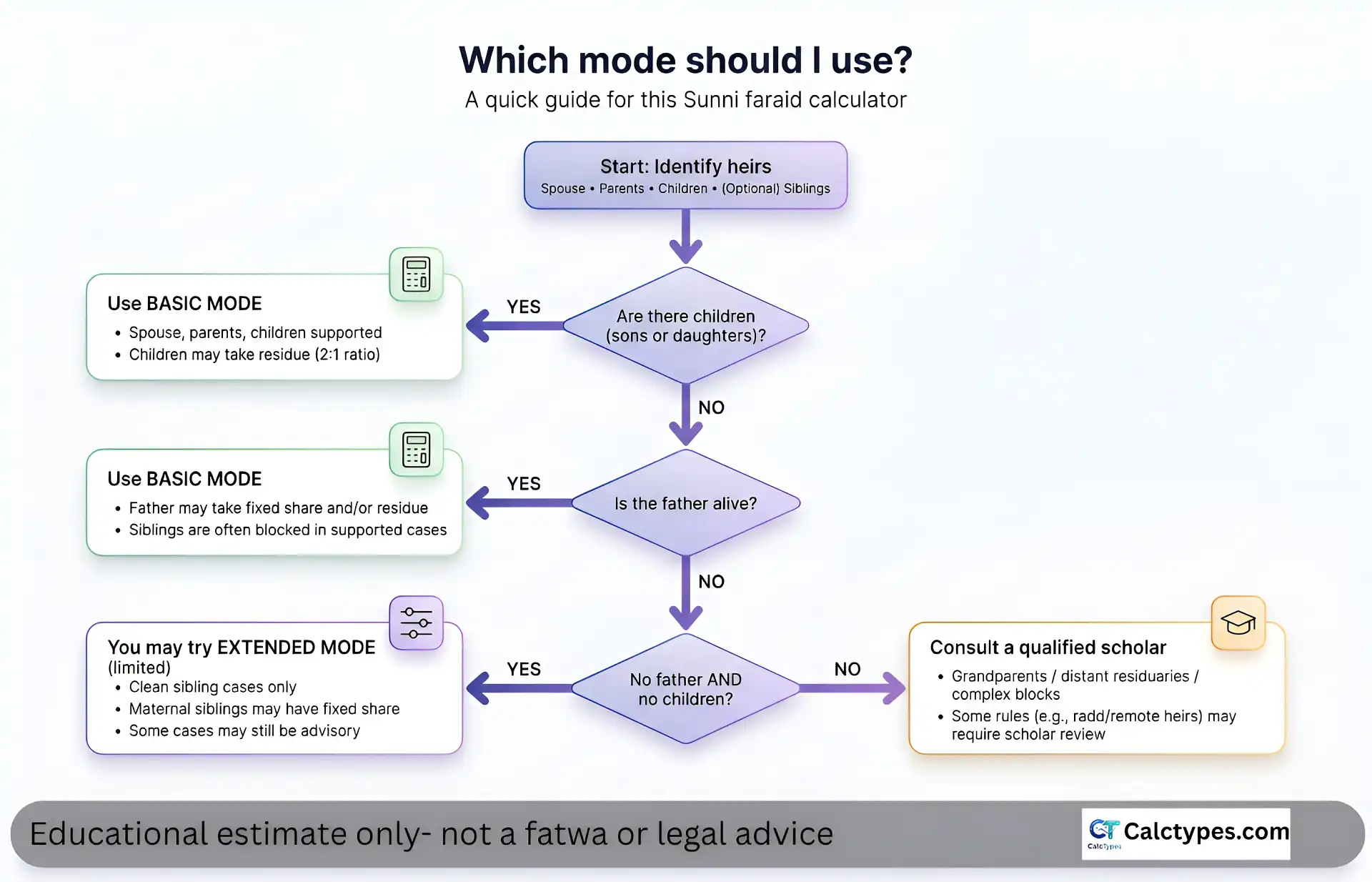
What Heirs Are Supported?
This public version focuses on the most common Sunni faraid cases and transparently flags unsupported scenarios.
Basic Mode
- Spouse (husband or wife/wives)
- Mother and father
- Sons and daughters
Extended Mode (limited clean cases)
- Full siblings (brothers/sisters)
- Maternal siblings (brothers/sisters)
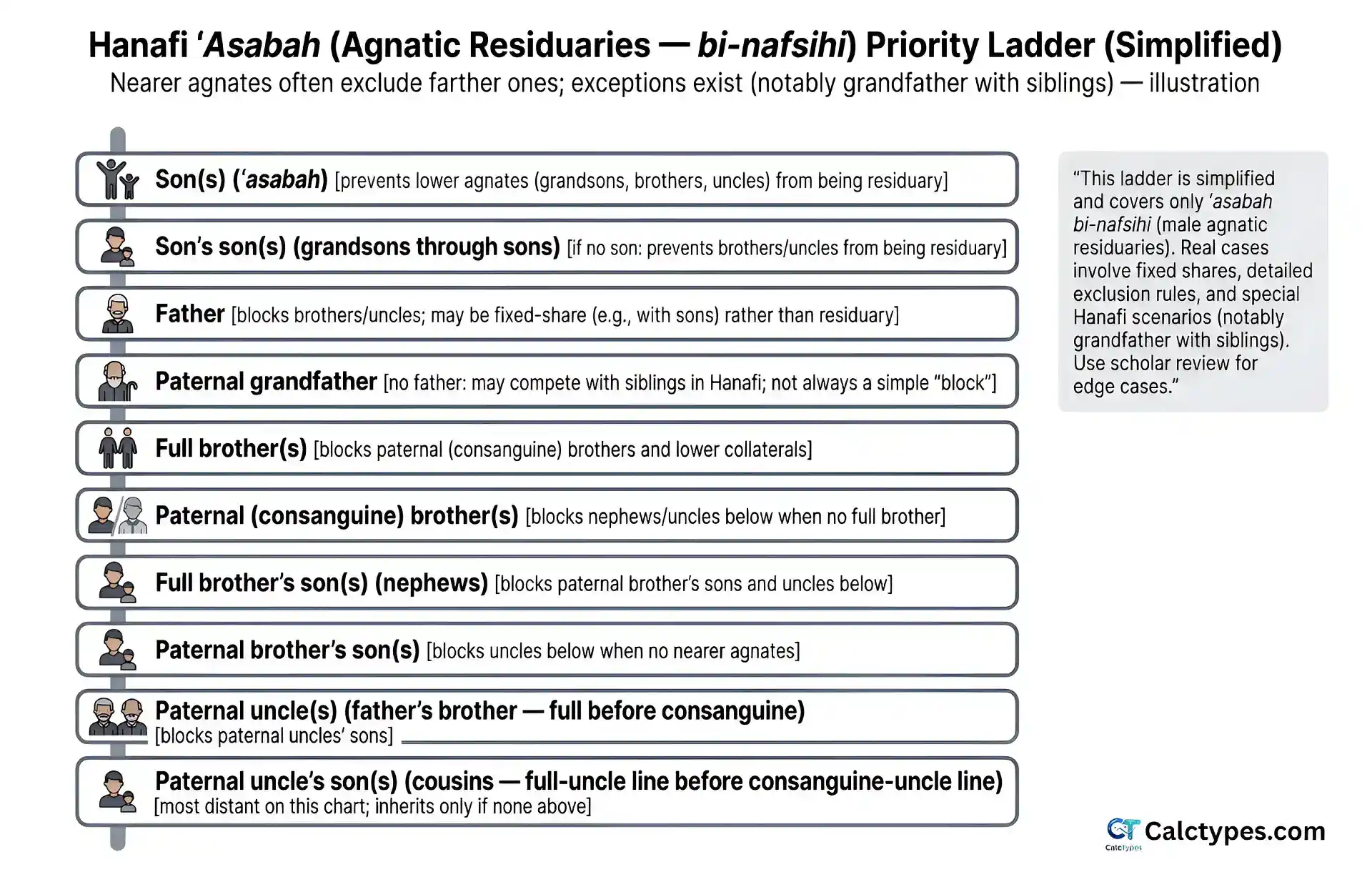
Note: Grandparents, paternal chain heirs (nephews/uncles), and full radd are under scholarly review for a future Advanced Mode (Hanafi).
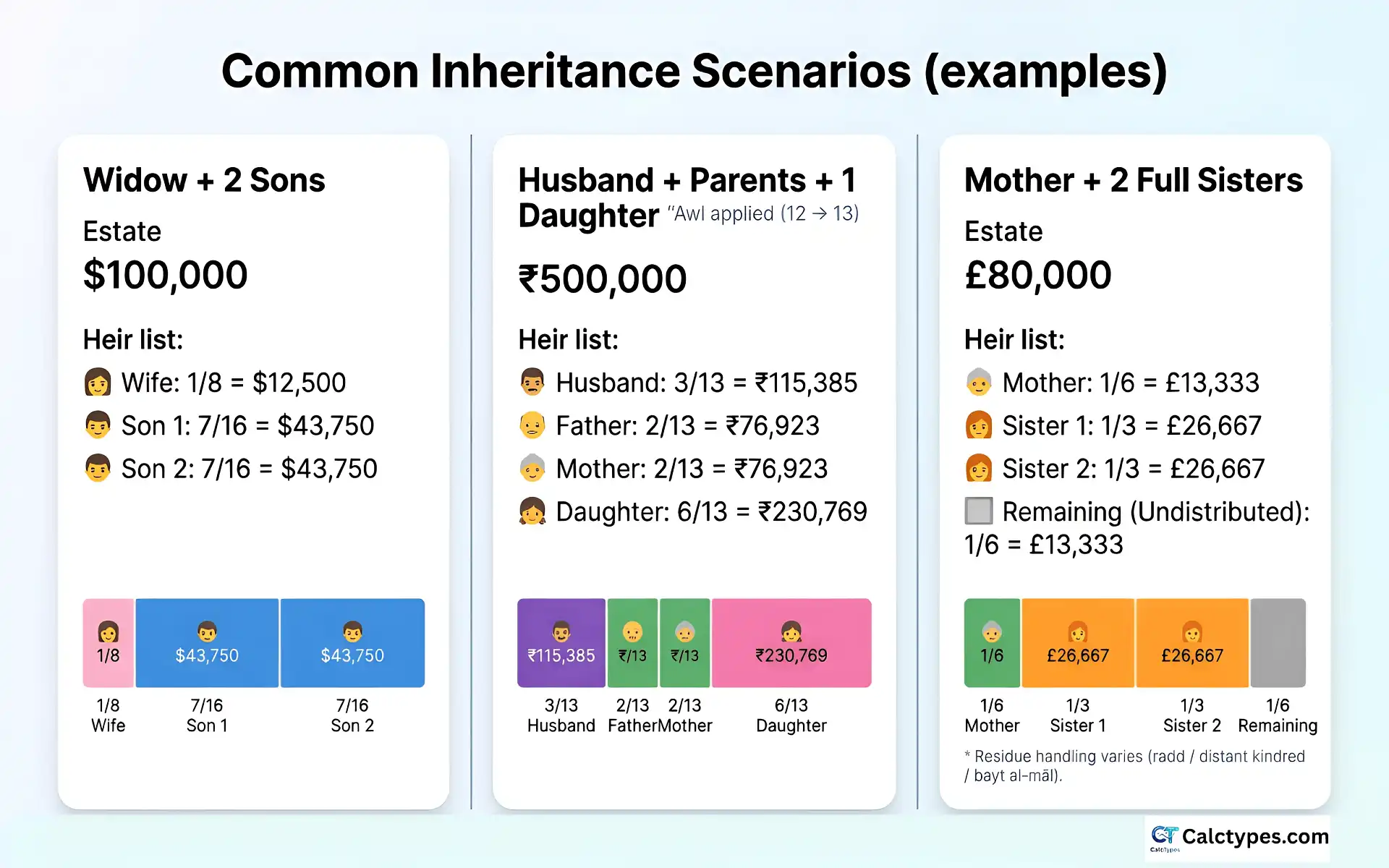
Understanding Awl and Umariyyatain
Awl: When the sum of fixed shares exceeds the estate, shares are proportionally scaled down so the total becomes 100%. The calculator will show a warning when this happens.
Umariyyatain: In the scenario where the heirs are only spouse, mother, and father (and no descendants), the mother receives one-third of the residue after the spouse share (not one-third of the whole estate). This is applied automatically in supported cases.
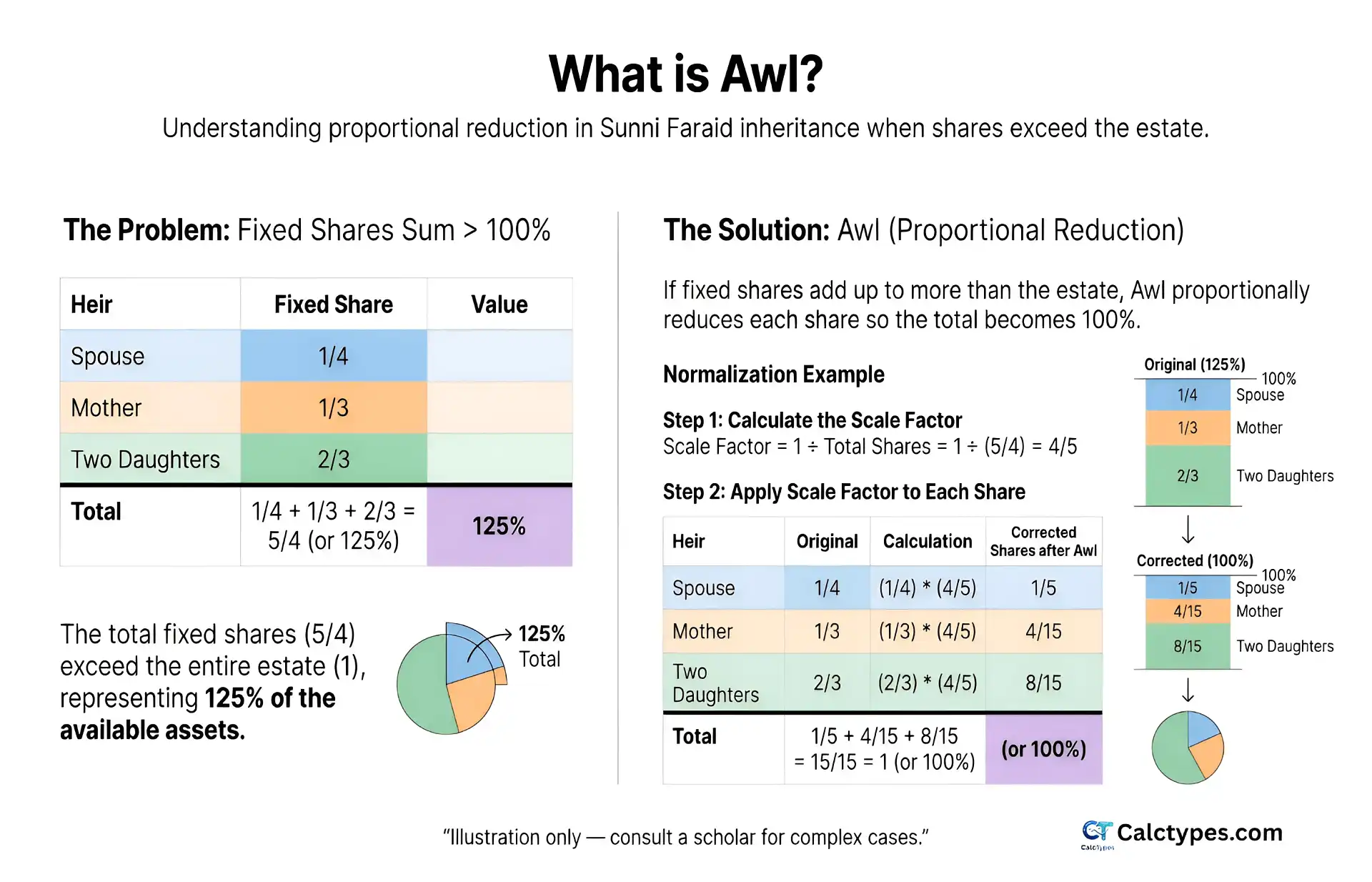
Frequently Asked Questions
These answers explain how this Islamic inheritance calculator (Faraid) works, what the results mean, and when you should seek scholar review. All answers are educational and not a fatwa.
What is Faraid in Islam?
Faraid refers to the Islamic inheritance rules that assign specific shares to certain heirs (for example spouses, parents, and children). These shares are primarily derived from Qur’anic guidance and the broader fiqh framework scholars apply to real cases.
This calculator helps you estimate inheritance distribution by:
- Applying supported Sunni rules for the heirs you enter
- Showing the share as a fraction (e.g., 1/6), percentage, and amount
- Warning you when a case likely requires additional rules not fully implemented in this public version
Is this a free Faraid calculator online (faraid calculator online free)?
Yes. This is a free Faraid calculator that produces an educational estimate for supported Sunni cases. You can also use the built-in tools to:
- Copy Link (to share or revisit the same inputs)
- Download Result Image (easy sharing in WhatsApp/email)
- Save as PDF / Print (for records or scholar review)
Is this an Islamic inheritance calculator with amount (not only percentages)?
Yes. When you enter the Total estate value, the calculator converts each heir’s share into an exact amount. It also shows the share as a fraction and percentage so you can understand both the fiqh-style share and the practical amount.
If multiple heirs share a collective portion (for example, multiple wives or multiple daughters in a fixed-share scenario), the calculator also displays an “each receives ~ …” note where applicable.
What should I enter as the “Total estate value” (after debts & wasiyyah)?
Enter the distributable estate amount—meaning what remains after you account for:
- Funeral expenses (as applicable)
- Confirmed debts
- Any valid Islamic bequest (wasiyyah) you already accounted for
If you are unsure about debts, jointly owned property, disputed assets, or whether a bequest is valid/within limits, treat your output as preliminary and get verification.
Is this a Hanafi inheritance calculator (Islamic inheritance calculator Hanafi)?
Many users search for a Hanafi inheritance calculator. The public version currently focuses on supported Sunni inheritance rules for common scenarios and transparently flags unsupported cases.
A more complete Advanced Mode (Sunni Hanafi) is under scholarly review to support additional heirs and rules (e.g., grandparents, Hanafi ‘asabah chain, and radd) and reduce “Remaining (Undistributed)” outcomes. Until it’s verified and released, some Hanafi-style edge cases may show Scholar Advisory.
Does this page support a Shia inheritance calculator (Islamic inheritance calculator Shia)?
Not in the current public version. Shia inheritance rules can differ from Sunni approaches in important ways. If you specifically need a Shia inheritance calculator, do not rely on a Sunni estimator for a final answer.
You can still use this page for general learning (fractions, amounts, and process), but for actual Shia distribution, consult a qualified scholar and use Shia-specific references.
What does “Scholar Advisory” mean in this Islamic inheritance calculator?
“Scholar Advisory” means your case likely involves rules or heirs beyond what this public calculator fully supports today. The calculator shows what it can compute, but flags the outcome to avoid false certainty.
Common reasons include:
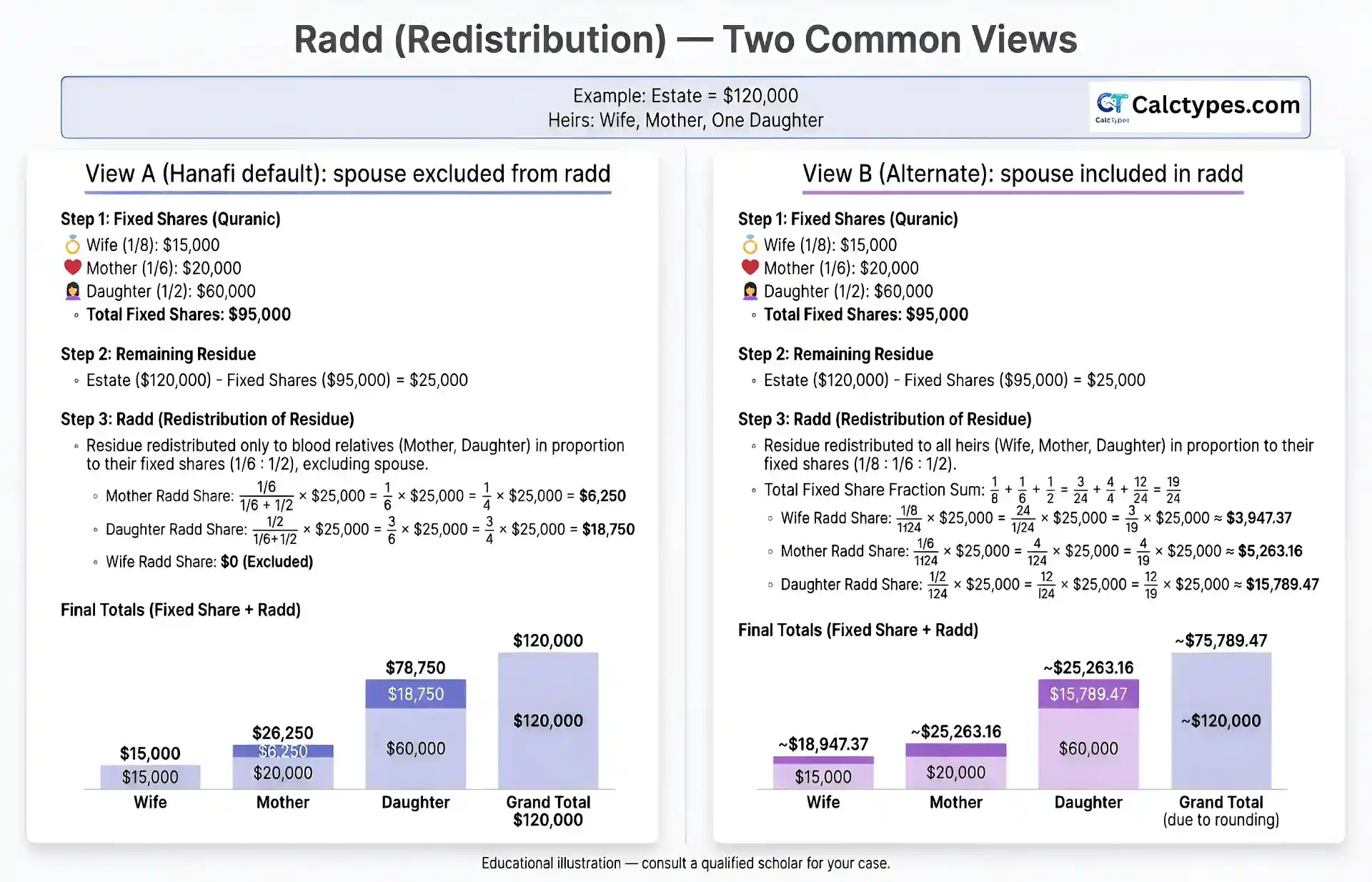
- A remainder that requires radd (redistribution) or remote residuaries
- Heirs not supported in this version (e.g., grandparents or deeper ‘asabah chain)
- Complex blocking/priority situations that need scholar-level review
What does “Remaining (Undistributed)” mean?
“Remaining (Undistributed)” is the portion of the estate that the current public version does not assign after applying supported shares. In full fiqh practice, this remainder may be handled through additional residuaries and/or radd, depending on the case.
When you see a remainder, it’s a strong signal to verify the full case with a qualified scholar—especially if there are extended heirs, multiple family branches, disputed assets, or missing information.
What is Awl in Faraid calculation (and why did my shares change)?
Awl happens when the sum of fixed shares exceeds the estate (more than 100%). In that situation, the shares are scaled down proportionally so the total becomes exactly 100%.
This calculator labels such results as Adjusted (Awl) and adds a warning so you understand why the final percentages differ.
What is Umariyyatain (mother’s share after spouse)?
In the Umariyyatain scenario (commonly: spouse + mother + father, with no descendants), the mother receives one-third of the residue after the spouse share (not one-third of the entire estate).
This calculator applies Umariyyatain automatically in supported cases and will reflect it in the steps/assumptions.
Father property distribution in Islam calculator: how does this tool handle it?
People often search for a “father property distribution in Islam calculator” when the deceased is the father and heirs include spouse and children. In supported cases, the calculator applies:
- Spouse fixed share (wife/wives), depending on whether descendants exist
- Mother/father shares if parents are alive
- Children distribution of the residue using the 2:1 male-to-female ratio when sons exist
Real estates can be complicated by debts, jointly owned property, missing heirs, or local probate steps—so verify before acting.
Daughter share in father property in Islam (calculator explanation)
A daughter’s share depends on what other heirs exist. In supported Sunni cases:
- No sons + one daughter: the daughter may receive a fixed share of 1/2.
- No sons + two or more daughters: daughters may collectively receive 2/3.
- Sons exist: children share the residue using a 2:1 male-to-female ratio.
The calculator shows the share as a fraction, percentage, and amount. If multiple daughters share a collective portion, it will show an “each receives ~ …” estimate where relevant.
Property division between brother and sister in Islam calculator (how sibling cases work)
Sibling inheritance depends on the type of siblings and whether the deceased has a father or descendants (who may block siblings). It is not correct to assume “brother and sister always 2:1” in every sibling scenario.
In this calculator:
- Basic Mode: sibling inputs are ignored (and the calculator warns you if siblings were entered).
- Extended Mode: supports limited clean sibling cases (generally no father and no descendants).
- Maternal siblings: in supported clean cases, they share equally (no 2:1 ratio).
If you see residue or advisory notes, treat the result as educational and seek scholar verification.
Widow vs widower shares (inheritance calculator widower / widow)
In supported Sunni cases, spouse shares depend on whether descendants exist:
- Wife/wives: typically 1/8 if descendants exist, otherwise 1/4.
- Husband: typically 1/4 if descendants exist, otherwise 1/2.
Note: these are general spouse shares for supported cases. The remainder may go to parents, children, or other heirs depending on your inputs.
What’s the difference between Basic Mode and Extended Mode?
Basic Mode is for the most common heir set: spouse, parents, sons, daughters. It keeps the model simpler to reduce incorrect outputs in complicated estates.
Extended Mode adds limited sibling rules intended for clean sibling cases (generally no father and no descendants). If your case doesn’t match this clean structure, the calculator may show warnings or a scholar advisory.
Why are my sibling inputs ignored in Basic Mode?
Because Basic Mode is intentionally limited to spouse/parents/children. Sibling rules quickly become complex due to blocking rules and residuary priorities. If siblings are relevant to your case, switch to Extended Mode for supported clean sibling scenarios.
If you still receive “Scholar Advisory” in Extended Mode, that’s a sign the case likely requires rules beyond this public version.
Why does the calculator show “each receives ~…”?
Some shares are shown as a collective portion for a group (for example, multiple wives, or multiple daughters in a fixed-share scenario). The calculator divides that collective amount equally among the count you entered and displays an approximate per-person value.
The “each receives ~ …” line is a convenience for readability; the legal/fiqh share is still represented by the fraction and percentage.
What does “kalkulator faraid” mean?
Kalkulator faraid is a Malay/Indonesian phrasing meaning “Faraid calculator.” People searching this term typically want a quick estimate of inheritance shares with clear amounts and explanations.
This tool provides an educational estimate and clearly flags when a case needs scholar review.
MUIS Faraid calculator (Singapore): is this calculator the same?
MUIS-related calculators are often searched by name for Singapore context. This calculator is not affiliated with MUIS.
You can still use this tool to understand shares and amounts, but for official procedures and jurisdiction-specific guidance, consult official sources and a qualified advisor.
Islamic inheritance calculator Excel / download Islamic inheritance calculator / app — do you provide these?
Many users search for an Islamic inheritance calculator Excel file, a download, or an app because they want offline record-keeping or easier sharing.
This page currently provides practical alternatives:
- Download Result Image (share quickly with family or a scholar)
- Save as PDF / Print (archive the result)
- Copy Link (reopen the same inputs later)
If you copy the results table into Excel for archiving, keep the warnings/assumptions with it so the context isn’t lost.
How can I quickly sanity-check the result?
- Confirm heirs entered match the real case (spouse, parents, children; siblings only when relevant and in Extended Mode).
- Check status: Calculated, Adjusted (Awl), or Scholar Advisory.
- Check totals: Distributed + Residue should match the estate.
- Check residue logic: if children share residue, amounts should reflect the 2:1 ratio where applicable.
If anything is unclear, use “Download Result Image” and share it with a scholar for review.
Is this result a fatwa or legal advice?
No. This is an educational estimator. Final inheritance distribution should be verified by a qualified Islamic scholar (mufti). Also consider local probate/estate requirements in your country.
FAQ update summary
- Kept all questions from your previous set (none removed).
- Converted the FAQ into clean, individual collapsible blocks using the same pattern (one Q&A per block, collapsed by default, tap/click to expand).
- Expanded answers significantly so users can understand shares, modes, warnings, and common scenarios without needing to search elsewhere.
- Added new questions naturally based on real GSC query intent and missing topics, including: “with amount”, estate value definition, scholar advisory meaning, sibling behavior, “kalkulator faraid”, “MUIS faraid calculator”, and “Excel/download/app” intent.
- Improved search-intent alignment by embedding high-relevance query phrases in the question text (not stuffed in paragraphs), which tends to improve relevance + CTR while keeping the content readable.
Is it better or worse than before? Better for users and SEO: it’s clearer, more complete, and more aligned to the actual searches you’re receiving, while staying honest about scope (Sunni-supported; Hanafi advanced under review; Shia not supported).
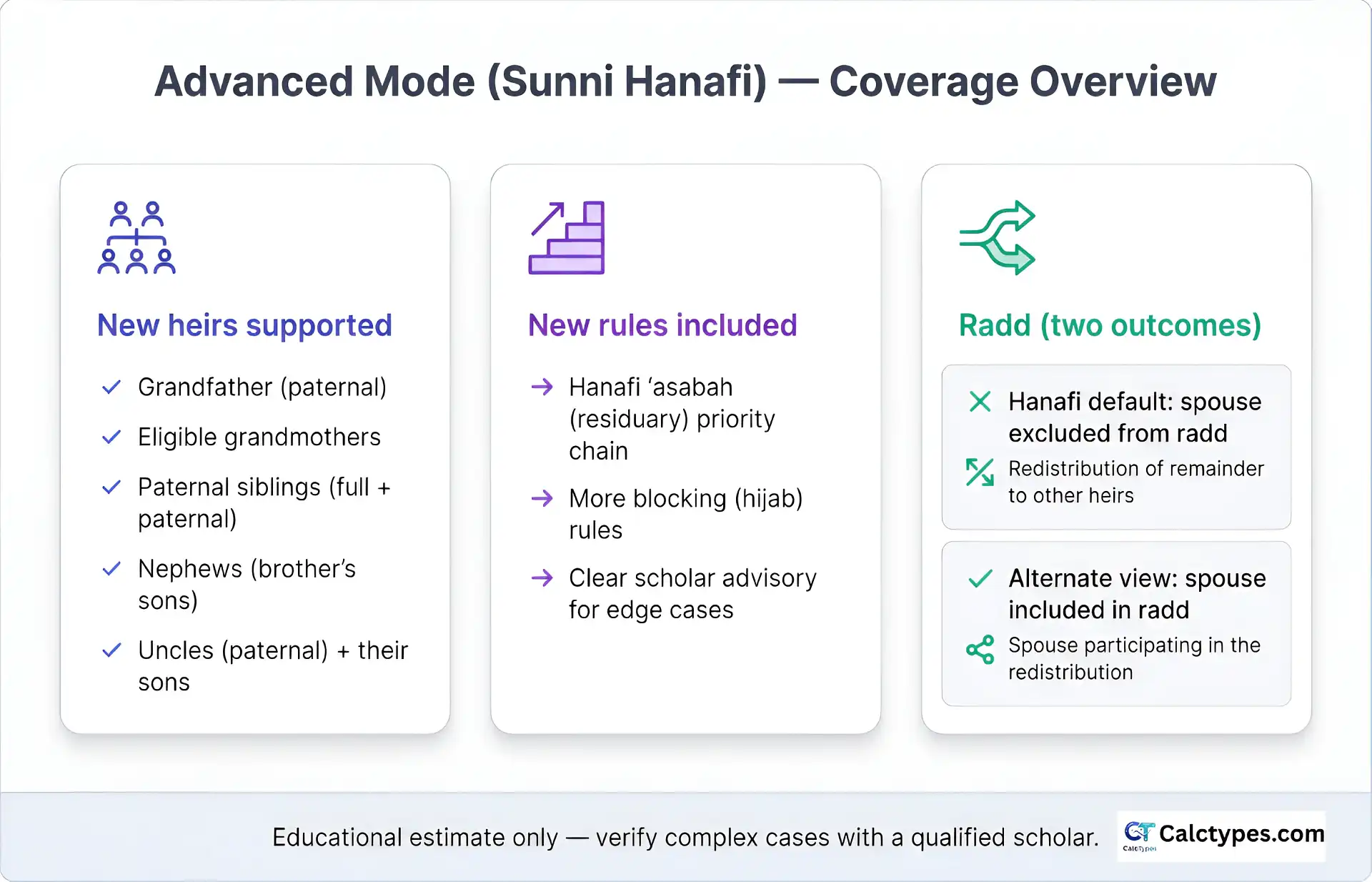
🧭 Advanced Mode (Sunni Hanafi) — under scholarly review
We are preparing an Advanced Mode based on Sunni Hanafi fiqh to support more heir types and reduce “Remaining (Undistributed)” cases. It will include grandparents, the Hanafi ‘asabah (residuary) chain (paternal siblings, nephews, uncles, and beyond), and radd. Complex edge cases will still show a scholar advisory.
Until verification is complete, Advanced Mode is not enabled on the public calculator.
📦 Embed this calculator
Add this free Islamic inheritance calculator to your site — no signup required.
Recommended iframe height: 1100px (minimum 980px). Please keep the visible attribution link for transparency and updates.
Sources & Further Reading
The core basis for this calculator is the Quranic inheritance framework, especially Surah An-Nisa (4:11–12) and the broader inheritance guidance (including 4:176).
Qur'an 4:11 — Inheritance shares for children and parents Qur'an 4:12 — Inheritance shares for spouses and siblings Qur'an 4:176 — Kalalah and sibling rulings SeekersGuidance — Inheritance and lineage (third-party)Disclaimer on sources: This tool is for educational estimation only. Final verified scholarly sources should be reviewed by a qualified mufti or Islamic scholar.
This calculator is provided for understanding and guidance only. It generates an educational estimate based on the heirs and values you enter and the calculator’s supported Sunni inheritance rules. It is not a fatwa, not legal advice, and not a substitute for consultation with a qualified Islamic scholar (mufti) and an estate/probate attorney where applicable.
Before distributing any inheritance in real life, you must verify the full case with a qualified scholar—especially if the calculator shows Scholar Advisory or Remaining (Undistributed), or if there are disputes, missing information, jointly owned assets, unclear debts/wasiyyah, or country-specific probate requirements.
Limitation of responsibility: To the fullest extent permitted by law, CalcTypes (and its authors/contributors) is not responsible or liable for decisions, losses, disputes, or outcomes arising from the use of this calculator or its results.
After planning for inheritance, you can also calculate your zakat or browse the complete Islamic calculators directory.