AHA vs WHO sugar recommendations: the key differences
AHA vs WHO sugar recommendations: the key differences
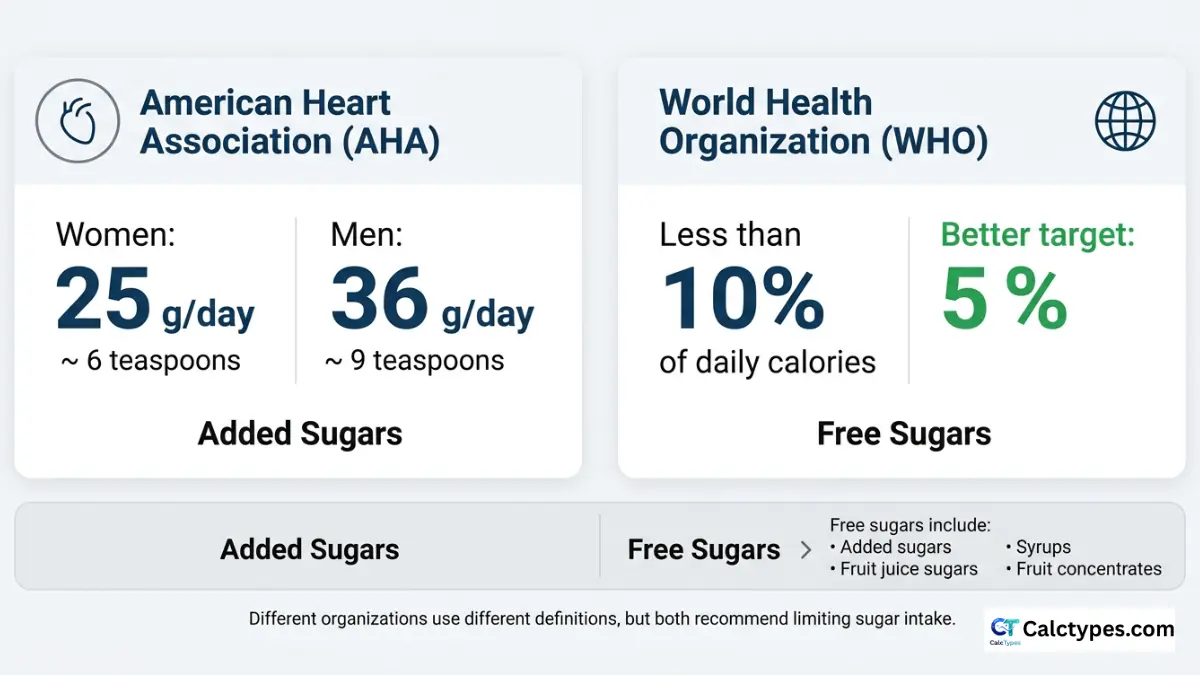
AHA vs WHO sugar recommendations can look contradictory at first because they use different definitions and different ways of expressing limits. AHA guidance is usually framed as an added sugar cap (grams/day), while WHO guidance targets free sugars as a percent of total daily calories.
If you want tools to apply the numbers to real foods, start from the sugar calculators hub.
Quick takeaway (AHA vs WHO sugar recommendations)
WHO’s <5% “conditional” target often lands near AHA’s commonly cited caps for many adults (because 5% of 2,000 kcal ≈ 25 g). But they are not interchangeable: WHO “free sugars” includes more sources (like fruit juice, honey, and syrups) than AHA “added sugars” in most label-based tracking.
New in 2026: US Dietary Guidelines 2025–2030 on added sugar
In January 2026 the US Departments of Agriculture and Health and Human Services published the Dietary Guidelines for Americans 2025–2030. They take a stricter line on added sugar than earlier editions:
- No amount of added sugar or non-nutritive sweetener is described as part of a healthy diet.
- A single meal should contain no more than 10 g of added sugar.
- Children should avoid added sugar until age 10 (earlier guidance said under age 2).
The previous limit of less than 10% of calories (about 50 g on a 2,000 kcal diet) has effectively been replaced. Three meals at the 10 g ceiling add up to about 30 g a day — close to the AHA’s 25 g and 36 g limits and the WHO’s 5% “ideal” target. US Nutrition Facts labels still calculate % Daily Value from 50 g for now, so a label’s %DV is not the same as the new guideline.
Source: Harvard T.H. Chan School of Public Health — The Nutrition Source; DietaryGuidelines.gov.
Content review
On this page
- Side-by-side comparison (table)
- Why AHA and WHO use different numbers
- Added sugars vs free sugars (what counts?)
- Turning WHO % into grams (examples)
- How to apply the guidance using labels
- Sugary drinks: why guidelines emphasize them
- Practical ways to reduce sugars
- Limitations
- Questions people ask
- Sources
AHA vs WHO sugar recommendations (side-by-side)
| Organization | What sugar type is limited? | How the limit is expressed | Commonly cited limit (adults) | What this often looks like in grams |
|---|---|---|---|---|
| AHA | Added sugars (often aligns with “Added Sugars” on U.S. labels) | Daily cap in calories/day (often converted to grams/day) | ≤100 kcal/day (women) and ≤150 kcal/day (men) from added sugars | Using 4 kcal/g: 25 g/day (women) and ~36–38 g/day (men) |
| WHO | Free sugars (added sugars + sugars in honey, syrups, juices, concentrates) | Percent of total daily energy intake | <10% (strong); consider <5% for additional benefits (conditional) | Example at 2,000 kcal/day: 10% ≈ 50 g; 5% ≈ 25 g |
Why AHA and WHO use different numbers
They’re solving different problems
AHA guidance is usually communicated as a practical daily cap for added sugars. WHO guidance is written for population-level policy and uses percent-of-energy targets that scale with different calorie needs.
They use different “sugar buckets”
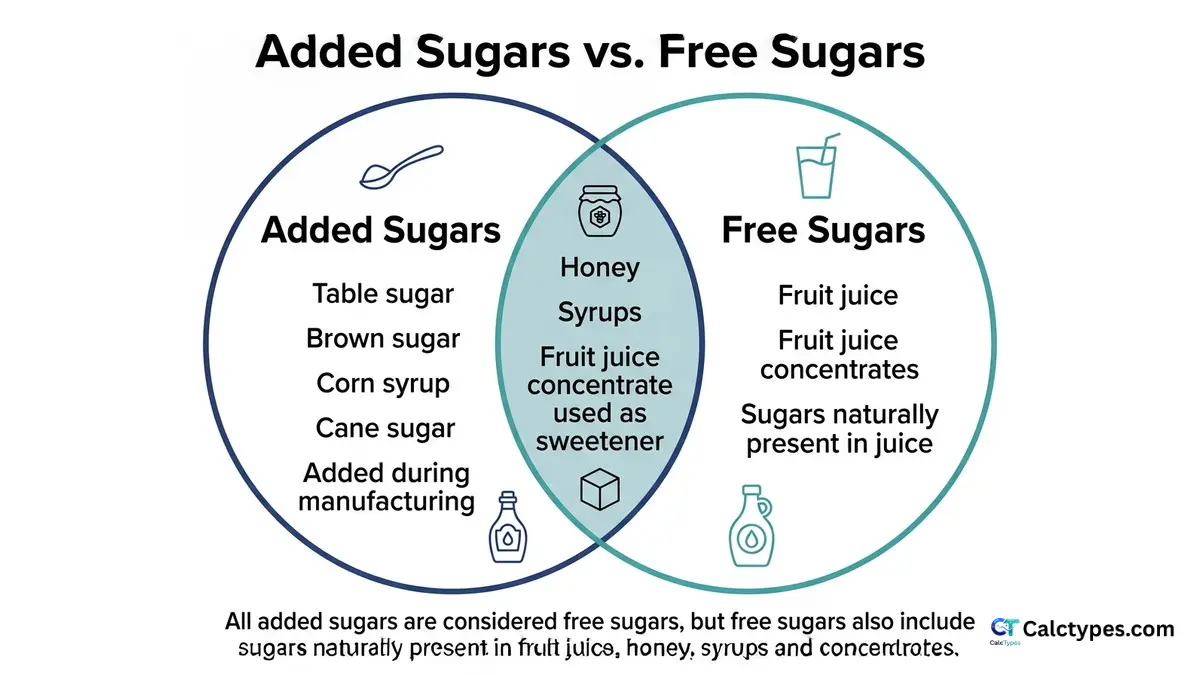
WHO’s “free sugars” is broader than “added sugars.” That’s why WHO-style tracking can feel stricter if you drink juice or use honey/syrups often.
The numbers can converge (especially around WHO 5%)
For many adults, WHO’s 5% target can land near the AHA’s commonly cited range. If you want a tool-based translation from calories → sugar share, see percent of calories from added sugar.
Added sugars vs free sugars (what counts?)
Added sugars (AHA-style tracking)
“Added sugars” generally means sugars added during manufacturing, cooking, or at the table. This can be easier to track when labels list “Added Sugars.”
Free sugars (WHO definition)
WHO “free sugars” includes added sugars plus sugars naturally present in honey, syrups, fruit juices, and juice concentrates.
For label clarity, see: added sugar vs total sugar.
Turning WHO % into grams (examples)
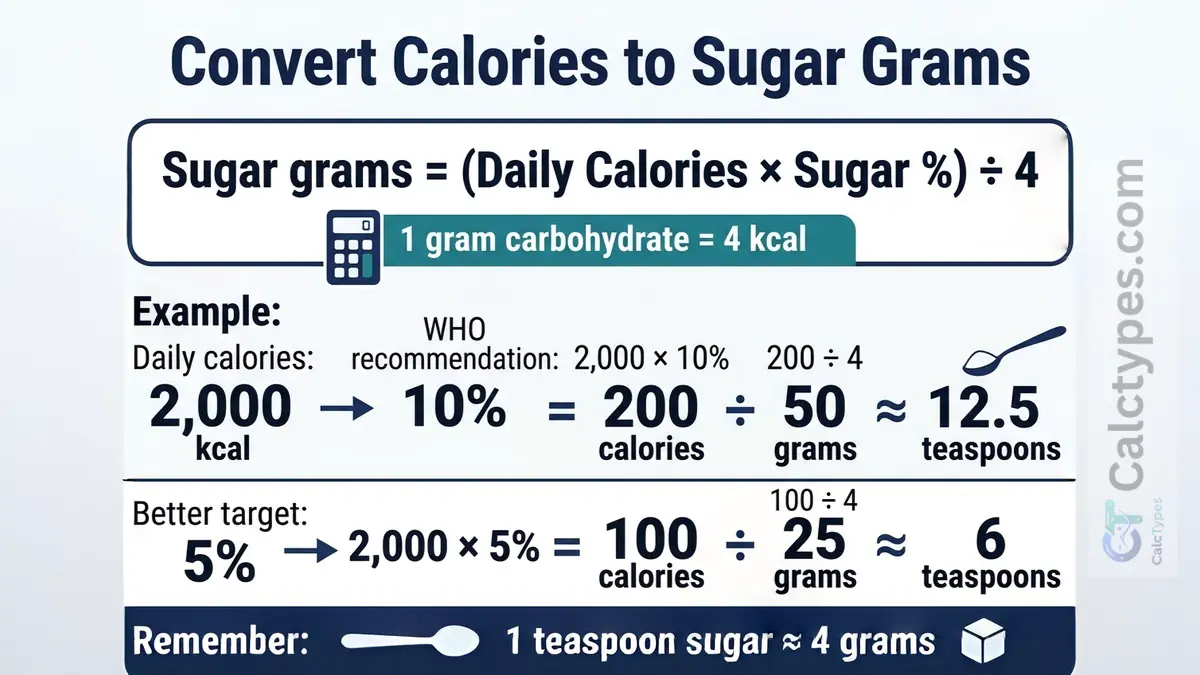
Conversion formula (percent of calories → grams/day)
A practical estimate is 1 gram of sugar ≈ 4 kcal. To estimate WHO-style free-sugar grams/day:
Example (2,000 kcal): 10% → 50 g/day; 5% → 25 g/day
Prefer teaspoons? Use: convert sugar grams to teaspoons.
How to apply the guidance using labels
AHA-style: use “Added Sugars” when available
If the label lists “Added Sugars,” it’s usually the most direct way to track toward AHA-style targets. Step-by-step: how to read an added sugar label.
WHO-style: watch for free-sugar sources that labels may not flag
WHO “free sugars” can include juice and some concentrates—so your “added sugars” tracking can undercount WHO-style free sugars. When in doubt, prioritize drinks first.
Sugary drinks: why guidelines emphasize them
Liquid sugar adds up fast
Sweetened drinks can deliver a lot of sugar quickly and may not reduce appetite the way solid food does. If beverages are your main source, try the sugary drinks sugar calculator.
Practical ways to reduce added/free sugars
Biggest sources first (most people don’t need perfection)
Start with the highest-impact category: drinks, sweet snacks/desserts, then “everyday” foods like cereal and flavored yogurt. Consistency matters more than obsessing over one number.
Limitations (important)
These are guideline targets, not diagnostic cutoffs
AHA/WHO recommendations support general health promotion and population risk reduction. They do not diagnose disease.
Definitions may not map perfectly to every label or country
WHO free sugars includes sources (like juice/honey) that may not be counted as “added sugars” on labels, so label tracking can undercount WHO-style intake.
Questions people ask
Which guideline is stricter: AHA or WHO?
It depends on which WHO target you mean and whether you’re counting “free sugars” broadly. WHO’s <10% target can be higher in grams than AHA’s commonly cited caps at typical calorie levels (e.g., 2,000 kcal → ~50 g). WHO’s <5% target is often closer to AHA’s commonly cited adult caps (e.g., 2,000 kcal → ~25 g).
Definitions matter too: WHO includes sugars from juice/honey/syrups as “free sugars,” which can make it stricter in practice for some eating patterns.
Does WHO count fruit juice as sugar?
Yes. WHO includes sugars in fruit juices and fruit juice concentrates under “free sugars,” which are part of the limit.
Is honey “added sugar” or “free sugar”?
WHO explicitly includes honey as a free sugar. In everyday tracking, honey used to sweeten foods functions like an added sweetener.
What does “10% of calories from sugar” mean in grams?
Use grams = (daily calories × 0.10) ÷ 4. At 2,000 kcal/day: (2,000 × 0.10) ÷ 4 = 50 g/day.
Are these recommendations for total sugar or added sugar?
AHA generally focuses on added sugars. WHO focuses on free sugars. “Total sugar” on a label includes naturally occurring sugars too, so it doesn’t map cleanly to either guideline.
If I stay under AHA added sugar grams, am I automatically meeting WHO?
Not necessarily. You can meet an added-sugar target but still exceed WHO free sugars if you regularly consume juice, honey, or syrup-heavy foods.
What’s the simplest way to start lowering sugar without tracking everything?
Start with drinks. Replacing one daily sugary drink with water/seltzer/unsweetened tea often reduces intake noticeably without detailed tracking.
Disclaimer
This page is for educational purposes only and is not medical advice. It summarizes public guidance from major health organizations and provides general explanations and conversions.
If you have a medical condition (e.g., diabetes, heart disease), are pregnant, have a history of eating disorders, or are making changes for a child, seek individualized guidance from a qualified clinician or registered dietitian. Full disclaimer: https://calctypes.com/disclaimer/.