% Daily Value to Grams Calculator (Added Sugar)
Convert % Daily Value to Grams of Added Sugar
Enter the % Daily Value from any nutrition label and instantly see how many grams of added sugar that represents — plus teaspoons and daily limit context.
This % Daily Value to grams calculator converts the %DV shown next to “Added Sugars” on any US Nutrition Facts label into an exact gram amount — plus teaspoons and how it compares to daily sugar limits. Instead of guessing what “12% DV” actually means, enter the number and get a precise answer using the FDA’s official 50g Daily Value reference for added sugars.
It’s built for anyone reading a food label — whether you’re managing sugar intake, comparing two products, or simply curious what the percentage on the package actually adds up to.
Already have the gram number instead of a percentage? Use the added sugar label calculator to work from grams directly, or check the sugar calories calculator to see how many calories that sugar represents.
Calculator
Look for the % Daily Value column on your label, next to the “Added Sugars” row. Not sure where? How to read the added sugar label →
Quick examples:
Result
Want to see this amount as an actual spoon count? Visit the sugar grams to teaspoons calculator for a visual teaspoon breakdown.
On this page
What Does % Daily Value Actually Mean?
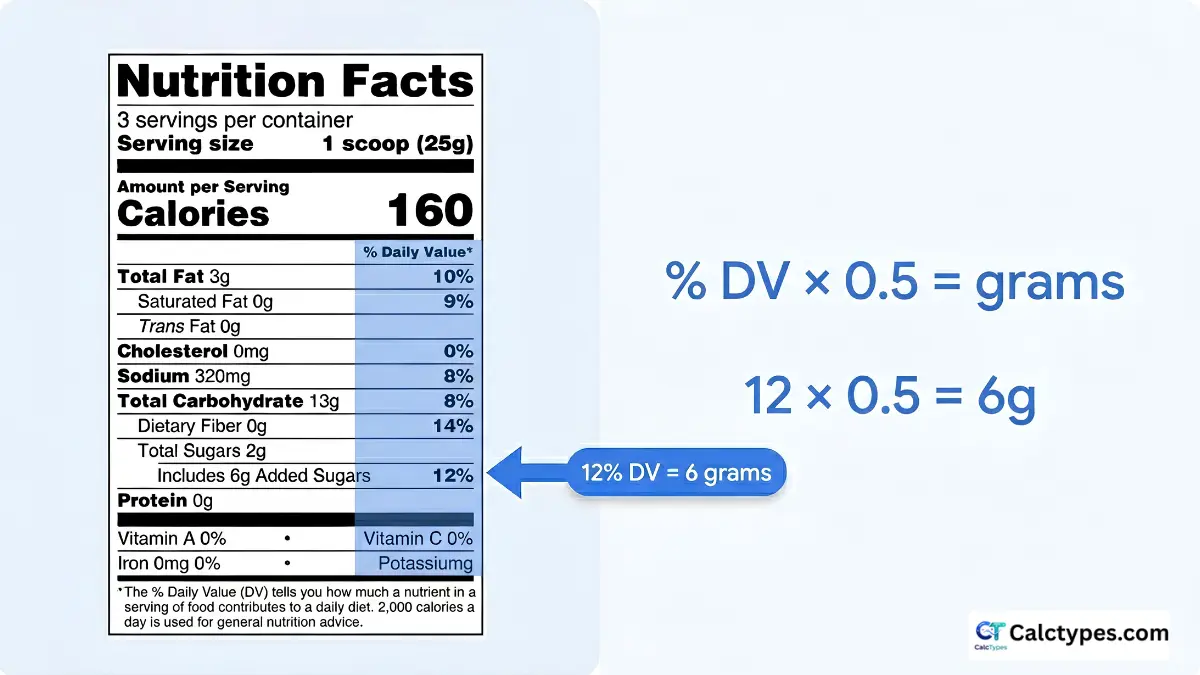
The % Daily Value (%DV) on a Nutrition Facts label tells you how much of a nutrient one serving contributes toward a standard daily diet. For added sugars, the FDA has set that reference at 50 grams per day — based on a 2,000 calorie diet. So every percentage point of %DV for added sugars equals exactly 0.5 grams.
Note: On US Nutrition Facts labels, the % Daily Value is provided for Added Sugars. Total Sugars usually has no %DV, so use the “Added Sugars” row for DV-based conversions.
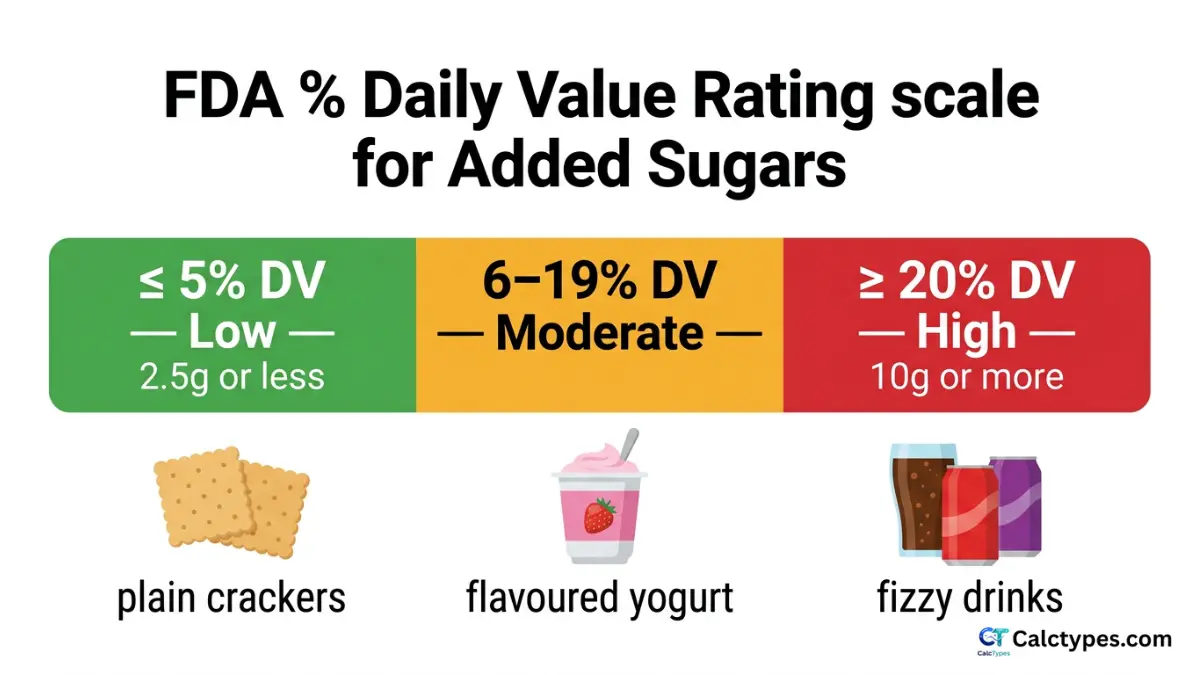
The FDA makes this guidance explicit on labels: 5% DV or less is considered low, while 20% DV or more is considered high. These thresholds are a quick screening tool — you don’t need to do any maths. But when you want the actual gram amount (to compare with AHA/WHO recommendations or convert to teaspoons), that’s when this calculator helps. Understanding how to read this part of the label is also covered in detail at this guide to reading sugar on labels.
How to Use the % Daily Value to Grams Calculator
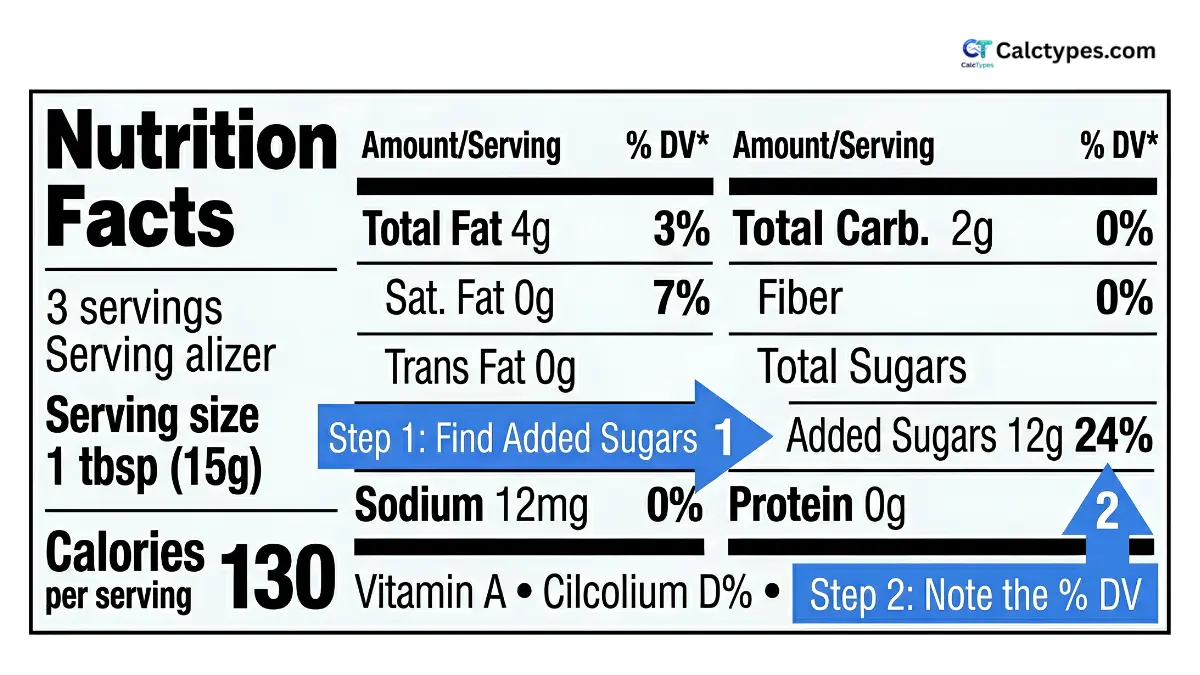
- Find the % Daily Value for Added Sugars on your nutrition label (right-hand column).
- Enter that percentage in the % Daily Value field above.
- Keep the reference at 50g (FDA standard) for standard US labels.
- Choose a daily limit context to see how this single product’s sugar compares to AHA or WHO limits.
- Click Convert % DV to grams — the result shows grams, teaspoons, and a DV rating.
The Formula: % Daily Value to Grams
The conversion is a straightforward percentage calculation. Because the FDA reference is fixed at 50g, you simply multiply the % DV by 0.5 (or equivalently, divide by 100 and multiply by 50).
One useful shortcut: because 1% DV always equals 0.5g of added sugar (on a standard US label), you can quickly estimate grams by halving the % DV number. So 14% DV ≈ 7 grams, 30% DV ≈ 15 grams, and so on.
Quick Reference: % Daily Value to Grams of Added Sugar
All values use the FDA standard: 100% DV = 50g added sugar.
| % Daily Value | Grams (added sugar) | Teaspoons | DV rating | Quick meaning |
|---|---|---|---|---|
| 1% DV | 0.5g | 0.13 tsp | Low | Trace amount |
| 5% DV | 2.5g | 0.63 tsp | Low | FDA “low sugar” threshold |
| 10% DV | 5g | 1.25 tsp | Moderate | One ketchup portion |
| 12% DV | 6g | 1.5 tsp | Moderate | Common flavoured yogurt serving |
| 20% DV | 10g | 2.5 tsp | High | FDA “high sugar” threshold |
| 25% DV | 12.5g | 3.13 tsp | High | Typical cereal/granola bar |
| 50% DV | 25g | 6.25 tsp | High | AHA daily limit (women/children) |
| 72% DV | 36g | 9 tsp | High | AHA daily limit (men) |
| 78% DV | 39g | 9.75 tsp | High | One can of regular cola |
| 100% DV | 50g | 12.5 tsp | High | Full FDA daily reference — entire day’s allowance |
Worked Examples
Click “Load” to fill the calculator automatically.
Example 1 — 5% DV: a “low sugar” snack
5% DV × 0.5 = 2.5g added sugar = 0.63 teaspoons. This sits below the FDA’s “low sugar” threshold. As a proportion of the AHA women’s limit (25g), it uses just 10% of the daily allowance — a genuinely small amount.
Example 2 — 20% DV: the “high sugar” threshold
20% DV × 0.5 = 10g added sugar = 2.5 teaspoons. This is exactly the FDA’s “high” threshold. A product at or above 20% DV is considered high in added sugar — meaning one serving supplies a significant fraction of the day’s allowance.
Example 3 — 50% DV: one serving uses half the day
50% DV × 0.5 = 25g added sugar = 6.25 teaspoons. This equals the entire AHA daily added sugar limit for women and children — in a single serving. Many flavoured coffees, sports drinks, and dessert-style yogurts land around this range.
Example 4 — 78% DV: one can of regular cola
78% DV × 0.5 = 39g added sugar = 9.75 teaspoons. That’s 78% of the FDA’s full daily reference for added sugars — in one drink. It exceeds the AHA daily limit for both women and men. Many foods in this range are not obviously sweet-tasting, which is why label reading matters. A deeper look at which products contain surprisingly high amounts is available at this guide to hidden added sugar in foods.
Example 5 — 100% DV: the full daily reference
100% DV × 0.5 = 50g added sugar = 12.5 teaspoons. This is the FDA’s entire daily reference amount for added sugars — it isn’t a target to hit, it’s the labeling ceiling. A single serving reaching 100% DV would supply an entire day’s worth of added sugar by FDA reference standards, well above AHA and WHO recommendations.
Questions People Ask
How many grams is 5% daily value of sugar?
5% DV equals 2.5 grams of added sugar (5 × 0.5 = 2.5g). This is the FDA’s “low sugar” threshold — products at or below 5% DV are considered low in added sugar.
How many grams is 10% daily value of added sugar?
10% DV equals 5 grams of added sugar (10 × 0.5 = 5g), which is 1.25 teaspoons. This sits in the moderate range — not low (5% or less) but not yet at the FDA’s high threshold (20% or more).
How many grams is 20% daily value of sugar?
20% DV equals 10 grams of added sugar (20 × 0.5 = 10g), which is 2.5 teaspoons. The FDA considers 20% DV or higher to be high in added sugar for a single serving.
What is 100% daily value in grams?
100% DV equals 50 grams of added sugar — the FDA’s full daily reference amount for a 2,000 calorie diet. No single serving should reach 100% DV; seeing this on a label would mean that one product contains the entire day’s worth of added sugar by FDA reference standards.
Why is the Daily Value for added sugar set at 50g?
The FDA established 50g as the Daily Value reference for added sugars when updating the Nutrition Facts label in 2016. It represents 10% of a 2,000 calorie reference diet — which aligns with the WHO’s upper limit for free sugars. It is a labeling reference for the general population, not a personal recommendation.
Is % daily value the same as my personal sugar limit?
No — and this is an important distinction. The % DV is calculated against the FDA’s 50g reference, which may be higher than your personal recommended limit. The AHA recommends only 25g per day for women and children, and 36g for men. So a product at 50% DV (25g) has already used all of the AHA women’s daily allowance, even though the label says only 50%. The daily limit context selector in this calculator adjusts for this, or find your own personalised target with our daily added sugar limit calculator.
What does 1% daily value of sugar equal in grams?
1% DV equals 0.5 grams of added sugar. This is the simplest form of the conversion rule — every 1% DV on a US nutrition label equals exactly half a gram of added sugar. So you can quickly estimate any %DV: just halve the percentage to get grams.
Does the daily value for sugar change with calorie intake?
The % DV printed on the label always references the fixed 50g FDA standard, regardless of your personal calorie intake. However, if your actual calorie intake differs significantly from 2,000 kcal, your personal sugar allowance may be proportionally different. This calculator lets you enter a custom Daily Value reference for this reason.
How do I find the % Daily Value on my nutrition label?
Look at the right-hand column of the Nutrition Facts panel. Find the “Added Sugars” row (listed under Total Carbohydrate → Total Sugars). The % DV for added sugars appears directly to the right of the gram amount on that same row. A full walkthrough is in our guide on how to read the added sugar label.
Key Takeaways
- 1% DV = 0.5g added sugar on any US nutrition label using FDA standards.
- Shortcut: halve the % DV to get grams (e.g., 20% DV ÷ 2 = 10g).
- FDA thresholds: 5% DV or less = low; 20% DV or more = high in added sugar.
- The DV reference (50g) is not the same as the AHA limit — the AHA recommends only 25g for women and children, and 36g for men.
- Want a visual? This calculator already gives you teaspoons — but the sugar grams to teaspoons calculator shows the same amount as an actual spoon count.
- The added sugar label calculator covers the full label reading journey including serving size adjustments.
How This Calculator Works (Methodology)
The calculation uses: Grams = (% DV ÷ 100) × Daily Value reference. The default Daily Value reference is 50g — the FDA-established value for added sugars on the US Nutrition Facts label (21 CFR 101.9).
Teaspoons are derived at the standard 4g per teaspoon rate for granulated white sugar, consistent with USDA FoodData Central reference values and FDA nutrition labeling conventions.
The DV rating (Low / Moderate / High) follows FDA guidance: 5% DV or less = Low; 20% DV or more = High; between 6–19% = Moderate.
Daily limit progress bars use AHA and WHO added sugar guidelines as educational benchmarks only. These are population-level reference values — individual needs vary.
Sources
- U.S. FDA — Added Sugars on the Nutrition Facts Label (21 CFR 101.9). Link
- U.S. FDA — Daily Values for Nutrients. Link
- American Heart Association — Added Sugars. Link
- World Health Organization — Sugars intake for adults and children (2015). Link
- USDA FoodData Central — Sugars, granulated (density reference). Link